- 214 pages
- English
- ePUB (mobile friendly)
- Available on iOS & Android
eBook - ePub
About this book
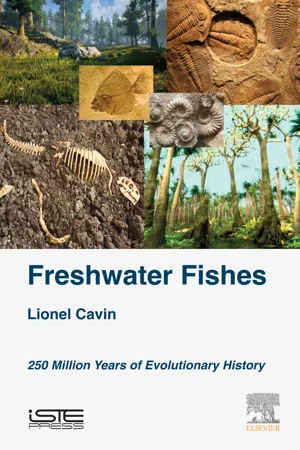
With more than 15,000 species, nearly a quarter of the total number of vertebrate species on Earth, freshwater fishes are extremely varied. They include the largest fish species, the beluga at over 7 meters long, and the smallest, the Paedocypris at just 8 millimeters, as well as the carnivorous, such as the piranha, and the calm, such as the Chinese algae eater. Certain species evolve rapidly, cichlids for example, while others transform very slowly, like lungfish. The fossils of these animals are very diverse in nature, sometimes just small scattered bones where sites correspond to ancient river beds or magnificent fossils of entire fish where there was once a lake.
This book covers the history of these fishes over the last 250 million years by exploring the links between their biological evolution and the paleogeographic and environmental transformations of our planet, whether these be gradual or sudden.
- Gathers and synthetizes data from a vast number of publications regarding past freshwater assemblages and several fish lineages that invaded freshwaters
- Describes the work of the author's own team, concerning fauna from the Cretaceous of France, Morocco, and Thailand
- Presents the recent results of the tempo of diversification in freshwater environments and the evolutionary histories of clades and gar lineages
Trusted by 375,005 students
Access to over 1.5 million titles for a fair monthly price.
Study more efficiently using our study tools.
Information
1
Freshwater Environments and Fishes
Abstract:
Freshwater environments, which include all continental aquatic environments, are difficult to define. As the name indicates, freshwater is characterized by low concentrations of salt as opposed to seawater (the term “sweetwater” is also used as a synonym for “freshwater”). Generally, freshwater is defined as containing less than 0.05% of dissolved salts. Freshwater only accounts for about 2.5–2.75% of all water on Earth. However, 1.75–2% of freshwater is frozen in polar ice caps and glaciers as ice, and 0.5–0.75% exists as groundwater. This leaves about 0.01% of freshwater on the surface where fish can live. Today, nearly three-quarters of freshwater is concentrated in the Great Lakes region of Africa, the Great Lakes in North America and the Baikal Lake in Siberia. Certain continental aquatic environments do not contain freshwater, but still share some characteristics that connect them to the environments we are interested in, despite them having higher salt concentrations. These include sabkhas, which are depressions in hot climates from which water evaporates which increases the salt concentration.
Keywords
Air breathing; Biological crises; Cenozoic; Electric fishes; Freshwater Environments; Ichthyofauna; Mesozoic; Pharyngeal dentition; Weberian apparatus
1.1 Environments of freshwater ichthyofauna
1.1.1 Areas and volumes of freshwater environments
Freshwater environments, which include all continental aquatic environments, are difficult to define (Figure 1.1). As the name indicates, freshwater is characterized by low concentrations of salt as opposed to seawater (the term “sweetwater” is also used as a synonym for “freshwater”). Generally, freshwater is defined as containing less than 0.05% of dissolved salts. Freshwater only accounts for about 2.5–2.75% of all water on Earth. However, 1.75–2% of freshwater is frozen in polar ice caps and glaciers as ice, and 0.5–0.75% exists as groundwater. This leaves about 0.01% of freshwater on the surface where fish can live. Today, nearly three-quarters of freshwater is concentrated in the Great Lakes region of Africa, the Great Lakes in North America and the Baikal Lake in Siberia. Certain continental aquatic environments do not contain freshwater, but still share some characteristics that connect them to the environments we are interested in, despite them having higher salt concentrations. These include sabkhas, which are depressions in hot climates from which water evaporates which increases the salt concentration.

Brackish water has an intermediate salt concentration between freshwater and marine water, between 0.05 and 3%. There are several types of brackish environments today. The most substantial in terms of area are estuaries and river mouths subject to tidal influence. Large rivers discharge such substantial quantities of water into the ocean that brackish or even freshwater ecosystems can extend considerable distances out into the sea. These environments could form freshwater connections across narrow oceans when two rivers face one another. This was the case during the Cretaceous and at the start of the Paleogene when South American and African rivers discharged their freshwater into the proto-Southern Atlantic Ocean. The introduction of freshwater into the marine environment allowed freshwater fishes to spread from one river basin to the next by following the coast [SCH 52]. However, this large outflow could also have acted as a barrier that prevented the spread of marine species along the coast [ROC 03]. In present-day brackish environments, the salinity of mangroves varies according to tidal influence. Modern mangroves have existed since the lower Eocene [PLA 01] but ecosystems with features comparable to mangroves must have existed in the Mesozoic, or at least since the Cretaceous [VUL 08]. Deltas, another kind of brackish environment, form on accumulations of sediment located on the border between marine and freshwater areas. These three types of environments, river mouths, mangroves and deltas, are all characterized by elevated rates of sedimentation as well as abundant and diverse life. These two conditions are favorable for the formation of rich fossil deposits (Figure 1.1). It is very probable that the assemblages of fossilized vertebrates originating from this kind of environment are overrepresented in the fossil record. However, these environments are the most difficult to interpret from a paleoecological point of view because they present a mix of non-native elements from freshwater environments upriver, potentially marine elements brought back to the coasts, and typical elements native to brackish environments. Finally, some lakes and seas can be considered brackish due to high and low salinity, such as the Caspian Sea (which is a lake) and the Baltic Sea, respectively.
One central feature of freshwater environments is the kinetic energy of water in movement (Figure 1.1). If the energy is low and the water is stagnant, we are in the presence of lakes or ponds. These are called lentic environments. If the energy is strong and creates a significant current, we are in the presence of torrents and rivers, which are lotic environments. Lotic environments only represent about 1.2% of open freshwater on the Earth’s surface, whereas the remaining 98.8% are lentic environments. This physical feature has a considerable effect on the fish living in this environment as well as on the way the fossils that accumulate there are preserved: although the fossils of fish that lived in ancient lakes are often preserved whole, the fossils of fish that lived in faster moving water are often dislocated and fragmented. An example of this can be observed in the contrast between the fossil records of two groups of otophysan fishes in the Cenozoic in South America: while the characiforms, which lived primarily in rivers, are represented by isolated teeth, the siluriforms, which lived in lentic habitats, are more numerous and represented by more complete fossils. In addition to the difference in habitat, the bones of the siluriforms are generally thicker and denser than those of the characiforms, which increases the probability of fossilization [LUN 98].
1.1.2 Mesozoic and Cenozoic freshwater environments and their fish fauna
It is difficult to fully map the nature and diversity of freshwater environments in the Mesozoic and Cenozoic because the sedimentary record in these environments is rather incomplete. Due to the absence of polar ice caps during a large part of the Mesozoic and the Paleocene, sea levels were on average much higher than they are today. Epicontinental seas have covered vast areas on all continents several times, spanning across Africa (the Trans-Saharan Seaway), North America (the Western Interior Seaway), Eurasia (the Turgai Strait) and South America. These high sea levels created many brackish ecosystems in paralic environments or interior seas where vast, shallow stretches were subject to extreme variations in salinity. The abundance of these intermediate and mixed environments with an increased potential for fossilization explains why many Mesozoic paleontological sites containing fossil assemblages of fishes are so difficult to define ecologically. For example, in 1952, Schaeffer believed that, with the exception of some formations from the Triassic, no continental formation from the Mesozoic contained any “reasonably representative” fish fauna. Based on our current understanding, we know that this opinion is extreme and certainly exaggerated, as our work will demonstrate.
While the present-day families and genera appeared gradually in the Cenozoic, the composition of the ichthyological assemblages often reveals information about the paleoenvironments. Deducing a type of environment from only a single taxon’s autoecology risks falling into a circular reasoning, but this analysis is, however, valuable if it incorporates a set of signals that point toward the same environment. For example, Gaudant [GAU 82] used this method to describe the conditions of formation for three brackish deposits from the Cenozoic: Eocene gypsum of Montmartre, Oligocene gypsiferous marl of Aix-en-Provence and Messinian evaporite deposit in Italy. According to the composition of the fish faunas, the first two assemblages are continental but close to the coast and the third corresponds to an environment with a variable salinity with marine influences.
1.1.3 Climates and sea levels
The global climate has varied considerably in the last 250 million years. This is fundamental to our understanding of the evolutionary history of freshwater fishes because even if physical connections between distinct geographical regions allow dispersal events, organisms must still find suitable climate conditions in the region to be colonized. Throughout a large part of the Mesozoic, specifically in the Cretaceous and much of the Paleocene, the average global temperature was higher than it is today (see Figure 1.2). Peak temperatures were reached in the Cenomanian 100 million years ago and during the Paleocene–Eocene Thermal Maximums 56 million years ago. These peaks were followed by long hot periods, in particular a thermal maximum in the lower Eocene.

Sea level height, or eustasy, has a considerable influence on the diversity of freshwater fishes (see Figure 1.2). Sea level directly affects the degree of fragmentation of land surface by creating barriers that are impassable for many freshwater fishes. These barriers create islands inside continental masses, but also separate islands from continents and sometimes separate the continents between them. Sea level height certainly plays a role as important as, or even more important than the simple tectonic distribution of continental masses in the distribution of freshwater ichthyological fauna. This factor should be considered when examining paleogeographical maps, which generally do not show sea level. For example, looking at a current world map, it is easy to forget that only a few thousand years ago, although the layout of the tectonic plates was similar to today, many of the south-eastern Asian islands were still attached to the section of the Eurasian block known as Sundaland, Papua New Guinea was still connected to Australia, and a continental connection, Beringia, linked North America to Asia. Another effect of sea level variation pertains directly to the colonization of the continental aquatic environment. Marine incursions promote the transition of marine fishes to a freshwater lifestyle, as has been demonstrated during the incursions in the Miocene in the Neotropical zone [LOV 06]. Some of the freshwater forms in this region that originated in the sea currently include ophichthids, engraulids, pristigasterids, batrachoidids, belonids, hemiramphids, sygnathids, sciaenids, mugilids, gobiids, achirids and tetraodontids [LOV 06]. Current sea levels are low relative to this time period because the polar ice caps retain huge quantities of water, but levels were even lower during the last great ice ages when ice caps were more substantial. During the Mesozoic, on the other hand, sea levels were much higher on average, sometimes by more than 200 m. While a high sea level fragmented the continental environment by creating new inlets, a low sea level increased the surface of the low-lying areas and encouraged freshwater fishes to spread from one hydrographic basin to another. Although it is difficult to precisely determine their number and duration, periods of low sea level may have existed during the Mesozoic, brought about by colder periods and the possible presence of ice caps. Such periods are suspected during the Bajocian-Bathonian, Tithonian, Valanginian and the lower Aptian [PRI 99, PUC 03].
1.1.4 Biological crises
The period under study in this book is marked by several mass extinctions. The first, the greatest mass extinction of life in the entire Phanerozoic, occurred at the transition between the Permian and the Triassic. The second occurred at the Triassic-Jurassic boundary, and the third occurred at the Cretaceous-Paleogene boundary. There are many hypotheses that attempt to explain these three events. We ...
Table of contents
- Cover image
- Title page
- Table of Contents
- Copyright
- Foreword
- Introduction
- 1: Freshwater Environments and Fishes
- 2: Assemblages of Freshwater Fishes in the Mesozoic
- 3: Assemblages of Freshwater Fishes in the Cenozoic
- 4: Evolutionary Histories of Freshwater Fishes
- 5: Evolutionary Patterns in Freshwater Fishes
- Conclusion
- Bibliography
- Index: Topics, Families and Genera
Frequently asked questions
Yes, you can cancel anytime from the Subscription tab in your account settings on the Perlego website. Your subscription will stay active until the end of your current billing period. Learn how to cancel your subscription
No, books cannot be downloaded as external files, such as PDFs, for use outside of Perlego. However, you can download books within the Perlego app for offline reading on mobile or tablet. Learn how to download books offline
Perlego offers two plans: Essential and Complete
- Essential is ideal for learners and professionals who enjoy exploring a wide range of subjects. Access the Essential Library with 800,000+ trusted titles and best-sellers across business, personal growth, and the humanities. Includes unlimited reading time and Standard Read Aloud voice.
- Complete: Perfect for advanced learners and researchers needing full, unrestricted access. Unlock 1.5M+ books across hundreds of subjects, including academic and specialized titles. The Complete Plan also includes advanced features like Premium Read Aloud and Research Assistant.
We are an online textbook subscription service, where you can get access to an entire online library for less than the price of a single book per month. With over 1.5 million books across 990+ topics, we’ve got you covered! Learn about our mission
Look out for the read-aloud symbol on your next book to see if you can listen to it. The read-aloud tool reads text aloud for you, highlighting the text as it is being read. You can pause it, speed it up and slow it down. Learn more about Read Aloud
Yes! You can use the Perlego app on both iOS and Android devices to read anytime, anywhere — even offline. Perfect for commutes or when you’re on the go.
Please note we cannot support devices running on iOS 13 and Android 7 or earlier. Learn more about using the app
Please note we cannot support devices running on iOS 13 and Android 7 or earlier. Learn more about using the app
Yes, you can access Freshwater Fishes by Lionel Cavin in PDF and/or ePUB format, as well as other popular books in Biological Sciences & Ecology. We have over 1.5 million books available in our catalogue for you to explore.