- 308 pages
- English
- ePUB (mobile friendly)
- Available on iOS & Android
eBook - ePub
About this book
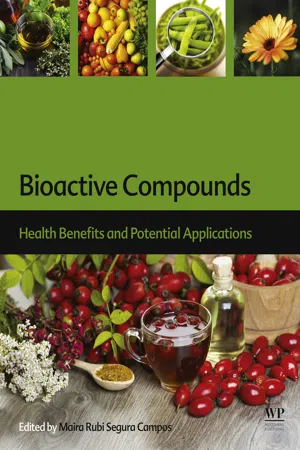
Bioactive Compounds: Health Benefits and Potential Applications provides information about different bioactive compounds including their sources, biological effects, health benefits and, potential applications which could contribute as alternatives in the prevention or treatment of multifactorial diseases for vulnerable population groups. Going beyond the basics to include discussion of bioaccessibility and the legislative aspects of marketing of bioactive compounds as nutraceuticals or food supplements, this book presents insights from a global perspective.
Written for researchers, professors and graduate students, this book is sure to be a welcomed reference for all who work in food chemistry, new product development and nutritional science.
- Highlights potential contributions of bioactive compounds as alternatives in the prevention or treatment of disease
- Investigates the world of bioactive compounds and the many activities associated with them
- Contains information relevant to food chemistry, new product development and nutritional science
Trusted by 375,005 students
Access to over 1.5 million titles for a fair monthly price.
Study more efficiently using our study tools.
Information
Part 1
Antioxidant Activity of Phenolic Compounds
Chapter 1
Antioxidant Activity of Phenolic Compounds Biosynthesized by Plants and Its Relationship With Prevention of Neurodegenerative Diseases
Janne Rojas 1 , and Alexis Buitrago 1 , 2 1 Organic Biomolecular Research group, Research Institute, Faculty of Pharmacy and Bioanalysis, University of Los Andes, Mérida, Venezuela 2 Analysis and Control Department, Faculty of Pharmacy and Bioanalysis, University of Los Andes, Mérida, Venezuela
Abstract
Free radicals are chemical compounds which contain an unpaired electron spinning on the peripheral layer around the nucleus, are a highly reactive species generated from normal oxygen metabolism, as well as exogenous factors and biochemical reactions from human organisms. Accumulation of these may lead to oxidative stress in cells and promote several pathologies. Antioxidant capacity is related to compounds capable of protecting a biological system against the harmful effect of processes involving reactive species. The search for natural antioxidants that might prevent degenerative diseases has attracted the attention of researchers. Furthermore, plant extracts have been revealed to be a major source of chemical compounds with high antioxidant activity. This chapter aims to summarize the major topics related to antioxidant activity found either in plant extracts or secondary metabolites such as phenols and flavonoids, among other compounds isolated from natural sources. Several methods to determine antioxidant capacity have also been included.
Keywords
Antioxidant; Flavonoids; Methods; Neurodegenerative diseases; Phenols
1.1. Introduction
Oxygen is the most predominant element in earth layer and it exists in air as a diatomic molecule, O2. Almost all living organisms use O2 for energy production, thus it is essential for life. To produce energy, an organism requires a process called oxidation, which implies the loss of electrons. However, oxidation also involves the inactivation of enzymes that do not have antioxidant mechanisms and do not survive in an O2 environment (Magder, 2006). Under physiological conditions oxidizing agents and antioxidant defenses are in balance. Enzymes such as catalase, superoxide dismutase, glutathione peroxidase, and nonenzymatic antioxidants such as glutathione, and vitamins C and E are among the antioxidative defense molecules. However, if the production of free radicals exceeds the antioxidant capacity of a living system, these species may react with lipids, proteins, and DNA causing structural and functional damage to enzymes and genetic material (Barreiros et al., 2006). The predominance of oxidants, and their consequent damage is called oxidative stress and is considered as an etiological or pathogenic agent of cardiovascular and neurodegenerative diseases, such as cancer, Alzheimer, diabetes, and aging, among others (Jang et al., 2010; Krishnaiah et al., 2011). These pathologies and the evidence that are promoted by oxidative stress have brought the attention of scientists to find antioxidants for the prevention and treatment of such diseases (Halliwell and Gutteridge, 2007). Interest in naturally occurring antioxidants has increased; the food, cosmetic, and pharmaceutical industries are focused on natural products to replace synthetic antioxidants which are often restricted due to carcinogenic effects (Djeridane et al., 2006; Wannes et al., 1970). Plants are source of numerous secondary metabolites, many of these are natural antioxidants like polyphenols, flavonoids, essential oils, etc., that may be considered as sources of these substances. This chapter aims to review the basic concepts related to free radicals and their relationship to several ailments, to describe some natural products with proved antioxidant activity, as well as a number of in vivo and in vitro antioxidant activity assessment methods for natural products, developed by different researchers. A selection of reported studies in the last 10 years, related to antioxidant activity carry out in plant extracts, has also been included.
1.2. Free Radicals and Their Relationship to Several Ailments
Free radicals are produced to support life under ...
Table of contents
- Cover image
- Title page
- Table of Contents
- Copyright
- List of Contributors
- Part 1. Antioxidant Activity of Phenolic Compounds
- Part 2. Antidiabetic Activity of Bioactive Compounds
- Part 3. Anti-inflammatory Effect of Medicinal Plants
- Part 4. Anticancer Activity of Plants Metabolites
- Part 5. Bioavailability of Bioactive Compounds In Vitro and In Vivo Models
- Part 6. Bioactive Compounds as Ingredients of Functional Foods
- Part 7. Health Benefits of Bioactive Compounds
- Part 8. Health Benefits of Functional Foods
- Part 9. Bioactive Compounds and Functional Foods as Therapeutic Alternative
- Index
Frequently asked questions
Yes, you can cancel anytime from the Subscription tab in your account settings on the Perlego website. Your subscription will stay active until the end of your current billing period. Learn how to cancel your subscription
No, books cannot be downloaded as external files, such as PDFs, for use outside of Perlego. However, you can download books within the Perlego app for offline reading on mobile or tablet. Learn how to download books offline
Perlego offers two plans: Essential and Complete
- Essential is ideal for learners and professionals who enjoy exploring a wide range of subjects. Access the Essential Library with 800,000+ trusted titles and best-sellers across business, personal growth, and the humanities. Includes unlimited reading time and Standard Read Aloud voice.
- Complete: Perfect for advanced learners and researchers needing full, unrestricted access. Unlock 1.5M+ books across hundreds of subjects, including academic and specialized titles. The Complete Plan also includes advanced features like Premium Read Aloud and Research Assistant.
We are an online textbook subscription service, where you can get access to an entire online library for less than the price of a single book per month. With over 1.5 million books across 990+ topics, we’ve got you covered! Learn about our mission
Look out for the read-aloud symbol on your next book to see if you can listen to it. The read-aloud tool reads text aloud for you, highlighting the text as it is being read. You can pause it, speed it up and slow it down. Learn more about Read Aloud
Yes! You can use the Perlego app on both iOS and Android devices to read anytime, anywhere — even offline. Perfect for commutes or when you’re on the go.
Please note we cannot support devices running on iOS 13 and Android 7 or earlier. Learn more about using the app
Please note we cannot support devices running on iOS 13 and Android 7 or earlier. Learn more about using the app
Yes, you can access Bioactive Compounds by Maira Rubi Segura Campos in PDF and/or ePUB format, as well as other popular books in Technology & Engineering & Food Science. We have over 1.5 million books available in our catalogue for you to explore.