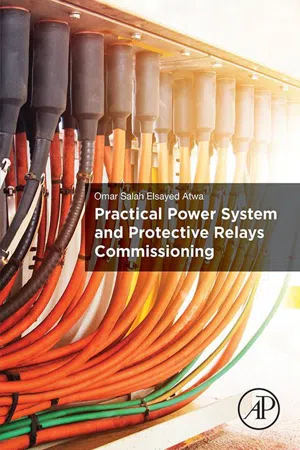
Practical Power System and Protective Relays Commissioning is a unique collection of the most important developments in the field of power system setup. It includes simple explanations and cost affordable models for operating engineers. The book explains the theory of power system components in a simple, clear method that also shows how to apply different commissioning tests for different protective relays. The book discusses scheduling for substation commissioning and how to manage available resources to efficiently complete projects on budget and with optimal use of resources.- Explains the theory of power system components and how to set the different types of relays- Discusses the time schedule for substation commissioning and how to manage available resources and cost implications- Details worked examples and illustrates best practices
- 420 pages
- English
- ePUB (mobile friendly)
- Available on iOS & Android
eBook - ePub
Practical Power System and Protective Relays Commissioning
About this book
Trusted by 375,005 students
Access to over 1.5 million titles for a fair monthly price.
Study more efficiently using our study tools.
Information
Chapter 1
Power System Elements
Abstract
This chapter defines the elements of a power system and shows how it is connected to create a system. It also discusses IEEE device numbers and the functions of switchgear apparatus symbols.
Keywords
Power system; generation; transmission system; distribution system; loads; system voltages; power system components; IEEE device numbers; functions of switchgear symbols
1.1 Introduction
A power system consists of a group of elements working together, including generation, transmission, distribution, and loads. Each of these are discussed in the following sections.
1.2 Overview of a Power System
1.2.1 Generation of Power
Power generation converts energy from one form to another. Examples are:
- 1. Thermal generating stations that use fuels such as coal, oil, and gas that are burnt to generate electricity.
- 2. Hydro generating stations that depend on water flow through a turbine to drive the generator.
- 3. Nuclear generation stations that depend on uranium to generate electricity (nuclear fuel).
1.2.2 Transmission System
A transmission system is a network of overhead lines, underground cables, and transformers that transfer generated power in high voltage levels to loads.
High voltage levels are used to reduce the losses in the system during power transfer between each end of the transmission line.
1.2.3 Distribution System
A distribution system is a network of overhead transmission lines, underground cables, and transformers that carry small amounts of power to loads in medium and low voltage levels.
1.2.4 Loads
Loads are defined as items that consume electricity, for example, homes and factories.
1.3 System Voltages
Voltages differ from country to country, however, a general classification is:
- Generation voltage levels range from 12 to 33 kV.
- Transmission voltage levels range from 110 to 800 kV.
- Distribution voltage levels range from 4 to 35 kV.
1.4 Power System Components
A power system is made up of multiple components. These are:
Generators that generate electrical power.
Transformers that change voltage levels as per system requirements.
Circuit breakers that open and close the power circuits under normal and abnormal conditions.
Shunt reactors and capacitors that are used for system compensation for reactive power in transmission lines.
Surge arresters are used for protecting the primary system from overvoltages.
Protective relays are used to detect any faults in the system and to trip the circuit breakers to isolate the faulty part in the power system to keep other parts of the system healthy and working in normal condition.
Substations are nodes of several transmission lines or distribution lines with power transformers.
Buses are heavy conductors that collect power and distribute it to the different system components.
These are all shown in the simplified power system shown in Fig. 1.1.

1.5 IEEE Device Numbers and Functions for Switchgear Apparatus
The devices in switching equipment are referred to by numbers, according to the functions they perform. These numbers are based on a system which has been adopted as standard for automatic switchgear by the Institute of Electrical and Electronics Engineers (IEEE). This system is used on connection diagrams, in instruction books, and in specifications. The standard numbers referring to device functions in switchgear components are as follows.
32 Directional power relay
21 Distance relay
25 Synchronizing or synchrocheck device
27 Under voltage relay
37 Under current or under power relay
40 Field relay
41 Field circuit breaker
42 Running circuit breaker
46 Reverse phase or phase–balance current relay
47 Phase–sequence voltage relay
49 Machine or transformer thermal relay
50 Instantaneous overcurrent or rate of rise relay
51 AC time overcurrent relay
52 AC circuit breakers
55 Power factor...
Table of contents
- Cover image
- Title page
- Table of Contents
- Copyright
- Introduction
- Chapter 1. Power System Elements
- Chapter 2. Substations
- Chapter 3. Introduction to Testing and Commissioning of Power System
- Chapter 4. Generators and Motors: Theory and Testing
- Chapter 5. Power Transformers Theory Testing and Commissioning
- Chapter 6. Transmission Lines Theory Testing and Commissioning
- Chapter 7. Circuit Breakers Theory Testing and Commissioning
- Chapter 8. Air Insulated System Substations Theory and Testing
- Chapter 9. Surge Arresters Theory Testing and Commissioning
- Chapter 10. Traditional and Electronic Current Transformers Theory Testing and Commissioning
- Chapter 11. Voltage Transformers
- Chapter 12. Disconnecting Switches and Earthing Switches Theory Testing and Commissioning
- Chapter 13. Fault Recorders in Substations and Power Stations
- Chapter 14. Gas Insulated System Substations
- Chapter 15. Batteries
- Chapter 16. Power System Fault Analysis
- Chapter 17. IEC 61850 Protocols Used in Protective Relays Communication
- Chapter 18. Protection Relays
- Chapter 19. Protection Relays Settings
- Chapter 20. Protective Relays Testing and Commissioning
- Chapter 21. A Guided Practical Value of Some Test Results Collected From Actual Power System Testing at Site
- Chapter 22. Final Substation Primary and Energization and Loading Tests
- Chapter 23. Substation Testing and Commissioning Time Schedules and Resources Management
- Index
Frequently asked questions
Yes, you can cancel anytime from the Subscription tab in your account settings on the Perlego website. Your subscription will stay active until the end of your current billing period. Learn how to cancel your subscription
No, books cannot be downloaded as external files, such as PDFs, for use outside of Perlego. However, you can download books within the Perlego app for offline reading on mobile or tablet. Learn how to download books offline
Perlego offers two plans: Essential and Complete
- Essential is ideal for learners and professionals who enjoy exploring a wide range of subjects. Access the Essential Library with 800,000+ trusted titles and best-sellers across business, personal growth, and the humanities. Includes unlimited reading time and Standard Read Aloud voice.
- Complete: Perfect for advanced learners and researchers needing full, unrestricted access. Unlock 1.5M+ books across hundreds of subjects, including academic and specialized titles. The Complete Plan also includes advanced features like Premium Read Aloud and Research Assistant.
We are an online textbook subscription service, where you can get access to an entire online library for less than the price of a single book per month. With over 1.5 million books across 990+ topics, we’ve got you covered! Learn about our mission
Look out for the read-aloud symbol on your next book to see if you can listen to it. The read-aloud tool reads text aloud for you, highlighting the text as it is being read. You can pause it, speed it up and slow it down. Learn more about Read Aloud
Yes! You can use the Perlego app on both iOS and Android devices to read anytime, anywhere — even offline. Perfect for commutes or when you’re on the go.
Please note we cannot support devices running on iOS 13 and Android 7 or earlier. Learn more about using the app
Please note we cannot support devices running on iOS 13 and Android 7 or earlier. Learn more about using the app
Yes, you can access Practical Power System and Protective Relays Commissioning by Omar Salah Elsayed Atwa in PDF and/or ePUB format, as well as other popular books in Technology & Engineering & Energy. We have over 1.5 million books available in our catalogue for you to explore.