- 452 pages
- English
- ePUB (mobile friendly)
- Available on iOS & Android
eBook - ePub
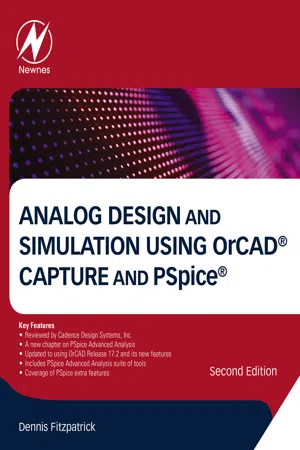
Analog Design and Simulation Using OrCAD Capture and PSpice
About this book
New to this edition: Updated to using OrCAD Release 17.2 and its new features; Coverage of PSPICE extra features: PSpice Designer, PSpice Designer Plus, Modelling Application, PSpice Part Search Symbol Viewer, PSpice Report, Associate PSpice model, New delay functions for Behavioural Simulation Models, New Models, Support for negative values in hysteresis voltage and threshold voltage; A new chapter on PSpice Advanced Analysis
Analog Design and Simulation Using OrCAD Capture and PSpice, Second Edition provides step-by-step instructions on how to use the Cadence/OrCAD family of Electronic Design Automation software for analog design and simulation. The book explains how to enter schematics in Capture, set up project types, project libraries and prepare circuits for PSpice simulation. There are chapters on the different analysis types for DC Bias point, DC sweep, AC frequency sweep, Parametric analysis, Temperature analysis, Performance Analysis, Noise analysis, Sensitivity and Monte Carlo simulation. Subsequent chapters explain how the Stimulus Editor is used to define custom analog and digital signals, how the Model Editor is used to view and create new PSpice models and Capture parts and how the Magnetic Parts Editor is used to design transformers and inductors. Other chapters include Analog Behaviorial models, Test Benches as well as how to create hierarchical designs.
The book includes the latest features in the OrCAD 17.2 release and there are exercises with step by step instructions at the end of each chapter that enables the reader to progress based upon their experience and knowledge gained from previous chapters. The author worked for Cadence for over eight years and supported and delivered OrCAD PSpice training courses all over Europe. This book has been endorsed by Cadence.
In addition, there are new chapters on the PSpice Advanced Analysis suite of tools: Sensitivity Analysis, Optimizer, Monte Carlo, and Smoke Analysis.The chapters show how circuit performance can effectively be maximised and optimised for variations in component tolerances, temperature effects, manufacturing yields and component stress.
- Provides both a comprehensive user guide and a detailed overview of simulation using OrCAD Capture and PSpice
- Includes worked and ready to try sample designs and a wide range of to-do exercises
- Covers Capture and PSpice together
Information
Topic
DesignSubtopic
Industrial DesignChapter 1
Getting Started
Abstract
For those of you who are familiar in setting up projects and drawing schematics in Capture, you may want to skip this chapter as this chapter is for those of you who have little or no experience of using Capture. The chapter will describe how to start Capture and how to set up the project type and libraries for PSpice simulation. The chapter will also introduce some of the features found in the latest software releases. At the end of each chapter there are some exercises to do and as you go through the book, each chapter will build upon the exercises from previous chapters.
Keywords
Simulation; Components; Resistor; Voltage; Circuits
For those of you who are familiar in setting up projects and drawing schematics in Capture, you may want to skip this chapter as this chapter is for those of you who have little or no experience of using Capture. The chapter will describe how to start Capture and how to set up the project type and libraries for PSpice simulation. The chapter will also introduce some of the features found in the latest software releases. At the end of each chapter there are some exercises to do and as you go through the book, each chapter will build upon the exercises from previous chapters.
1.1 Starting Capture
Circuit diagrams for PSpice simulation are drawn in either Capture or Capture component information system (CIS) schematic editor. The CIS option allows you to select and place components from a component database instead of selecting and placing components from a library. For this book, it does not matter if the circuits are drawn in Capture or Capture CIS.
If you have the software installed under the OrCAD name, launch Capture or Capture CIS, by clicking on:
Start > Program Files > OrCAD xx.x > Capture
or
Start > Program Files > OrCAD xx.x > Capture CIS
where xx.x is the version number, i.e., 10.5, 11.0, 15.5, 15.7, 16.0, 16.2, 16.3, 16.5, or 16.6.
For example:
Start > All Programs > Cadence > OrCAD 16.6 Lite > OrCAD Capture CIS Lite
Start > All Programs > Cadence > Release 16.5 > Capture
If you have the Cadence software installed, the products are installed under the Allegro platform name. In this case, only Capture CIS is available and is branded as Design Entry CIS.
Start > Program Files > Allegro SPB 16.6 > Design Entry CIS
For the 17.2 release:
Start > All Programs > Cadence Release 17.2-2016 > OrCAD Lite Products > Capture CIS Lite
or
Start > All Programs > Cadence Release 17.2-2016 > OrCAD Products > Capture
1.2 Creating a PSpice Project
New designs started in Capture will automatically create a project file (.opj) that references the design fil...
Table of contents
- Cover image
- Title page
- Table of Contents
- Copyright
- Preface
- Instructions
- Chapter 1: Getting Started
- Chapter 2: DC Bias Point Analysis
- Chapter 3: DC Analysis
- Chapter 4: AC Analysis
- Chapter 5: Parametric Sweep
- Chapter 6: Stimulus Editor
- Chapter 7: Transient Analysis
- Chapter 8: Convergence Problems and Error Messages
- Chapter 9: Transformers
- Chapter 10: Monte Carlo Analysis
- Chapter 11: Worst Case Analysis
- Chapter 12: Performance Analysis
- Chapter 13: Analog Behaviorial Models
- Chapter 14: Noise Analysis
- Chapter 15: Temperature Analysis
- Chapter 16: Adding and Creating PSpice Models
- Chapter 17: Transmission Lines
- Chapter 18: Digital Simulation
- Chapter 19: Mixed Simulation
- Chapter 20: Creating Hierarchical Designs
- Chapter 21: Magnetic Parts Editor
- Chapter 22: Test Benches
- Chapter 23: Advanced Analysis
- Chapter 24: Sensitivity Analysis
- Chapter 25: Optimizer
- Chapter 26: Monte Carlo
- Chapter 27: Smoke Analysis
- Appendix: PSpice Measurement Definitions
- Index
Trusted by 375,005 students
Access to over 1.5 million titles for a fair monthly price.
Study more efficiently using our study tools.
Frequently asked questions
Yes, you can cancel anytime from the Subscription tab in your account settings on the Perlego website. Your subscription will stay active until the end of your current billing period. Learn how to cancel your subscription
No, books cannot be downloaded as external files, such as PDFs, for use outside of Perlego. However, you can download books within the Perlego app for offline reading on mobile or tablet. Learn how to download books offline
Perlego offers two plans: Essential and Complete
- Essential is ideal for learners and professionals who enjoy exploring a wide range of subjects. Access the Essential Library with 800,000+ trusted titles and best-sellers across business, personal growth, and the humanities. Includes unlimited reading time and Standard Read Aloud voice.
- Complete: Perfect for advanced learners and researchers needing full, unrestricted access. Unlock 1.5M+ books across hundreds of subjects, including academic and specialized titles. The Complete Plan also includes advanced features like Premium Read Aloud and Research Assistant.
We are an online textbook subscription service, where you can get access to an entire online library for less than the price of a single book per month. With over 1.5 million books across 990+ topics, we’ve got you covered! Learn about our mission
Look out for the read-aloud symbol on your next book to see if you can listen to it. The read-aloud tool reads text aloud for you, highlighting the text as it is being read. You can pause it, speed it up and slow it down. Learn more about Read Aloud
Yes! You can use the Perlego app on both iOS and Android devices to read anytime, anywhere — even offline. Perfect for commutes or when you’re on the go.
Please note we cannot support devices running on iOS 13 and Android 7 or earlier. Learn more about using the app
Please note we cannot support devices running on iOS 13 and Android 7 or earlier. Learn more about using the app
Yes, you can access Analog Design and Simulation Using OrCAD Capture and PSpice by Dennis Fitzpatrick in PDF and/or ePUB format, as well as other popular books in Design & Industrial Design. We have over 1.5 million books available in our catalogue for you to explore.