
eBook - ePub
Intermediate Temperature Solid Oxide Fuel Cells
Electrolytes, Electrodes and Interconnects
- 516 pages
- English
- ePUB (mobile friendly)
- Available on iOS & Android
eBook - ePub
Intermediate Temperature Solid Oxide Fuel Cells
Electrolytes, Electrodes and Interconnects
About this book
Intermediate Temperature Solid Oxide Fuel Cells: Electrolytes, Electrodes and Interconnects introduces the fundamental principles of intermediate solid oxide fuel cells technology. It provides the reader with a broad understanding and practical knowledge of the electrodes, pyrochlore/perovskite/oxide electrolytes and interconnects which form the backbone of the Solid Oxide Fuel Cell (SOFC) unit. Opening with an introduction to the thermodynamics, physiochemical and electrochemical behavior of Solid Oxide Fuel Cells (SOFC), the book also discusses specific materials, including low temperature brownmillerites and aurivillius electrolytes, as well as pyrochlore interconnects.
This book analyzes the basic concepts, providing cutting-edge information for both researchers and students. It is a complete reference for Intermediate Solid Oxide Fuel Cells technology that will be a vital resource for those working in materials science, fuel cells and solid state chemistry.
- Provides a single source of information on glass, electrolytes, interconnects, vanadates, pyrochlores and perovskite SOFC
- Includes illustrations that provide a clear visual explanation of concepts being discussed
- Progresses from a discussion of basic concepts that will enable readers to easily comprehend the subject matter
Trusted by 375,005 students
Access to over 1.5 million titles for a fair monthly price.
Study more efficiently using our study tools.
Information
Chapter 1
Understanding intermediate temperature solid oxide fuel cells
Mandeep Kaur1, Gurbinder Kaur2 and V. Kumar3, 1Baba Banda Singh Bahadur Engineering College, Fatehgarh Sahib, Punjab, India, 2School of Physics and Materials Science, Thapar University, Patiala, Punjab, India, 3Sri Guru Granth Sahib World University, Fatehgarh Sahib, Punjab, India
Abstract
This chapter focuses on the technological advancements in designing intermediate temperature solid oxide fuel cells (IT-SOFCs). IT-SOFCs have been discussed in accordance to their working temperature range (500°C–750°C), which is advantageous in many applications and can solve many persisting problems, which could not be coped up at high operating temperature. Furthermore, IT-SOFCs components such as electrolytes, cathodes, anodes, interconnect materials, and suitable sealants required for planar design of IT-SOFC have been discussed in detail. Applications of IT-SOFCs in various fields such as residential, military, and mobile make them preferred when compared with high temperature SOFCs.
Keywords
Solid oxide fuel cell; glass sealant; coefficient of thermal expansion; glass transition temperature
1.1 Introduction to fuel cells
In today’s world, the most challenging need to protect environment is to fulfill growing energy demands with highly efficient systems. The tremendous increase in industrialization and population has compelled many countries to look for alternate energy sources in near future. Solid oxide fuel cell (SOFC) technology can be considered as one of the promising solutions to this problem [1–10]. Basically, fuel cells are electrochemical devices capable to convert chemical energy from fuel (hydrogen/hydrocarbons) and oxygen (oxidant) into electricity [10–12]. These devices are highly efficient and clean sources of energy carrying diversified advantages in contrast to other alternate energy resources. These include fuel production, mobile and stationary power generation, chemical synthesis, carbon dioxide recycling, modularity, fuel flexibility, negligible pollution, and reliability. In addition to this, these provide uninterruptible power supplies, protection from corrosion, domestic appliances, remote generation, etc. [1,2,13–16]. A simplistic view of mode of operation for an SOFC is shown in Fig. 1.1.
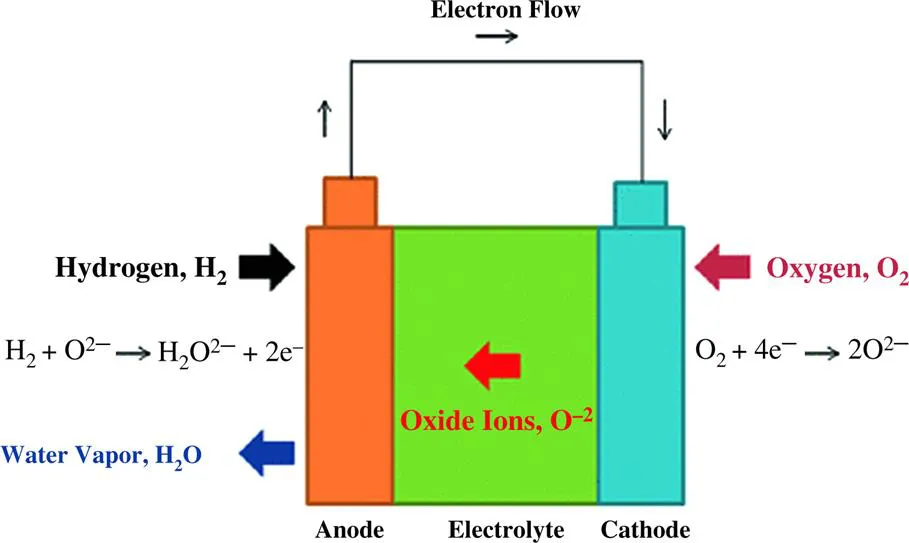
It consists of an electrolyte, which is oxide ion conductor, generally a nonporous metal oxide such as yttria-stabilized zirconia (YSZ). Among other fuel cells, the operating temperature of the SOFC is highest, that is, between 600°C and 1000°C. Due to the high operating temperature of SOFC (600°C–1000°C), heat is produced by products of high quality, which can be used for combined heat and power generation. Furthermore, the components of SOFC are solid; hence, there is no restriction on the configuration of the cell [18,19]. For cathode, Sr-based LaMnO3, and for anode of Ni-based ZrO2 or Co-based ZrO2 materials are used. No catalyst is required during operation of the cell due to high operating temperature of the fuel cell. In case of intermediate temperature SOFCs (IT-SOFCs), the cathode material is made up of porous mixed conducting ceramics having high electronic conductivities (~100 S cm−1) as well as oxygen diffusion coefficients (~10−6 cm−2 s−1). On the other hand, anode materials are composites of a ceramic and a metal (cermet). The metal is capable to provide sufficient electronic conductivity along with catalytic activities in order to promote anodic reactions. Electrolyte materials are generally pure ionic conductors [20]. The electrolyte is surrounded by electrodes from each side. Hydrogen fuel is supplied into the anode of the fuel cell, whereas oxygen or air is fed to the cathode. This can be understood from the following equations [21]:


The oxygen concentration gets reduced to oxygen ions when fuel (hydrogen) is burnt. The oxygen ions migrate through the conducting electrolyte, eventually reacting with the fuel at anode. Water as a byproduct is also liberated in the reaction [10,21]. SOFC technology is expanding rapidly and has emerged out to be the most reliable and efficient fuel cell technology. The SOFCs can also be operated in reverse form (solid oxide electrolyzer cell) for generation of hydrogen by splitting water. Fuel cells based on hydrogen as fuel coupled along with electrolyzers and renewable energy conversion techniques in a complete loop of pollution free, energy conserving and generating electricity is shown in Fig. 1.2.

1.2 Operating temperature of fuel cells
The classification of the fuel cells can be done on the basis of their operating temperature and electrolyte materials used [23]. Fig. 1.3 shows the operating principle as well as temperature of different kinds of fuel cells. The operating temperature of a fuel cell predominantly dictates the type of fuel that can be used in it. The fuel cells operating at low temperatures with aqueous electrolytes are restricted to hydrogen to be used as fuel. On the other hand, hydrocarbons such as CH4, due to rapid kinetics and low catalytic requirements at high temperatures can be used directly in high temperature fuel cells. In such fuel cells, the reforming reactions occur within the cell, that is, conversion of hydrocarbon to hydrogen. Thus considering hydrogen a synthetic as well as expensive energy carrier instead of natural resource, it can be anticipated to be used in fuel cells based on hydrocarbons in future. Due to similar reasons, the external reformers are getting attention in recent years to be used in fuel cells operating at low temperatures [24].

Recently, significant advancements in developing SOFC are to decrease its working temperature in the range of 600°C–800°C from around 800°C–1000°C [25]. Developers such as Siemens Westinghouse and Rolls-Royce epitomized high temperature SOFCs (HT-SOFCs), which operate in the temperature range of 850°C–1000°C. Such systems when integrated with gas turbines can accomplish high efficiencies in large-scale stationary applications. However, operating SOFCs at high temperature requires predominantly ceramics and high temperature metal alloys as components of stack. On the other hand, for applications at small scale, incorporation with a heat engine is not suitable. Thus in such cases SOFCs with low operating temperatures, ge...
Table of contents
- Cover image
- Title page
- Table of Contents
- Copyright
- Dedication
- List of contributors
- About the editor
- Foreword
- Acknowledgments
- Chapter 1. Understanding intermediate temperature solid oxide fuel cells
- Chapter 2. Thermodynamics, polarizations, and intermediate temperature solid oxide fuel cell performance
- Chapter 3. Brownmillerite and Aurivillius electrolytes for intermediate temperature solid oxide fuel cell
- Chapter 4. Proton-conducting electrolyte materials
- Chapter 5. Enhancing the ionic conductivity in the ceria-based electrolytes for intermediate temperature solid oxide fuel cells
- Chapter 6. Cermets as anode materials
- Chapter 7. Progress in perovskite anodes for intermediate-temperature solid oxide fuel cells
- Chapter 8. Cathode materials for proton-conducting solid oxide fuel cells
- Chapter 9. Perovskite and layered oxide materials for intermediate temperature solid oxide fuel cells
- Chapter 10. Misfit-layered Ca-cobaltite–based cathodes for intermediate-temperature solid oxide fuel cell
- Chapter 11. Stacking designs and sealing principles for IT-solid oxide fuel cell
- Chapter 12. Interaction of glass-ceramic sealants with solid oxide fuel cell components: thermo-mechanical analysis
- Chapter 13. Intermediate-temperature solid oxide fuel cell fueled by biofuels
- Index
Frequently asked questions
Yes, you can cancel anytime from the Subscription tab in your account settings on the Perlego website. Your subscription will stay active until the end of your current billing period. Learn how to cancel your subscription
No, books cannot be downloaded as external files, such as PDFs, for use outside of Perlego. However, you can download books within the Perlego app for offline reading on mobile or tablet. Learn how to download books offline
Perlego offers two plans: Essential and Complete
- Essential is ideal for learners and professionals who enjoy exploring a wide range of subjects. Access the Essential Library with 800,000+ trusted titles and best-sellers across business, personal growth, and the humanities. Includes unlimited reading time and Standard Read Aloud voice.
- Complete: Perfect for advanced learners and researchers needing full, unrestricted access. Unlock 1.5M+ books across hundreds of subjects, including academic and specialized titles. The Complete Plan also includes advanced features like Premium Read Aloud and Research Assistant.
We are an online textbook subscription service, where you can get access to an entire online library for less than the price of a single book per month. With over 1.5 million books across 990+ topics, we’ve got you covered! Learn about our mission
Look out for the read-aloud symbol on your next book to see if you can listen to it. The read-aloud tool reads text aloud for you, highlighting the text as it is being read. You can pause it, speed it up and slow it down. Learn more about Read Aloud
Yes! You can use the Perlego app on both iOS and Android devices to read anytime, anywhere — even offline. Perfect for commutes or when you’re on the go.
Please note we cannot support devices running on iOS 13 and Android 7 or earlier. Learn more about using the app
Please note we cannot support devices running on iOS 13 and Android 7 or earlier. Learn more about using the app
Yes, you can access Intermediate Temperature Solid Oxide Fuel Cells by Gurbinder Kaur in PDF and/or ePUB format, as well as other popular books in Technology & Engineering & Materials Science. We have over 1.5 million books available in our catalogue for you to explore.