eBook - ePub
Chemical, Gas, and Biosensors for Internet of Things and Related Applications
- 406 pages
- English
- ePUB (mobile friendly)
- Available on iOS & Android
eBook - ePub
Chemical, Gas, and Biosensors for Internet of Things and Related Applications
About this book
Chemical, Gas, and Biosensors for the Internet of Things and Related Applications brings together the fields of sensors and analytical chemistry, devices and machines, and network and information technology. This thorough resource enables researchers to effectively collaborate to advance this rapidly expanding, interdisciplinary area of study. As innovative developments in the Internet of Things (IoT) continue to open new possibilities for quality of life improvement, sensor technology must keep pace, Drs. Mitsubayashi, Niwa and Ueno have brought together the top minds in their respective fields to provide the latest information on the numerous uses of this technology.
Topics covered include life-assist systems, network monitoring with portable environmental sensors, wireless livestock health monitoring, point-of-care health monitoring, organic electronics and bio-batteries, and more.
- 2020 PROSE Awards - Winner: Category: Chemistry and Physics: Association of American Publishers
- Describes the latest advances and underlying principles of sensors used in biomedicine, healthcare, biotechnology, nanotechnology and food and environment safety
- Focuses on sensors' methods of data communication, logging and analysis for IoT applications
- Explains the specific requirements of sensor design and performance improvement, helping researchers enhance sensitivity, selectivity, stability, reproducibility and response time
Trusted by 375,005 students
Access to over 1.5 million titles for a fair monthly price.
Study more efficiently using our study tools.
Information
Topic
Physical SciencesSubtopic
Analytic ChemistryPart I
Sensors and Devices for Internet of Things Applications
Outline
1
Portable urine glucose sensor
Narushi Ito1, Mariko Miyashita2 and Satoshi Ikeda2, 1PROVIGATE Inc., Tokyo, Japan, 2TANITA Corporation, Tokyo, Japan
Abstract
This section describes the development of a portable urine glucose sensor for diabetic care in home use. Urine glucose monitoring is thought to be a quite useful monitor for the self-management of diabetes, as it can be done without pain, and it allows us to detect prediabetes by monitoring the postprandial urine glucose level.
Keywords
Urine glucose; enzyme sensor; noninvasive; postprandial hyperglycemia; clinical application
1.1 Introduction
Development of a noninvasive blood glucose monitoring system is based on measurement of near infrared light passing through fingers and arms [1,2], measurement of interstitial fluid collected from the skin surface with a micro glucose sensor [3,4], and measurement of contact lens type tears [5,6], etc. It has been done over the past 30 years and enormous amount of research and development has been published, however, there are still no practical products.
A series of products that have succeeded in development include a continuous blood glucose monitor and a flash glucose monitor that place small needles in the abdomen and the like. These are minimally invasive, and continuous monitoring for 2 weeks is possible. Meanwhile, as a noninvasive measurement, a portable urine glucose meter that makes it possible to quantitatively measure urine glucose levels correlated with blood glucose levels has been put to practical use.
In this section, we describe the principle and structure of the microplanar type urine glucose sensor and examples of application of commercialized urine glucose meter to healthcare.
1.2 Significance of urine glucose measurement
In the urine glucose tests, diabetes screening tests are being conducted to test positive (+) or negative (−) by measuring fasting urine such as common in medical examinations.
Positive (+) is based on 100 mg/dL as the urine glucose concentration. Medically urine glucose positivity is considered as a suspicious indicator of diabetes first. Then further inspections are necessary, because there are transient cases such as renal diabetes, stress, pregnancy, etc., in addition to other findings for diagnosis of diabetes.
Ultimately diabetes is confirmed by the 75 g oral glucose tolerance test. Urine glucose test is regarded as an auxiliary test and a large number of screening tests are still being carried out at present, due to its advantage of noninvasive measurement.
Changes in urine glucose concentration after meals are shown in Fig. 1.1. The postprandial urine glucose concentration is linked to blood glucose levels, and it is important that it does not overlook postprandial hyperglycemia occurring after meals. When the urine glucose concentration exceeds 50 mg/dL, it means that the blood glucose level exceeds the glucose excretion threshold of 160–180 mg/dL in the kidney.

Even when blood glucose level rises with the diet, it decreases after 1 hour due to the action of insulin. In other words, the blood glucose level measured at 2 hours after a meal usually returns to the normal range. On the other hand, it is known that the urine glucose concentration 2 hours after a meal reflects the elevated blood glucose level with the meal. As well, it is demonstrated that urine glucose level correlates with the mean blood glucose level.
1.3 Operating principle of urine glucose sensor and laminated structure
1.3.1 Principle of operation
Urine glucose sensor is an enzyme electrode method combining glucose oxidase (GOX) and hydrogen peroxide electrode.
The electrode is fabricated by photolithography technology. Glucose is enzymatically converted to hydrogen peroxide (H2O2) by GOX, and the yielded H2O2 is electrochemically detected by the electrodes.
The enzymatic reaction (1) and the electrode reactions (2) are as follows:
- 1. Enzymatic reaction
GOX: Glucose+O2→gluconolactone+H2O2 - 2. Electrochemical reactions at electrodes
Working electrode: H2O2→2H++O2+2e−
Counter electrode: 2H+ +1/2O2+2e−→H2O
Entire electrode system: H2O2→H2O+1/2O2
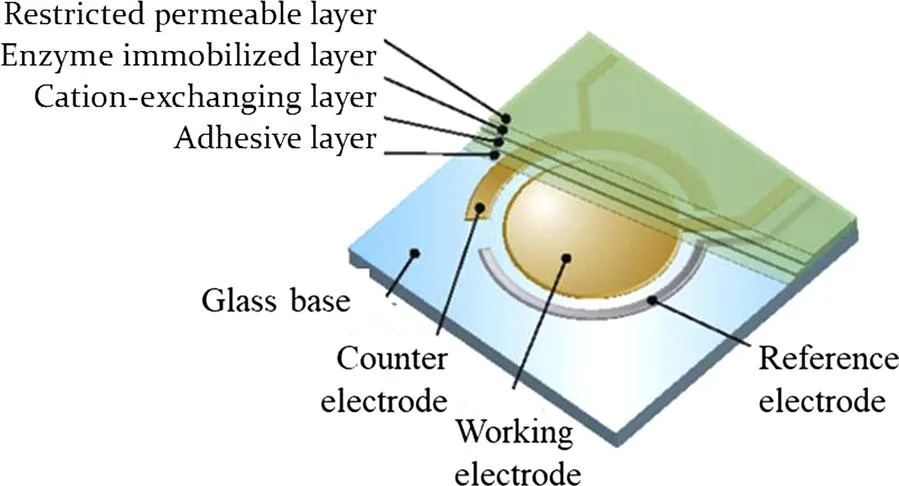
A perspective view of the sensor is shown in Fig. 1.2. Three electrodes, a working electrode, a counter electrode, and a reference electrode, are formed in the hole of the cartridge. The working electrode and the counter electrode are Pt electrodes, and thin film Ag/AgCl electrodes are formed as reference electrode. The reference electrode has the role of stabilizing the potential after immersion in the solution. The outermost layer of the electrode is coated with a thin film of a fluorinated polymer to prevent contamination due to urine components while protecting the electrode system as a whole and stabilizing the operation of the electrodes for more than 1 year in solution.
1.3.2 Laminated structure of urine glucose sensor
To accurately measure postprandial urine, means to eliminate the influence of vitamin C (ascorbic acid) among substances released from foods are required. Ascorbic acid has a reaction that gives electrons to an electrode and another reaction decomposing hydrogen peroxide, and it is typical of an interfering substance of an amperometric sensor.
Furthermore, it is necessary to fabricate a membrane structure so that interfering substances other than ascorbic acid contained in the urine do not affect the measured values.
Fig. 1.3 shows a laminated structure of the urine glucose sensor. This sensor is composed of four layers: a restricted permeable layer, an enzyme immobilized layer, a cation-exchanging layer, and an adhesive layer.
- 1. The restricted permeable layer has a wide measurement range from 10 to 2000 mg/dL, limiting the diffusion of molecules larger than glucose. It has the role of preventing the influence of adhered substances in urine.
- 2. The enzyme immobilized layer is the one where enzyme (GOX) and bovine serum albumin are crosslinked and immobilized so as not to inactivate the enzyme; as a result, repetition of the sensor is possible.
- 3. The cation-exchanging layer has the role of permeating hydrogen peroxide and limiting the diffusion of molecules larger than hydrogen peroxide. Furthermore, it has the function of preventing permeation of ionized molecules.
- 4. The adhesive layer has the role of covalently bonding the selectively permeable film, which is an organic material, to the surface of the glass substrate or the electrode and stably adhering for a long time in water.
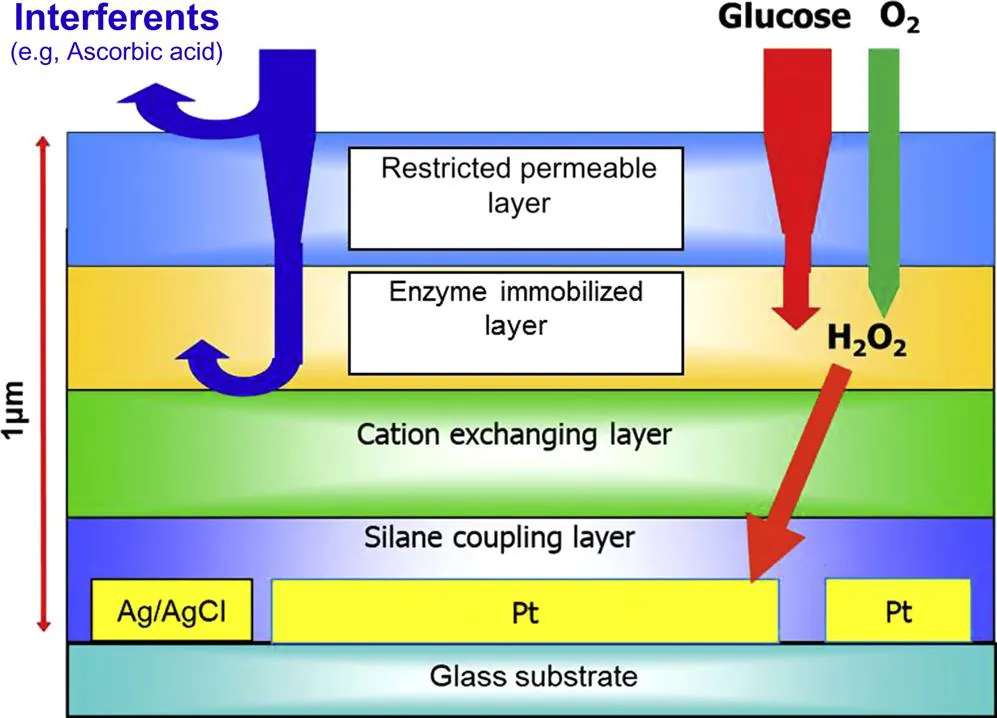
This sensor is formed of a thin film of four layers with a total thickness of 1 μm or less, effectively eliminating the influence of interfering substances in the urine and an early time response [7].
1.4 Development of portable urine glucose meter
1.4.1 Composition of urine glucose meter
This urine glucose meter consists of a body and a sensor. Portability is designed so that the sensor section is folded down to be compact, and at the time of measurement it is extended. Photo 1.1 shows a urine glucose meter in a stored state. Photo 1.2 shows the urine glucose meter extended at the time of measurement. The urine glucose meter sensor section is composed of a preservation solution bottle, which makes the sensor wet. The preservation solution is reserved to hold the sensor, which can cause optimal enzymatic reaction with pH buffer and physiological saline. After the sensor is taken out, it becomes possible to measure instantly.
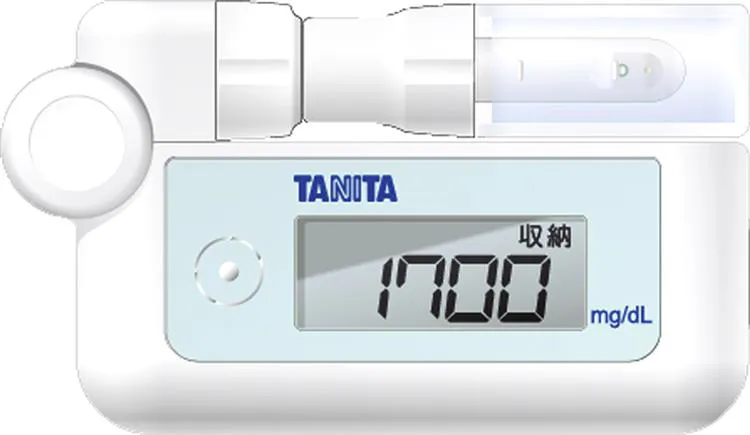
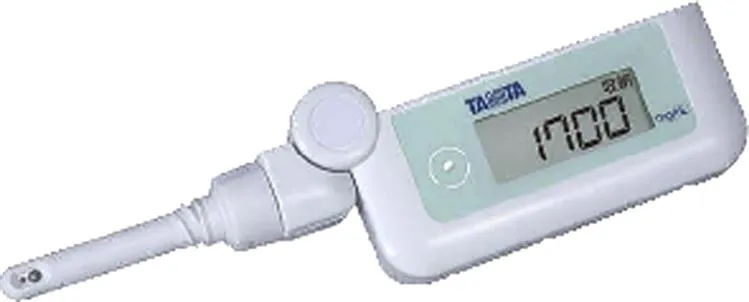
Photo 1.2 shows a urine glucose meter at the time of measurement. When measured, total len...
Table of contents
- Cover image
- Title page
- Table of Contents
- Copyright
- List of Contributors
- Preface
- Part I: Sensors and Devices for Internet of Things Applications
- Part II: Flexible, Wearable, and Mobile Sensors and Related Technologies
- Part III: Information and Network Technologies for Sensor-Internet of Things Applications
- Summary and future issues
- Index
Frequently asked questions
Yes, you can cancel anytime from the Subscription tab in your account settings on the Perlego website. Your subscription will stay active until the end of your current billing period. Learn how to cancel your subscription
No, books cannot be downloaded as external files, such as PDFs, for use outside of Perlego. However, you can download books within the Perlego app for offline reading on mobile or tablet. Learn how to download books offline
Perlego offers two plans: Essential and Complete
- Essential is ideal for learners and professionals who enjoy exploring a wide range of subjects. Access the Essential Library with 800,000+ trusted titles and best-sellers across business, personal growth, and the humanities. Includes unlimited reading time and Standard Read Aloud voice.
- Complete: Perfect for advanced learners and researchers needing full, unrestricted access. Unlock 1.5M+ books across hundreds of subjects, including academic and specialized titles. The Complete Plan also includes advanced features like Premium Read Aloud and Research Assistant.
We are an online textbook subscription service, where you can get access to an entire online library for less than the price of a single book per month. With over 1.5 million books across 990+ topics, we’ve got you covered! Learn about our mission
Look out for the read-aloud symbol on your next book to see if you can listen to it. The read-aloud tool reads text aloud for you, highlighting the text as it is being read. You can pause it, speed it up and slow it down. Learn more about Read Aloud
Yes! You can use the Perlego app on both iOS and Android devices to read anytime, anywhere — even offline. Perfect for commutes or when you’re on the go.
Please note we cannot support devices running on iOS 13 and Android 7 or earlier. Learn more about using the app
Please note we cannot support devices running on iOS 13 and Android 7 or earlier. Learn more about using the app
Yes, you can access Chemical, Gas, and Biosensors for Internet of Things and Related Applications by Kohji Mitsubayashi,Osamu Niwa,Yuko Ueno in PDF and/or ePUB format, as well as other popular books in Physical Sciences & Analytic Chemistry. We have over 1.5 million books available in our catalogue for you to explore.