eBook - ePub
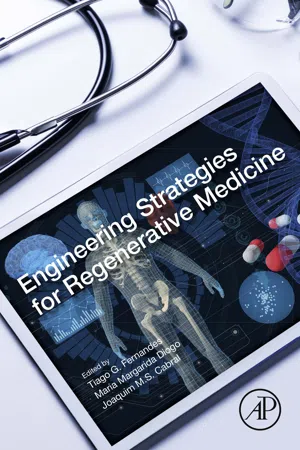
Engineering Strategies for Regenerative Medicine
- 284 pages
- English
- ePUB (mobile friendly)
- Available on iOS & Android
eBook - ePub
Engineering Strategies for Regenerative Medicine
About this book
Engineering Strategies for Regenerative Medicine considers how engineering strategies can be applied to accelerate advances in regenerative medicine. The book provides relevant and up-to-date content on key topics, including the interdisciplinary integration of different aspects of stem cell biology and technology, diverse technologies, and their applications. By providing massive amounts of data on each individual, recent scientific advances are rapidly accelerating medicine. Cellular, molecular and genetic parameters from biological samples combined with clinical information can now provide valuable data to scientists, clinicians and ultimately patients, leading to the development of precision medicine.
Equally noteworthy are the contributions of stem cell biology, bioengineering and tissue engineering that unravel the mechanisms of disease, regeneration and development.
- Considers how engineering strategies can accelerate novel advances in regenerative medicine
- Takes an interdisciplinary approach, integrating different aspects of research, technology and application
- Provides up-to-date coverage on this rapidly developing area of medicine
- Presents insights from an experienced and cross-disciplinary group of researchers and practitioners with close links to industry
Trusted by 375,005 students
Access to over 1.5 million titles for a fair monthly price.
Study more efficiently using our study tools.
Information
Topic
Scienze biologicheSubtopic
Biotecnologia Chapter 1
Pluripotent stem cell biology and engineering
João P. Cotovioa,b; Tiago G. Fernandesa,b; Maria Margarida Diogoa,b; Joaquim M.S. Cabrala,b a Department of Bioengineering and iBB-Institute for Bioengineering and Biosciences, Instituto Superior Técnico (IST), Universidade de Lisboa, Lisbon, Portugal
b The Discoveries Centre for Regenerative and Precision Medicine, Lisbon Campus, Instituto Superior Técnico (IST), Universidade de Lisboa, Lisbon, Portugal
b The Discoveries Centre for Regenerative and Precision Medicine, Lisbon Campus, Instituto Superior Técnico (IST), Universidade de Lisboa, Lisbon, Portugal
Abstract
Since the isolation and culture of human pluripotent stem cells (hPSCs) in vitro, the use of these cells as a potential tool for research and biomedical applications has been growing. Therefore, it is essential to understand the complexity and the dynamics of such stem cell-derived systems, from the single-cell to the multiorgan level. It has been at the intersection of stem cell biology and engineering that new advances on the study and recreation of niches, tissues, and organ-like structures has been accomplished, mimicking the complexity and architecture of the human body. In this chapter, the main bioengineering strategies used to recreate cellular, multicellular, and multiorgan level systems are discussed. We also highlight how stem cell bioengineering is producing the necessary tools for the development of precision medicine approaches that are expected to have a major impact in the fields of disease modeling, drug discovery, and regenerative medicine.
Keywords
Pluripotent stem cells; Stem cell engineering; Stem cell systems; Bioengineering; Systems biology
1 Stem cells
In 1868 Ernst Haeckel [1], a notable biologist from Germany, came up with the term Stammzelle to describe the unicellular ancestor from which all multicellular organisms evolved, a concept very different from the one existing today. Later, he used the same term to describe the fertilized egg, or the zygote, capable of giving rise to all cell types of an organism [2]. This was the cradle for the English term “stem cell” (Fig. 1.1) [3]. After previous studies on the continuity of the germ plasm and on the origin of the hematopoietic system, Till and McCulloch proposed in the 1960s what are still today the two gold standard features of stem cells: (1) undifferentiated cells that are capable of self-renewal and (2) the production of specialized progeny through differentiation [4]. To accomplish such attributes, it is now known that stem cells undergo asymmetric cell division, by which the cell divides to generate one stem cell and one differentiating cell. Therefore, it may be added that stem cells are of major importance in the maintenance of homeostasis through a balance between self-renewal and differentiation [5–7].

From conception to death, as cells develop derived from embryonic tissue, they become progressively restricted in their developmental potency, reaching the point when each cell can only differentiate into a single specific cell type. In the beginning, the earliest cells in ontogeny are totipotent, giving rise, in mammals, to all embryonic and extraembryonic tissues, that is, only a totipotent cell can originate an entire organism [8, 9]. Through embryogenesis, when the pluripotent state is reached, a pluripotent stem cell (PSC) can originate all the cells from all the tissues of the body, although the contributions to the extraembryonic membranes or placenta are limited [8]. On the other hand, a multipotent stem cell is restricted to the generation of the mature cell type of its tissue of origin and finally, a unipotent stem cell displays limited developmental potential, giving rise to only a single-cell type [8]. In an adult organism, stem cells can be found in most tissues throughout the body, even within relatively dormant tissues. These stem cells experience low or no division in normal homeostasis, remaining quiescent for extended periods of time. However, these cells can respond efficiently to stimuli upon initiation of homeostasis or injury [10].
Altogether, in both plant and animal kingdoms, the multicellularity of highly regulated tissues is dependent of the generation of new cells for growth and repair. Therefore, biological systems are driven by a balance between cell death and cell proliferation, preserving form and function in tissues. From this point of view, stem cells are the units of the following attributes: development, regeneration, and evolution [9, 11].
1.1 Pluripotent stem cells
Pluripotency can be defined as a transient property of cells within the early embryo, where PSCs have the capacity to form tissues of all three germ layers of the developing embryo and, later, the organs of the adult organism—ectoderm, mesoderm, and endoderm—and still the germ lineage. As previously mentioned, PSCs typically provide little or no contribution to the trophoblast layers of the placenta [8, 12].
The first PSCs to be isolated and investigated in culture were derived from mouse teratocarcinomas—a tumor of germ cell origin that maintain a wide variety of diversely differentiated tissues—known as embryonal carcinoma (EC) cells [8, 13]. Nevertheless, PSCs can be isolated from several sources through development [14], as murine [15, 16] and human blastocyst [17] or even from the postimplantation epiblast [18, 19] or germ line [20, 21]. Also, pluripotency can be recapitulated in vitro by reprogramming somatic cells to become induced pluripotent stem cells (iPSCs) [22–24].
There are specific molecular mechanisms that characterize PSCs anchored by a selected set of core transcription factors essential to establish pluripotency. As part of the core pluripotency transcription factors encoding genes are octamer-binding transcription factor 4 (OCT4), SRY-box 2 (SOX2), and NANOG. In certain circumstances, the loss of SOX2 or NANOG or their substitution can be tolerated [8, 12]. Despite that, PSCs can be classified into different states of pluripotency based on the molecular signatures, with the terms “naïve” and “primed” being introduced to describe early and late phases of ontogeny, respectively [25].
Pluripotency can be suggested by such molecular signatures, but only functional assays can reveal the developmental potential of a cell. Functional assays to assess pluripotency include: differentiation into three germ layers in vitro, teratoma formation in vivo, chimaera formation, germline transmission through blastocyst injection, tetraploid complementation, and single-cell chimaera formation [8]. For human pluripotent stem cells (hPSCs), teratoma formation remains the gold standard of functional assays.
1.1.1 Embryonic stem cells
Mammalian embryogenesis starts with a single totipotent cell, the zygote. After the first cell division, the two-cell embryo is composed by two equal blastomeres. In the earlier stages, including two- and four-cell embryos, cells are still considered totipotent. Later, in what is called blastocyst, it is possible to distinguish the extraembryonic trophectoderm (TE) on the outside and the inner cell mass (ICM) [14, 26]. It is in the ICM that pluripotent cells first arise. The ICM cells, cultured in conditions that allow indefinite self-renewal and maintenance of the pluripotent state, are known as embryonic stem cells (ESCs) and were first ...
Table of contents
- Cover image
- Title page
- Table of Contents
- Copyright
- Contributors
- Engineering strategies for regenerative medicine
- Chapter 1: Pluripotent stem cell biology and engineering
- Chapter 2: Process development and manufacturing approaches for mesenchymal stem cell therapies
- Chapter 3: Bioinspired materials and tissue engineering approaches applied to the regeneration of musculoskeletal tissues
- Chapter 4: Bioengineering strategies for gene delivery
- Chapter 5: Advanced microtechnologies for high-throughput screening
- Chapter 6: Inductive factors for generation of pluripotent stem cell-derived cardiomyocytes
- Chapter 7: Pluripotent cells for the assessment of chemically induced teratogenesis and developmental toxicology
- Chapter 8: Conclusions and closing remarks
- Index
Frequently asked questions
Yes, you can cancel anytime from the Subscription tab in your account settings on the Perlego website. Your subscription will stay active until the end of your current billing period. Learn how to cancel your subscription
No, books cannot be downloaded as external files, such as PDFs, for use outside of Perlego. However, you can download books within the Perlego app for offline reading on mobile or tablet. Learn how to download books offline
Perlego offers two plans: Essential and Complete
- Essential is ideal for learners and professionals who enjoy exploring a wide range of subjects. Access the Essential Library with 800,000+ trusted titles and best-sellers across business, personal growth, and the humanities. Includes unlimited reading time and Standard Read Aloud voice.
- Complete: Perfect for advanced learners and researchers needing full, unrestricted access. Unlock 1.5M+ books across hundreds of subjects, including academic and specialized titles. The Complete Plan also includes advanced features like Premium Read Aloud and Research Assistant.
We are an online textbook subscription service, where you can get access to an entire online library for less than the price of a single book per month. With over 1.5 million books across 990+ topics, we’ve got you covered! Learn about our mission
Look out for the read-aloud symbol on your next book to see if you can listen to it. The read-aloud tool reads text aloud for you, highlighting the text as it is being read. You can pause it, speed it up and slow it down. Learn more about Read Aloud
Yes! You can use the Perlego app on both iOS and Android devices to read anytime, anywhere — even offline. Perfect for commutes or when you’re on the go.
Please note we cannot support devices running on iOS 13 and Android 7 or earlier. Learn more about using the app
Please note we cannot support devices running on iOS 13 and Android 7 or earlier. Learn more about using the app
Yes, you can access Engineering Strategies for Regenerative Medicine by Tiago G. Fernandes,M. Margardia Diogo,Joaquim M.S. Cabral in PDF and/or ePUB format, as well as other popular books in Scienze biologiche & Biotecnologia. We have over 1.5 million books available in our catalogue for you to explore.