- 388 pages
- English
- ePUB (mobile friendly)
- Available on iOS & Android
eBook - ePub
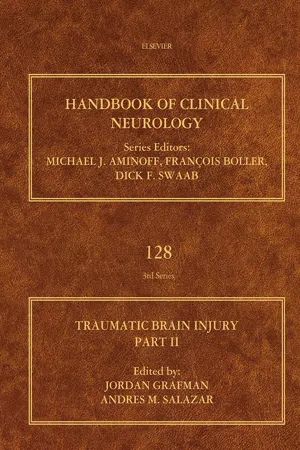
Traumatic Brain Injury, Part II
About this book
The Handbook of Clinical Neurology volumes on Traumatic Brain Injury (TBI) provide the reader with an updated review of emerging approaches to TBI research, clinical management and patient rehabilitation. Chapters in Part II offer coverage of clinical sequelae and long-term outcome, brain plasticity and long-term risks, and clinical trials. Contemporary investigations on blast injury and chronic traumatic encephalopathy are presented, making this state-of-the-art volume a must have for clinicians and researchers concerned with the clinical management, or investigation, of TBI.
- Internationally renowned scientists describe cutting edge research on the neurobiological response to traumatic brain injury, including complications to movement, mood, cognition and more
- Explores cellular/molecular and genetic factors contributing to plasticity
- Presents up-to-date expert recommendation for clinical trials and issues related to effective rehabilitation
- New findings are included on the long-term effects of traumatic brain injury that may impact aging and lead to dementia
Trusted by 375,005 students
Access to over 1.5 million titles for a fair monthly price.
Study more efficiently using our study tools.
SECTION 6
Clinical sequelae and long-term outcome
Chapter 29
Predicting outcome after traumatic brain injury
Andrew I.R. Maas1,*; Hester F. Lingsma2; Bob Roozenbeek3 1 Department of Neurosurgery, Antwerp University Hospital and University of Antwerp, Edegem, Belgium
2 Department of Public Health, Erasmus Medical Center, Rotterdam, The Netherlands
3 Department of Neurology, Erasmus Medical Center, Rotterdam, The Netherlands
* Correspondence to: Andrew I.R. Maas, M.D., Ph.D., Department of Neurosurgery, Antwerp University Hospital/University of Antwerp, Wilrijkstraat 10, 2650 Edegem, Belgium. Tel: +32-3-821-46-32 email address: [email protected]
2 Department of Public Health, Erasmus Medical Center, Rotterdam, The Netherlands
3 Department of Neurology, Erasmus Medical Center, Rotterdam, The Netherlands
* Correspondence to: Andrew I.R. Maas, M.D., Ph.D., Department of Neurosurgery, Antwerp University Hospital/University of Antwerp, Wilrijkstraat 10, 2650 Edegem, Belgium. Tel: +32-3-821-46-32 email address: [email protected]
Abstract
Developing insight into which factors determine prognosis after traumatic brain injury (TBI) is useful for clinical practice, research, and policy making. Several steps can be identified in prediction research: univariate analysis, multivariable analysis, and the development of prediction models. For each step, several methodological issues should be considered, such as selection/coding of predictors and dealing with missing data. “Traditional” predictors include demographic factors (age), type of injury, clinical severity, second insults, and the presence of structural abnormalities on neuroimaging. In combination, these predictors can explain approximately 35% of the variance in outcome in populations with severe and moderate TBI. Novel and emerging predictors include genetic constitution, biomarkers, and advanced magnetic resonance (MR) imaging.
To estimate prognosis for individual patients reliably, multiple predictors need to be considered jointly in prognostic models. Two prognostic models for use in TBI, developed upon large patient numbers, have been extensively validated externally: the IMPACT and CRASH prediction models. Both models showed good performance in validations across a wide range of settings. Importantly, these models were developed not only for mortality but also for functional outcome. Prognostic models can be used for providing information to relatives of individual patients, for resource allocation, and to support decisions on treatment. At the group level, prognostic models aid in the characterization of patient populations, are important to clinical trial design and analysis, and importantly, can serve as benchmarks for assessing quality of care. Continued development, refinement, and validation of prognostic models for TBI is required and this should become an ongoing process.
Key words
Traumatic brain injury
prognosis
prediction model
discrimination
validation
biomarkers
advanced MR imaging
No head injury is too severe to be despaired of, nor too trivial to be ignored.
Hippocrates
Introduction
Interest in prognosis after traumatic brain injury (TBI) dates back to classical times. In Ancient Greece, the quality of care was judged not so much by the actual result of treatment, but rather by the accuracy of the physician's prediction of outcome. Estimates of prognosis – often subconsciously applied – are an important component in clinical decision making. However, as captured in the Hippocratic aphorism quoted above, it has always been considered difficult to predict the likely outcome in patients with TBI. For many years estimates of prognosis after TBI were little more than prophecies based upon clinical experience of physicians. The science of clinical decision making and advances in statistical modeling allow us now to consider prognosis in terms of probabilities rather than vague prophecies. Standardization of the assessment of initial severity following the introduction of the Glasgow Coma Scale (GCS) (Teasdale and Jennett, 1974) and standardized approaches to outcome assessment based upon the Glasgow Outcome Scale (GOS) (Jennett and Bond, 1975) have facilitated prognostic analysis in TBI. Furthermore, the availability of large databases has offered new opportunities for an evidence-based approach.
Quantification of prognostic risk and predictive statements can be useful in a number of ways. Concern about the most likely outcome is of paramount importance to relatives, and prognostic estimates facilitate realistic counseling. The role of quantification of prognostic risk in influencing decisions about the management in individual patients is more controversial. Although many physicians acknowledge that prognostic estimates have an important role in decision making, others attribute only a minor or even nonexistent role to prognosis. This difference reflects a range of attitudes influenced by both ethical and cultural differences as well as by clinical convictions. Nevertheless, some form of prognostic estimate is consciously or subconsciously used by physicians when allocating resources and prioritizing treatment – particularly in situations where resources may be more limited. Caution in the interpretation of prognostic risk estimates is appropriate: a prognostic estimate in an individual patient concerns a probabilistic equation with a range of uncertainties reflected in the confidence interval (CI). We should further recognize that predictive equations can never include all items relevant to an individual patient. Estimates derived from evidence-based analysis of large datasets remain preferable to a clinical prophecy, as estimates performed by physicians are often unduly optimistic, or, on the other hand, sometimes even unnecessarily pessimistic or inappropriately ambiguous (Barlow and Teasdale, 1986; Chang et al., 1989; Dawes et al., 1989; Kaufmann et al., 1992). No single clinician's experience can ever match the wealth of data available in databases consisting of thousands of patients. The most important application of prognostic analysis in TBI is perhaps not so much at the level of the individual patient, but more at the group level. Patient populations can be characterized by baseline prognostic risk, thus facilitating more accurate and valid comparisons between different studies. Moreover, estimation of the baseline prognostic risk can be used as a benchmark for evaluating quality of care. Finally, prognostic analysis and identification of covariates are important for stratification and covariate adjustment in clinical trials.
In this chapter, we focus on the prediction of outcome in terms of mortality and functional outcome in adult patients with moderate and severe TBI. Cognitive and psychosocial outcomes are addressed in more detail in Chapters 31, 40, and 44. Specific pediatric considerations are described in Chapters 15 and 41.
We aim to describe the basics of prognostic analysis and to review current knowledge about traditional and newly recognized predictors for outcome. We will also discuss prognostic modeling as an important instrument in clinical practice and research and critically review existing models. Finally, we will discuss the potential of prognostic analysis in the field of TBI.
Methodology of prognostic studies
Prognostic studies are inherently longitudinal and most commonly performed in cohorts of patients with outcome determined at a fixed time point. The cohort is defined by the presence of one or more particular characteristics such as hospital admission for TBI. It is important to define the cohort as accurately as possible in order to prevent a bias in the selection of patients for participation.
Several steps can be identified in prediction research (Table 29.1): univariate analysis, multivariable analysis, and the development of prediction models.
Table 29.1
Steps in prognostic analysis in traumatic brain injury
| Aim | Limitations | Performance measures | |
| Univariate analysis | To estimate the relation between a single predictor and outcome | Does not take into account the role of confounding factors that may explain (part of) the observed association | Sensitivity, specificity, positive predictive value, negative predictive value, odds ratio |
| Multivariable analysis | To determine the prognostic value of a predictor, adjusting for confounding effects of other predictors | In individual patients, predictors may influence outcome in opposite directions; does not take into account interactions or differential effects for specific subpopulations | Odds ratio Risk ratio Nagelkerkers R2 |
| Prediction models | To combine predictors into a model to estimate the risk of an outcome for individual patients | External validation essential to prove generalizability outside the development setting | Discrimination: area under the receiver operating characteristic curve Calibration: graphical representation Hosmer-Lemeshow goodness of fit test |

(Adapted from Lingsma et al., 2010.)
Sensitivity, proportion of patients with the outcome that have the predictor (true positive); specificity, proportion of patients without the outcome that do not have the predictor (true negative); positive predictive value, proportion of patients with the predictor that have the outcome; negative predictive v...
Table of contents
- Cover image
- Title page
- Table of Contents
- Copyright
- Handbook of Clinical Neurology 3rd Series
- Foreword
- Preface
- Contributors
- SECTION 6: Clinical sequelae and long-term outcome
- SECTION 7: Brain plasticity and long-term risks
- SECTION 8: Conducting clinical trials in traumatic brain injury
- Index
Frequently asked questions
Yes, you can cancel anytime from the Subscription tab in your account settings on the Perlego website. Your subscription will stay active until the end of your current billing period. Learn how to cancel your subscription
No, books cannot be downloaded as external files, such as PDFs, for use outside of Perlego. However, you can download books within the Perlego app for offline reading on mobile or tablet. Learn how to download books offline
Perlego offers two plans: Essential and Complete
- Essential is ideal for learners and professionals who enjoy exploring a wide range of subjects. Access the Essential Library with 800,000+ trusted titles and best-sellers across business, personal growth, and the humanities. Includes unlimited reading time and Standard Read Aloud voice.
- Complete: Perfect for advanced learners and researchers needing full, unrestricted access. Unlock 1.5M+ books across hundreds of subjects, including academic and specialized titles. The Complete Plan also includes advanced features like Premium Read Aloud and Research Assistant.
We are an online textbook subscription service, where you can get access to an entire online library for less than the price of a single book per month. With over 1.5 million books across 990+ topics, we’ve got you covered! Learn about our mission
Look out for the read-aloud symbol on your next book to see if you can listen to it. The read-aloud tool reads text aloud for you, highlighting the text as it is being read. You can pause it, speed it up and slow it down. Learn more about Read Aloud
Yes! You can use the Perlego app on both iOS and Android devices to read anytime, anywhere — even offline. Perfect for commutes or when you’re on the go.
Please note we cannot support devices running on iOS 13 and Android 7 or earlier. Learn more about using the app
Please note we cannot support devices running on iOS 13 and Android 7 or earlier. Learn more about using the app
Yes, you can access Traumatic Brain Injury, Part II by Jordan H. Grafman,Andres M. Salazar in PDF and/or ePUB format, as well as other popular books in Medicine & Neurology. We have over 1.5 million books available in our catalogue for you to explore.