eBook - ePub
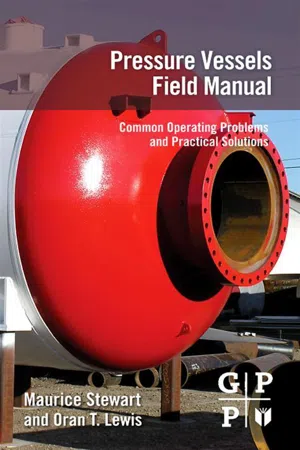
Pressure Vessels Field Manual
Common Operating Problems and Practical Solutions
- 498 pages
- English
- ePUB (mobile friendly)
- Available on iOS & Android
eBook - ePub
Pressure Vessels Field Manual
Common Operating Problems and Practical Solutions
About this book
The majority of the cost-savings for any oil production facility is the prevention of failure in the production equipment such as pressure vessels. Money lost through lost production far outweighs expenses associated with maintenance and proper operation. However, many new engineers lack the necessary skills to effectively find and troubleshoot operating problems while experienced engineers lack knowledge of the latest codes and standards. The fifth book in the Field Manual Series, the Pressure Vessel Operations Field Manual provides new and experienced engineers with the latest tools to alter, repair and re-rate pressure vessels using ASME, NBIC and API 510 codes and standards.
- Step-by-step procedure on how to design, perform in-shop and in-field inspections and repairs, perform alterations and re-rate a pressure vessel
- How to select the appropriate vessel specifications, evaluate associated reports and determine allowable stresses
- Calculations for stresses in pressure vessels
- Select the appropriate materials of construction for a pressure vessel
- Design pressure vessels using the ASME Code Section VIII, Division 1 and 2 to best fit the circumstance
Information
1
History and Organization of Codes
Overview
This chapter discusses the following topics:
Use of pressure vessels and equipment
History of pressure vessel codes in the United States
Organization of the ASME Boiler and Pressure Vessel Code
Updating and interpreting the code
ASME Code stamps
Organization of the ANSI/ASME B31 Code for Pressure Piping
Some other pressure vessel codes and standards in the United States
Worldwide pressure vessel codes
ASME Code, Section VIII, Division 1 versus Division 2 and Division 3
Design criteria, ASME Code, Section VIII, Division 1
Design Criteria, ASME Code, Section VIII, Division 2
Welding criteria, ASME Code, Section IX
ASME Code, Section I, Power Boilers
Additional requirements employed by users in critical services
Use of Pressure Vessels and Equipment
Process vessels are used at all stages of processing oil and gas
Initial separation
Processing, conditioning, and treating
Storage
Pressure vessels are made in all sizes and shapes
Less than an inch and greater than 150 feet in diameter
Buried in the ground or deep in the ocean
Most are positioned on the ground or supported on platforms
Internal pressures
Less than 1 inch water gauge pressure or greater than 300,000 psi
Normal range for monoblock construction is between 15 to 5000 psi
ASME Boiler and Pressure Vessel Code
Specifies a minimum internal pressure from 15 psi
May require special design requirements at internal pressures above 3000 psi
Any pressure vessel that meets all the requirements of the ASME Code, regardless of the internal or external design pressure, may still be accepted by the authorized inspector and stamped by the manufacturer with the ASME Code symbol
American Petroleum Institute (API) storage tanks
May be designed for and contain no more internal pressure than that generated by the static head of fluid contained in the tank
History of Pressure Vessel Codes in the United States
In the late 1800s and early 1900s, explosions in boilers and pressure vessels were frequent
Firetube boiler explosion on the Mississippi River steamboat Sultana on April 27, 1865, resulted in the boat sinking within 20 minutes and killing 1500 people
Firetube boiler explosion in a shoe factory in Brockton, Massachusetts, in 1905 killed 58, injured 117, and did $400,000 in property damage
Another explosion in a shoe factory in Lynn, Massachusetts, in 1906 resulted in death, injury, and extensive property damage
Massachusetts governor directed the formation of a Board of Boiler Rules
First set of rules approved in 1907
The code was three pages long!
In 1911, the ASME Boiler and Pressure Vessel Code Committee was established to perform the following functions:
Formulate minimum rules for the construction of boilers
Interpret the rules when requested
Develop revisions and additional rules as needed
In 1915, the first ASME Boiler Code was issued:
Titled “Boiler Construction Code, 1914 Edition”
Beginning of the various sections of the code, which ultimately became Section I, “Power Boilers”
In 1925, the first ASME Code of Pressure Vessels was issued:
Titled “Rules for the Construction of Unfired Pressure Vessels,” Section VIII
Applied to vessels over 6 inches in diameter, volume over 1.5 ft3, and pressure over 30 psi
In 1931, a joint API-ASME committee was formed to develop an unfired pressure vessel code for the petroleum industry
In 1934, the first pressure vessel code for the petroleum industry was issued, and for the next 17 years, two separate unfired pressure vessel codes existed
In 1952, the two codes were consolidated into one, titled “ASME Unfired Pressure Vessel Code,” Section VIII
In 1968, the original code became Section VIII, Division 1, “Pressure Vessels,” and another part was issued, which was Section VIII, Division 2, “Alternate Rules for Pressure Vessels”
ANSI/ASME Boiler and Pressure Vessel Code is issued by the ASME with the approval by the ANSI as an ANSI/ASME document
ANSI/ASME Boiler and Pressure Vessel Code has been established as the set of legal requirements in many countries of the world
M...
Table of contents
- Cover image
- Title page
- Table of Contents
- Copyright
- 1. History and Organization of Codes
- 2. Materials of Construction
- 3. Materials Selection for Pressure Vessels
- 4. Mechanical Design of Pressure Vessels
- 5. Fabrication, Welding, and In-Shop Inspection
- 6. In-Service Inspection by Nondestructive Examination (NDE)
- 7. Repair, Alteration, and Re-rating
- Index
Trusted by 375,005 students
Access to over 1.5 million titles for a fair monthly price.
Study more efficiently using our study tools.
Frequently asked questions
Yes, you can cancel anytime from the Subscription tab in your account settings on the Perlego website. Your subscription will stay active until the end of your current billing period. Learn how to cancel your subscription
No, books cannot be downloaded as external files, such as PDFs, for use outside of Perlego. However, you can download books within the Perlego app for offline reading on mobile or tablet. Learn how to download books offline
Perlego offers two plans: Essential and Complete
- Essential is ideal for learners and professionals who enjoy exploring a wide range of subjects. Access the Essential Library with 800,000+ trusted titles and best-sellers across business, personal growth, and the humanities. Includes unlimited reading time and Standard Read Aloud voice.
- Complete: Perfect for advanced learners and researchers needing full, unrestricted access. Unlock 1.5M+ books across hundreds of subjects, including academic and specialized titles. The Complete Plan also includes advanced features like Premium Read Aloud and Research Assistant.
We are an online textbook subscription service, where you can get access to an entire online library for less than the price of a single book per month. With over 1.5 million books across 990+ topics, we’ve got you covered! Learn about our mission
Look out for the read-aloud symbol on your next book to see if you can listen to it. The read-aloud tool reads text aloud for you, highlighting the text as it is being read. You can pause it, speed it up and slow it down. Learn more about Read Aloud
Yes! You can use the Perlego app on both iOS and Android devices to read anytime, anywhere — even offline. Perfect for commutes or when you’re on the go.
Please note we cannot support devices running on iOS 13 and Android 7 or earlier. Learn more about using the app
Please note we cannot support devices running on iOS 13 and Android 7 or earlier. Learn more about using the app
Yes, you can access Pressure Vessels Field Manual by Maurice Stewart,Oran T. Lewis in PDF and/or ePUB format, as well as other popular books in Technology & Engineering & Industrial Design. We have over 1.5 million books available in our catalogue for you to explore.