- 572 pages
- English
- ePUB (mobile friendly)
- Available on iOS & Android
eBook - ePub
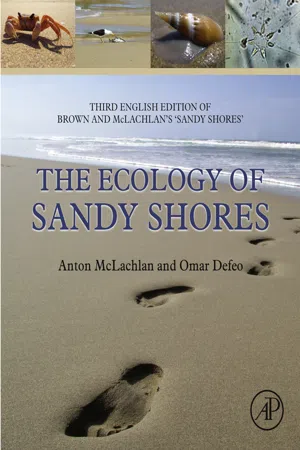
The Ecology of Sandy Shores
About this book
The Ecology of Sandy Shores, Third Edition, provides both a holistic and conceptual introduction for beginners, while also presenting an in-depth and cutting-edge analysis for researchers interested in sandy shores. This new edition focuses on resource use, and has also been updated to include recent findings, enhanced illustrations, and additional coverage on beach fisheries and global/climate change. In addition, this release presents insights on food webs, greater coverage on global biodiversity patterns in sandy beaches, and new insights on population patterns, behavior and threats.Research on beaches is difficult because of the dynamic nature of the environment. There is no other book covering the ecology of sandy beaches, despite the extent and economic importance of these systems. This book is designed to both provide the conceptual basis to introduce students to the basic principles of sandy shore ecology and to serve as a ready reference for doctoral students and researches working on these systems. It can also serve as a handbook for land and coastal managers.
- Fully updated edition of the preeminent book on sandy shores
- Covers sandy shores from the perspective that they are a socioecological system
- Represents the top resource on an enormous habitat that is important in every way—ecologically, environmentally, socially and economically
Trusted by 375,005 students
Access to over 1.5 million titles for a fair monthly price.
Study more efficiently using our study tools.
Information
Chapter 1
Introduction
Abstract
Sandy beaches have tended to be considered marine deserts and have attracted less attention from ecologists than other coastal environments. But beaches harbor a unique assemblage of specially adapted organisms and can, with their surf zones, be productive ecosystems. Research on sandy beaches has increased considerably since the first sandy beach symposium in 1983. This book takes a holistic approach toward sandy beach ecosystems, focusing on exposed ocean beaches.
Keywords
Conservation; Ecosystems; ISBSs; Management; Sand beaches; Social–ecological systems
Ocean sandy beaches are dynamic environments that make up two-thirds of the world’s ice-free coastlines. Here sea meets land, and waves, tides, and wind engage in a battleground where they dissipate their energy in driving sand transport. The alternating turbulence and peace of the beach environment enhance its scenic and aesthetic appeal, while its relative simplicity provides an ideal template for research. This should attract the student of coastal ecology. However, the biological study of sandy beaches has traditionally lagged behind that of rocky shores and other coastal ecosystems (Fairweather, 1990; McLachlan and Defeo, 2013). A few farsighted workers produced seminal papers, for example, Bruce (1928) in England, Stephen (1931) in Scotland, Remane (1933) in the North Sea, and Pearse et al. (1942) in the United States, but for the most part, scientific investigation, as opposed to casual observation and intermittent beachcombing, began only some 50 years after the first intensive studies of rocky shores. The reasons for this early neglect of sandy beach ecosystems are not far to seek.
Unlike sandy beaches, rocky shores teem with obvious life. Many of the plants and animals are large and highly colored and, when the tide is out, the life in rock pools may be observed without undue effort. Sessile or slow-moving animals are not only easy to collect, but the biologist may also enclose or exclude species from an area to study biological interactions and recolonization. None of these things is true of any but the most sheltered sandy beaches. To the casual observer, exposed intertidal sands may seem almost devoid of life. There are no attached plants intertidally; the majority of the animals are too small to be seen conveniently with the naked eye, and most macrofaunal invertebrates are cryptic, hiding within the sand and emerging only when necessary to feed or to perform other vital functions, often when covered by the tide. On a sheltered beach, the openings of burrows may give visible evidence of the life within the sand, but on beaches exposed to heavy wave action, the sand is far too unstable to support burrows intertidally. As the sand surface is in constant movement while covered by the tide, so must the animals themselves be highly mobile to maintain their positions on the beach or to regain them if swept out to sea. This mobility, coupled with a semicryptic mode of life, renders the observation of sandy beach animals in situ far more difficult than for other shore types—there simply appears to be little there. Indeed, sandy beaches have been likened to marine deserts.
Yet the ocean beach is teeming with life, microscopic and macroscopic. The spectrum of life in the sand includes clams, whelks, worms, sand hoppers, crabs, sea lice, sand dollars, and a host of smaller animals, as well as protozoans, microscopic plants, and bacteria. In addition to these residents of the intertidal beach, a variety of species move up over the beach from the surf zone on the rising tide, while others descend onto the beach from the dunes on the falling tide. All these components interact in a trophic network to create the open ecosystem of the sandy beach, which exchanges materials with sea and land. Increasingly, we have begun to realize that sandy beaches are not marine deserts but are interesting and often productive ecosystems. And so, fortunately, the earlier neglect of sandy beaches by researchers has been quite strongly addressed in the past few decades, providing the material for this book.
Although most early work on sandy beach ecology was descriptive, this has changed since the 1970s and 1980s. The complexity of the interactions between the surf-zone fauna and flora, the animals of the intertidal slope and the backshore biota were brought home to workers in this field at the first international symposium on sandy beaches in 1983 (McLachlan and Erasmus, 1983), where sandy beach ecology emerged for the first time as a distinct field of coastal science. In the decade following that symposium, systems energetics was a major theme among sandy beach researchers. Many ideas emerging from that phase of sandy beach research were covered in the first edition of this book (Brown and McLachlan, 1990). In the 16 years after the first edition, international sandy beach symposia (ISBSs) numbers II, III, and IV were held in Chile (1994), Italy (2001), and Spain (2006), respectively; the latter coinciding with the publication of the second edition of this book. During this period emphasis not only shifted to macrobenthic population and community ecology, but also to greater awareness of threats to coastal systems and the need to transfer research results to coastal managers and policy makers. Since the publication of the second edition of this book, three further ISBSs have taken place: number V was held in Morocco in 2009, number VI in South Africa in 2012, and number VII in Brazil in 2015. Over this 10-year period emphasis has shifted to the perception of beaches as social–ecological systems and broader issues of conservation and management in the light of global change. Now held every 3 years, these ISBSs have become a regular part of the sandy beach research landscape.
The aim of this third edition of Sandy Shores is to present an integrated account of sandy shore ecology, including the surf zone, the intertidal slope, the back beach, and the dunes. Since the second edition, our appreciation of the problems and pressures facing sandy coasts and the need for research and monitoring to inform strategic planning and coastal conservation and management have increased to a high priority; so this third edition includes major additions to these aspects of beach ecology. As before, we consider beaches as ecosystems: human impacts, climate change, sustainable fisheries, conservation, and management of these social–ecological systems are stressed, and new sections are added based on recent developments. For a full listing of the sandy beach ecological literature before 1990, the reader is referred to McLachlan and Erasmus (1983) and Brown and McLachlan (1990).
This book is unashamedly biased in favor of exposed beaches of pure sand. We have omitted consideration of estuarine sand flats, and such sheltered environments are mentioned only in passing; attention being concentrated on the world’s open, oceanic beaches. Because these are dynamic systems, mostly physically controlled, our account begins with two chapters appraising the physical environment of the sandy beach. This is appropriate because it is essential for any beach ecologist to have a sound understanding of the main features and processes of the physical environment of the sandy beach. Following this are chapters on the main components of flora and fauna; thereafter beach and dune systems are considered as a whole.

Figure 1.1 Swash modifies the beach face with every tide—a fresh look always awaits the student. Photo by Anton McLachlan.
Because sandy coastlines, in general, and especially their associated dune systems, are fragile environments facing many threats and because most are eroding, they require conservation and special management frameworks if they are to continue to function ecologically and provide for quality recreation. Appropriate management and successful conservation can only be achieved if the complex ecology of these ecosystems is understood, including humans as keystone species in the system. Indeed, human preference for coastal areas is increasing exponentially, making sandy beaches one of the largest social–ecological systems globally as they extend across different cultures and environmental conditions. Thus, sandy beaches can contribute to a global and fascinating model if we understand how the goods and services they provide will respond to the unprecedented environmental changes that are currently occurring. Furthering this understanding is also the task of this book.
Ocean sandy beaches are wonderful venues for recreation for everyone. They are also fascinating and important ecosystems for the student of coastal ecology (Fig. 1.1). They are magnets that draw our attention by their dynamic beauty and their contrasting restlessness and tranquility. And they still hold many secrets awaiting discovery. Willard Bascom’s (1964) epilogue is as true today as it was more than half a century ago: “Fortunately the beaches of the world are cleaned every night by the tide. A fresh look always awaits the student, and every wave is a masterpiece of originality. It will ever be so. Go and see.” We hope the chapters that follow will encourage the reader to do just that.

Chapter 2
The Physical Environment
Abstract
Beaches, surf zones, and dunes together make up the littoral active zone of the sandy coast. Sandy beaches are defined by the interaction among sand, waves, and tides, particularly sand particle size, wave height or energy, and spring tide range. The interaction among these three factors generates a range of beach types, with the extremes being the wave-dominated reflective beach under conditions of small waves and tides and coarse sand, and the tide-dominated dissipative beach under conditions of larger tides and fine sand. A variety of surf water flow patterns ...
Table of contents
- Cover image
- Title page
- Table of Contents
- Copyright
- Acknowledgments
- A Tribute to Alec Brown
- Chapter 1. Introduction
- Chapter 2. The Physical Environment
- Chapter 3. The Interstitial Environment
- Chapter 4. Beach and Surf-Zone Flora
- Chapter 5. Sandy-Beach Invertebrates
- Chapter 6. Adaptations to Sandy-Beach Life
- Chapter 7. Benthic Macrofauna Communities
- Chapter 8. Benthic Macrofauna Populations
- Chapter 9. Interstitial Ecology
- Chapter 10. Surf-Zone Zooplankton and Nekton
- Chapter 11. Other Marine and Terrestrial Vertebrates
- Chapter 12. Energetics and Nutrient Cycling
- Chapter 13. Coastal Dune Ecosystems and Dune–Beach Interactions
- Chapter 14. Fisheries
- Chapter 15. Human Impacts
- Chapter 16. Climate Change
- Chapter 17. Management and Conservation
- Appendix. The Chemical Environment of Sediments
- Glossary
- References
- Index
Frequently asked questions
Yes, you can cancel anytime from the Subscription tab in your account settings on the Perlego website. Your subscription will stay active until the end of your current billing period. Learn how to cancel your subscription
No, books cannot be downloaded as external files, such as PDFs, for use outside of Perlego. However, you can download books within the Perlego app for offline reading on mobile or tablet. Learn how to download books offline
Perlego offers two plans: Essential and Complete
- Essential is ideal for learners and professionals who enjoy exploring a wide range of subjects. Access the Essential Library with 800,000+ trusted titles and best-sellers across business, personal growth, and the humanities. Includes unlimited reading time and Standard Read Aloud voice.
- Complete: Perfect for advanced learners and researchers needing full, unrestricted access. Unlock 1.5M+ books across hundreds of subjects, including academic and specialized titles. The Complete Plan also includes advanced features like Premium Read Aloud and Research Assistant.
We are an online textbook subscription service, where you can get access to an entire online library for less than the price of a single book per month. With over 1.5 million books across 990+ topics, we’ve got you covered! Learn about our mission
Look out for the read-aloud symbol on your next book to see if you can listen to it. The read-aloud tool reads text aloud for you, highlighting the text as it is being read. You can pause it, speed it up and slow it down. Learn more about Read Aloud
Yes! You can use the Perlego app on both iOS and Android devices to read anytime, anywhere — even offline. Perfect for commutes or when you’re on the go.
Please note we cannot support devices running on iOS 13 and Android 7 or earlier. Learn more about using the app
Please note we cannot support devices running on iOS 13 and Android 7 or earlier. Learn more about using the app
Yes, you can access The Ecology of Sandy Shores by Anton McLachlan,Omar Defeo in PDF and/or ePUB format, as well as other popular books in Biological Sciences & Ecology. We have over 1.5 million books available in our catalogue for you to explore.