eBook - ePub
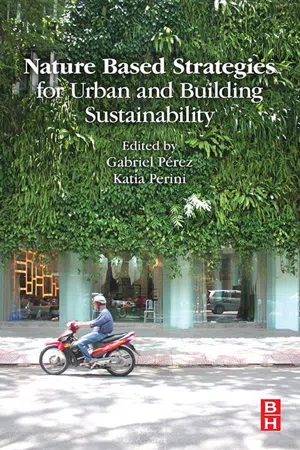
Nature Based Strategies for Urban and Building Sustainability
- 390 pages
- English
- ePUB (mobile friendly)
- Available on iOS & Android
eBook - ePub
Nature Based Strategies for Urban and Building Sustainability
About this book
Nature Based Strategies for Urban and Building Sustainability reviews the current state-of-the-art on the topic. In the introduction, the editors review the fundamental concepts of nature elements in the built environment, along with the strategies that are necessary for their inclusion in buildings and cities. Part One describes strategies for the urban environment, discussing urban ecosystems and ecosystem services, while Part Two covers strategies and technologies, including vertical greening systems, green roofs and green streets. Part Three covers the quantitative benefits, results, and issues and challenges, including energy performances and outdoor comfort, air quality improvement, acoustic performance, water management and biodiversity.
- Provides an overview of the different strategies available to integrate nature in the built environment
- Presents the current state of technology concerning systems and methodologies on how to incorporate nature in buildings and cities
- Features the latest research results on operation and ecosystem services
- Covers both established and new designs, including those still in the experimental stage
Trusted by 375,005 students
Access to over 1.5 million titles for a fair monthly price.
Study more efficiently using our study tools.
Information
Section III
Nature Based Strategies: Benefits and Challenges
Outline
Chapter 3.1
Vertical Greening Systems to Enhance the Thermal Performance of Buildings and Outdoor Comfort
Gabriel Pérez, Julià Coma and Luisa F. Cabeza
Abstract
This chapter provides an overview to the ability of vertical greening systems to provide passive energy savings at building scale and to reduce the urban heat island effect in the built environment. The main influencing aspects for energy performances and outdoor comfort, i.e., the differences between the current constructive systems (basically green facades and green walls), the climate and plant species (climber plants vs shrubs and herbaceous, or perennial vs deciduous), and the operating methods (shade effect, cooling effect, insulation effect, wind barrier effect) will be analyzed. Moreover, a short review throughout the main promising research findings on the topic will be presented to finish with some suggestions for further research.
Keywords
Vertical greening system; green wall; green facade; energy savings; passive system; building
Introduction
Recently, the concept of urban green infrastructure has been defined by the European Commission-Environment (2012) as a set of man-made elements that provide multiple ecosystem services both at building and urban scale. Among these functions, the building energy savings as well as the reduction of ambient temperatures and urban heat island (UHI) effect stand out. Some of the most innovative and interesting construction systems for this purpose are the vertical greening systems (VGS).
Since the vertical surface available in a building is much larger than the horizontal, especially in high rise buildings, it seems obvious that the potential of VGS in providing these services will also be proportionately higher. In view of these opportunities in the last years, a set of rigorous research studies have reviewed the use of VGS as a passive tool for energy savings, at building scale, as well as for the reduction of the UHI effect at city scale (Pérez et al., 2014).
In this chapter, the main influencing aspects for this purpose, which are the differences between the current construction systems, the climate and plant species influence, and the operating methods, will be analyzed. Moreover, a short review throughout the main research findings on the topic will be presented to finish with some suggestions for further research in the conclusions.
Main Influencing Aspects
Differences Between Construction Systems
Over the years, different VGS construction systems have been developed, in terms of materials and layers that make up the system, in the used support elements, the plants species as well as the maintenance requirements (extensive or intensive), etc. (Fig. 1). According to Pérez et al. (2011), these differences can have a big influence on the ecosystem services provided by each vertical greening system, e.g., energy savings or UHI reduction that must be taken into consideration already from the design phase. Table 1 summarizes the main VGS constructive systems, their layers and the level of maintenance (water and nutrients) (Pérez et al., 2011), and the great differences between systems, which results on different thermal behavior can be observed.

Table 1
| VGS System | Layer | Level of Maintenance | ||||
|---|---|---|---|---|---|---|
| Support Structure | Air Gap | Substrate | Plants | |||
| Green façade | Traditional | No | No | No | Climber plants | Extensive |
| Double-skin | Very light, steel wires or mesh | Yes, usually open | No | Climber plants | Extensive | |
| Perimeter flowerpots | Flowerpots | Yes, usually open | Only in the pots | Climber and hanging shrubs | Intensive | |
| Green wall | Geotextile | Geotextile felts | No | No | Shrubs and hanging shrubs | Intensive |
| Modular panels | Heavy and strong, anchored to the facade wall | Yes, open or closed | Yes, inside the modules | Shrubs | Intensive | |

In order to deal with the dispersion on designs, and with the aim to compare research studies relating to the thermal performance of these systems; in Pérez et al. (2014) the building external wall surface temperature reduction (°C) due to the effect of the VGS was established as the most relevant parameter for the research studies comparison, because it is the first and most direct effect arising from the presence of sunscreen. In addition, neither the heat fluxes through the wall nor the interior surface wall temperature are comparable due to the differences between constructive systems of the facade building wall between case studies or research studies.
The Climate Influence
When the passive energy saving potential of vertical vegetation systems for buildings is the aim, the big influence of climate conditions over their operation must be considered. Weather not only affects directly on the thermal performance of the building but also on specific aspects relating to plants such as their growth (foliage density, plant height, etc.) and their physiological responses (transpiration, position of leaves, etc.), and consequently over the thermal behavior of the whole system. In this regard, the most influential climatic parameters will be solar radiation, temperatures and relative humidity, rainfall, and finally the wind.
This fact is very important for two main reasons. On one hand, it must take it into account in the most suitable system choice during the design phase so that it fulfills the local climatic constraints. On the other hand, from research’s point of view, these aspects should be taken into account when comparing research results. Pérez et al. (2014) suggested the use of Köppen classification in order to unify criteria and to properly compare research results relating to the VGS as a passive tool for energy savings, because it is based on the annual and monthly temperature and precipitation averages which are the most influential parameters for vegetation development.
In this study it was found that there is still a lack of research regarding the use of VGS as a tool for passive energy saving in many climatic zones of the world. Specifically, a lack of studies in areas of the world that receive more radiation is observed and therefore where these systems could be more effective is due to the shade effect.
Plant Species Influence
Another aspect to consider in VGS (when used as passive energy savings systems) is the plant species used because each constructive system uses different types of pl...
Table of contents
- Cover image
- Title page
- Table of Contents
- Copyright
- List of Contributors
- Introduction
- Section I: Nature Based Strategies for Urban Environment
- Section II: Nature Based Strategies and Technologies
- Section III: Nature Based Strategies: Benefits and Challenges
- Section IV: Nature Based Strategies: Social, Economic and Environmental Sustainability
- Summary
- Index
Frequently asked questions
Yes, you can cancel anytime from the Subscription tab in your account settings on the Perlego website. Your subscription will stay active until the end of your current billing period. Learn how to cancel your subscription
No, books cannot be downloaded as external files, such as PDFs, for use outside of Perlego. However, you can download books within the Perlego app for offline reading on mobile or tablet. Learn how to download books offline
Perlego offers two plans: Essential and Complete
- Essential is ideal for learners and professionals who enjoy exploring a wide range of subjects. Access the Essential Library with 800,000+ trusted titles and best-sellers across business, personal growth, and the humanities. Includes unlimited reading time and Standard Read Aloud voice.
- Complete: Perfect for advanced learners and researchers needing full, unrestricted access. Unlock 1.5M+ books across hundreds of subjects, including academic and specialized titles. The Complete Plan also includes advanced features like Premium Read Aloud and Research Assistant.
We are an online textbook subscription service, where you can get access to an entire online library for less than the price of a single book per month. With over 1.5 million books across 990+ topics, we’ve got you covered! Learn about our mission
Look out for the read-aloud symbol on your next book to see if you can listen to it. The read-aloud tool reads text aloud for you, highlighting the text as it is being read. You can pause it, speed it up and slow it down. Learn more about Read Aloud
Yes! You can use the Perlego app on both iOS and Android devices to read anytime, anywhere — even offline. Perfect for commutes or when you’re on the go.
Please note we cannot support devices running on iOS 13 and Android 7 or earlier. Learn more about using the app
Please note we cannot support devices running on iOS 13 and Android 7 or earlier. Learn more about using the app
Yes, you can access Nature Based Strategies for Urban and Building Sustainability by Gabriel Perez,Katia Perini in PDF and/or ePUB format, as well as other popular books in Technology & Engineering & Civil Engineering. We have over 1.5 million books available in our catalogue for you to explore.