- 596 pages
- English
- ePUB (mobile friendly)
- Available on iOS & Android
eBook - ePub
About this book
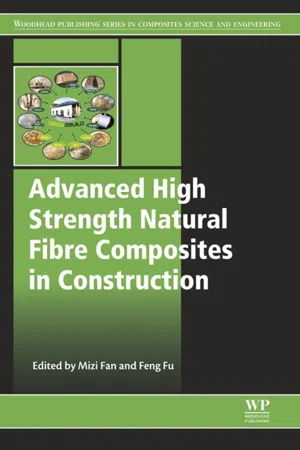
Advanced High Strength Natural Fibre Composites in Construction provides the basic framework and knowledge required for the efficient and sustainable use of natural fiber composites as a structural and building material, along with information on the ongoing efforts to improve the efficiency of use and competitiveness of these composites.
Areas of particular interest include understanding the nature and behavior of raw materials and their functional contributions to the advanced architectures of high strength composites (Part 1), discussing both traditional and novel manufacturing technologies for various advanced natural fiber construction materials (Part 2), examining the parameters and performance of the composites (Part 3), and finally commenting on the associated codes, standards, and sustainable development of advanced high strength natural fiber composites for construction. This exposition will be based on well understood environmental science as it applies to construction (Part 4).
The book is aimed at academics, research scholars, and engineers, and will serve as a most valuable text or reference book that challenges undergraduate and postgraduate students to think beyond standard practices when designing and creating novel construction materials.
- Presents the first comprehensive review on the efficient and sustainable use of natural fiber composites in construction and building materials
- Contains detailed information on the structure, chemical composition, and physical and mechanical properties of natural fibers
- Covers both traditional and novel manufacturing technologies for high strength natural fiber composites
- Includes material parameters and performance in use, as well as associated codes, standards, and applied case studies
- Presents contributions from leading international experts in the field
Trusted by 375,005 students
Access to over 1.5 million titles for a fair monthly price.
Study more efficiently using our study tools.
Information
1
Introduction
A perspective – natural fibre composites in construction
M. Fan1, and F. Fu2 1Brunel University London, London, United Kingdom 2Research Institute of Wood Industry, Chinese Academy of Forestry, Beijing, China
Abstract
The modern construction industry is subject to a period of dramatic policy shift and priority change from a profit-charged business machine to a socioeconomic and environmentally driven organism. The construction industry is one of the largest consumers of composite materials, and natural fibre composites have been identified as a potential low-impact alternative to other synthetic composites. This chapter first classifies the diverse range of natural fibre composites in construction from particle/short fibre reinforced, long natural fibre reinforced, and nano (cellulose) composites to consolidated composites. The chapter then identifies their applications in various applications of building systems. The chapter thirdly explores the hierarchical structures of natural fibre, eg, wood, which works across a length scale of more than 1010 and hence provides an equivalent opportunity for various innovations. The chapter finally outlines innovations of natural fibre composites for future construction, from the fundamental interface of natural fibre and matrix, which is super lightweight, long-term, and durable, to full biocomposites with both natural fibres and biopolymers, as well as the development of intelligent and multifunctional composites.
Keywords
Classification; Construction; Innovation; Intelligent composites; Natural fibre composite
1.1. Introduction
The modern construction industry is subject to a period of dramatic policy shift and priority change from a profit-charged business machine to a socioeconomic and environmentally driven organism. The environmental impact of the construction industry has been the subject of much scrutiny. Energy consumption in the use and the construction of buildings accounts for about 40% of all CO2 emissions, 15% of which can be attributed to the production of construction materials. Although the embodied impact of materials is relatively low when compared with the operational impact of buildings, the expected energy efficiency targets of new buildings will cast the embodied impact of materials into sharp relief. It is therefore crucial that the embodied impact of construction materials is addressed and that new materials in development support the realisation of the environmental aspirations in the construction industry.
Fibre reinforced polymer composites (FRP) form a multibillion-dollar market internationally. In this market, 95% is comprised of glass reinforced plastics (GRP). The construction industry accounts for one of the largest shares in GRPs, second only to the automotive industry. Polymers in isolation are used extensively in the construction industry, with many applications including electrical fittings, light fittings and design features. GRPs and indeed natural fibre composites, such as glulam, laminate veneer lumber or I-beam composites, are used in structural applications such as beams, columns with self-supporting structures and architectural features such as external cladding.
Natural fibre reinforced polymers (NFCs) have been identified as a potential low-impact alternative to GRPs. Although the replacement of glass fibre with natural fibres for reinforcement in polymer composites appears to be a modern phenomenon, NFCs are not strictly modern by invention. Henry Ford used hemp fibre reinforced plastic to form car panels as early as the 1930s. With the advent of glass fibre technology in 1938, GRPs have, up until recently, been more economically viable than NFCs. However, with the economic viability of materials set to become increasingly influenced by their embodied impact, natural fibres that are less harmful to humans, machinery and the environment are a realistic alternative to the energy intensive production of glass fibre. If research and development can resolve the unique technical problems posed by natural fibre reinforcement, NFCs have vast potential as construction materials and as a replacement of GRPs and other structural materials (eg, steel, concrete) in many applications. The assimilation of NFCs into the construction industry will depend on their proven performance in use, their economic viability and the confidence with which structural and architectural components can be designed.
1.2. Basic concept and classification of natural fibre composites for construction
Composite materials combine and maintain two or more discrete phases, each having its own physical and mechanical characteristics. Once formed by the process of combination, as optimised by best practice, the resulting composites have properties that can be markedly superior to their constituent parts. The range of these materials is very diverse, but composites in building construction can be categorised into four main divisions, namely particle/short fibre reinforced, long natural fibre reinforced, nano (cellulose) composites and consolidated composites. Each of these composites has various constituent combinations (Fig. 1.1). Natural fibre itself is a polymer composite with the constituents of cellulose, hemicellulose and lignin.
The first of these three divisions defined as being suitable for construction is that of particle or fibre-based composites, known as wood-based composites. This division of composites can be subdivided into two levels of composites. The first of these is wood itself as a polymer composite. Wood is a low-density, cellular, polymeric composite. The most successful model used to interpret the ultrastructure of timber/composite ascribes the role of ‘fibre’ to the cellulosic microfibrils, while the lignin and hemicelluloses are considered as separate components of the ‘matrix’ (Fig. 1.2). There is ample record of the ubiquity of wood as a construction medium. Five thousand years ago, the ancient Egyptians were using it to build boats, to make furniture and coffins and to sculpt statuary. Sophisticated carpentry techniques developed independently from c.1100 AD in England, mainland Europe, China, India and Japan. However, despite some brilliantly innovative exceptions, wood has tended to be usurped for structural and engineering applications by new strong materials. Nevertheless, in defiance of competition from lightweight metals and plastics, whether foamed or reinforced, wood remains the world's most successful natural fibre composite by virtue of its excellent strength-to-weight, ease of formation into complex shapes, ease of jointing, low cost and sustainability.

Figure 1.1 A classification of natural fibre composites in construction.

Figure 1.2 Natural fibre as a natural composite of cellulose, hemicellulose and lignin.

Figure 1.3 Various wood-based composites for construction (left = rigid composites and right = insulation mat).
The second level of the wood-based composites is the reformula of wood particles or fibres, known as particleboard, hardboard, medium density fibreboard (MDF), plywood and oriented strand board (OSB). There has been a surge of interest in these potentially versatile, carbon-capturing and sustainable composites, which has led to a number of new innovations that could succeed in bringing several enhanced natural fibre composites to the building material market (Fig. 1.3). Annual production of wood-based composites has almost reached to 300 million m3 in 2010, with an annual increase rate of 7%.
One slightly different form of wood used in construction is natural fibre as an insulation material (Fig. 1.3). Natural fibre insulation products can often be used as replacements for mineral fibre or petrochemical-based insulation. Natural fibre insulation materials are not only able to deliver thermal and acoustic insulation comparable to other insulation materials, but also a lower or potentially negative carbon footprint and fewer health issues in using building construction. Natural fibre-based materials are vapour permeable and are able to assist in regulating relative humidity of indoor environments.
The second of these divisions is that of long natural fibre composites. Long natural fibre composites (LNFCs), which are polymers reinforced with cellulosic long fibres, have a potential to be applied into a range of building products. They are often seen as an alternative for glass fibre reinforced plastics in some applications, because of the relatively high strength and low density of long natural fibres (LNF). There are six types of natural fibres used for the long natural fibre composites,...
Table of contents
- Cover image
- Title page
- Table of Contents
- Related titles
- Copyright
- List of contributors
- Woodhead Publishing Series in Composites Science and Engineering
- Preface
- 1. Introduction: A perspective – natural fibre composites in construction
- Part One. Natural fibres as raw materials for high strength composites: their nature and behaviour
- Part Two. Advanced design and manufacturing of high strength natural fibre composites
- Part Three. Performance in use
- Part Four. Intelligent construction and sustainability using high strength natural fibre composites
- Index
Frequently asked questions
Yes, you can cancel anytime from the Subscription tab in your account settings on the Perlego website. Your subscription will stay active until the end of your current billing period. Learn how to cancel your subscription
No, books cannot be downloaded as external files, such as PDFs, for use outside of Perlego. However, you can download books within the Perlego app for offline reading on mobile or tablet. Learn how to download books offline
Perlego offers two plans: Essential and Complete
- Essential is ideal for learners and professionals who enjoy exploring a wide range of subjects. Access the Essential Library with 800,000+ trusted titles and best-sellers across business, personal growth, and the humanities. Includes unlimited reading time and Standard Read Aloud voice.
- Complete: Perfect for advanced learners and researchers needing full, unrestricted access. Unlock 1.5M+ books across hundreds of subjects, including academic and specialized titles. The Complete Plan also includes advanced features like Premium Read Aloud and Research Assistant.
We are an online textbook subscription service, where you can get access to an entire online library for less than the price of a single book per month. With over 1.5 million books across 990+ topics, we’ve got you covered! Learn about our mission
Look out for the read-aloud symbol on your next book to see if you can listen to it. The read-aloud tool reads text aloud for you, highlighting the text as it is being read. You can pause it, speed it up and slow it down. Learn more about Read Aloud
Yes! You can use the Perlego app on both iOS and Android devices to read anytime, anywhere — even offline. Perfect for commutes or when you’re on the go.
Please note we cannot support devices running on iOS 13 and Android 7 or earlier. Learn more about using the app
Please note we cannot support devices running on iOS 13 and Android 7 or earlier. Learn more about using the app
Yes, you can access Advanced High Strength Natural Fibre Composites in Construction by Mizi Fan,Feng Fu in PDF and/or ePUB format, as well as other popular books in Technology & Engineering & Civil Engineering. We have over 1.5 million books available in our catalogue for you to explore.