- 572 pages
- English
- ePUB (mobile friendly)
- Available on iOS & Android
eBook - ePub
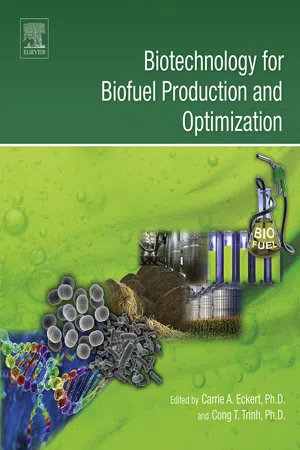
Biotechnology for Biofuel Production and Optimization
About this book
Biotechnology for Biofuel Production and Optimization is the compilation of current research findings that cover the entire process of biofuels production from manipulation of genes and pathways to organisms and renewable feedstocks for efficient biofuel production as well as different cultivation techniques and process scale-up considerations. This book captures recent breakthroughs in the interdisciplinary areas of systems and synthetic biology, metabolic engineering, and bioprocess engineering for renewable, cleaner sources of energy.
- Describes state-of-the-art engineering of metabolic pathways for the production of a variety of fuel molecules
- Discusses recent advances in synthetic biology and metabolic engineering for rational design, construction, evaluation of novel pathways and cell chassis
- Covers genome engineering technologies to address complex biofuel-tolerant phenotypes for enhanced biofuel production in engineered chassis
- Presents the use of novel microorganisms and expanded substrate utilization strategies for production of targeted fuel molecules
- Explores biohybrid methods for harvesting bioenergy
- Discusses bioreactor design and optimization of scale-up
Trusted by 375,005 students
Access to over 1.5 million titles for a fair monthly price.
Study more efficiently using our study tools.
Information
Chapter 1
Engineering Central Metabolism for Production of Higher Alcohol-based Biofuels
C.M. Immethun*; W.R. Henson*; X. Wang†; D.R. Nielsen‡; T.S. Moon* * Department of Energy, Environmental and Chemical Engineering, Washington University, Saint Louis, Missouri, USA
† School of Life Sciences, Arizona State University, Tempe, Arizona, USA
‡ Chemical Engineering, School for Engineering of Matter, Transport, and Energy, Arizona State University, Tempe, Arizona, USA
† School of Life Sciences, Arizona State University, Tempe, Arizona, USA
‡ Chemical Engineering, School for Engineering of Matter, Transport, and Energy, Arizona State University, Tempe, Arizona, USA
Abstract
Widespread concerns have been raised regarding the need to develop sustainable processes for the production of fuels from renewable resources. While bioethanol production processes have been studied and successfully developed at industrial scales, its inferior fuel properties (e.g., lower energy density and higher hygroscopicity) relative to higher chain alcohols have directed recent interest towards producing C3-C10 alcohols, a more challenging prospect than bioethanol production. Metabolic engineering enabled by systems biology and synthetic biology is an enabling technology in such efforts, and many research examples show great promise for addressing current issues, including engineering enzymes and pathway flux, enhancing cofactor and precursor availability, and improving hosts’ tolerance to toxic biofuel products. In this chapter, we discuss the challenges and research efforts towards engineering microbes for optimized production of alcohol-based biofuels, with an emphasis on C3-C10 alcohols produced via central metabolism. Section 1.1 begins with a general introduction and compares relevant properties of different fuels. Section 1.2 discusses two categories of alcohol-producing pathways in detail, including both fermentative (i.e., acetone-butanol-ethanol pathway called the ABE pathway) and non-fermentative (i.e., Ehrlich pathway linked with amino acid metabolism; and reverse β-oxidation pathway). In Section 1.3, engineering strategies to improve higher alcohol production are reviewed, which include (1) enhancing the function of enzymes and pathways as well as cofactor and precursor availability, and (2) addressing product toxicity. Section 1.4 covers successes and challenges towards commercialization of higher alcohol-based biofuels, giving some examples of successful commercialization and current issues and topics such as product separation, host choice, and alternative feedstocks. Section 1.5 concludes this chapter with an outlook on the future of higher alcohol biofuel production.
Keywords
Higher chain alcohol
Central metabolism
Metabolic engineering
Synthetic biology
Systems biology
Enzyme engineering
Cofactor availability
Biofuel toxicity
Biofuel commercialization
Alternative feedstock
Acknowledgments
Development of this manuscript was supported by funding from a National Science Foundation Graduate Research Fellowship to Cheryl M. Immethun, an ASU start-up fund to Xuan Wang, the National Science Foundation grants (CBET-1159200 and CBET-1067684) to David R. Nielsen, and the National Science Foundation and the Department of Energy grants (MCB-1331194, CBET-1350498, and DE-SC0012705) to Tae Seok Moon.
1.1 Introduction: Longer Chain Bioalcohols as Gasoline Alternatives
In the United States in 2012, nearly 120 billion gallons of gasoline were consumed for an average of 329 million gallons each day.1 Of this total, 40% of the crude oil used for gasoline production was imported from foreign sources,2 exposing the domestic supply chain and national security to possible disruptions. The combustion of non-renewable petroleum-based fuels also causes harm to the environment, releasing previously entombed carbon to the atmosphere in the form of carbon dioxide, a greenhouse gas, along with other nitrogenous greenhouse gases, particulate matter, and additional organic species (e.g., polyaromatic hydrocarbons).3 As energy consumption continues to soar both domestically and abroad, changes are now emerging in the atmosphere and global climate.4 Sustainable biofuels could provide a solution to many problems that stem from the dependence on petroleum-based fuels.
First generation biofuels utilize agricultural crops as their feedstock, with the most suitable crops being those that thrive in precise geographic settings: for example, corn in the United States, sugarcane in Brazil, palm oil in Malaysia, and rapeseed in Germany. In all cases, however, the limited availability of arable land, water, and other resources spurs a vehement debate over the competition of crop use for food versus fuel. As a result, second generation biofuels, which are produced using lignocellulosic agricultural waste products such as corn stalks, sugarcane bagasse, or the hardy perennial switchgrass, are emerging as more sustainable options. However, these cheap feedstocks require energy intensive pretreatment to separate the sugar polymers (i.e., cellulose and hemicellulose) from the lignin. Cellulose, for example, must then be further depolymerized using cellulases5 and acid hydrolysis6 to render the sugars suitable as fermentation feedstocks. To date, however, these expensive feedstock pretreatment steps are largely responsible for limiting the economic viability of second generation biofuels.7
Ethanol remains the most technologically mature biofuel. Ethanol can be produced by yeast, fermenting the sugars derived from corn or sugar cane at high yield (90%), titer (10-14 w%), and productivity (2.5 g/L/h).8 As a fuel, its high octane number prevents premature detonation (i.e., knocking) that causes engine damage and a loss of fuel economy. However, ethanol suffers from problems that prevent its full adoption by consumers and industry. For instance, its energy density is only two-thirds of that of gasoline (Table 1.1). Furthermore, the hygroscopic nature of ethanol both increases separation costs and can expose engines and other infrastructure (e.g., pipelines) to residual and damaging water.
Table 1.1
Comparison of fuel properties9
| Gasoline | Ethanol | n-Butanol | Isobutanol | |
| Chemical structure | C4 to C12 mixture of hydrocarbons | CH3CH2OH | CH3(CH2)2CH2OH | (CH3)2CHCH2OH |
| Fuel material | Crude oil | Sugars | Sugars | Sugars |
| Energy density (gasoline equivalent) | 100% | 67% | 83% | 83% |
| Blended octane number | 82–92 | 99 | 91 | 98 |

To address the physical and thermodynamic limitations of ethanol, recent interest has been directed towards the microbial production of a series of longer chain alcohols, including the products of both natural and engineered pathways. Researchers are applying the tools and strategies of metabolic engineering to create “cellular factories” suited for the task. Butanol, a four carbon alcohol, can be synthesized in both n- (naturally occurring) and iso- (engineered) forms. Relative to ethanol, both forms possess an energy density much closer to that of gasoline (Table 1.1). This trend furthermore continues as the alkyl chain length increases, with the energy content of n-hexanol reaching 93% of that of gasoline.9 Since longer chain alcohols are less hygroscopic, they are also more easily separated and display greater compatibility with conventional engines and other related infrastructure. Many recent examples illustrate how a range of emerging tools and strategies are being applied to engineer robust microbial production of higher alcohols.
While engineering microbes to produce a compound of interest is not a new topic, the emergence of systems biology and synthetic biology makes the practice of metabolic engineering even more powerful. Equipped w...
Table of contents
- Cover image
- Title page
- Table of Contents
- Copyright
- Contributors
- Preface
- Chapter 1: Engineering Central Metabolism for Production of Higher Alcohol-based Biofuels
- Chapter 2: Secondary Metabolism for Isoprenoid-based Biofuels
- Chapter 3: Metabolic Engineering for Fatty Acid and Biodiesel Production
- Chapter 4: Pathway and Strain Design for Biofuels Production
- Chapter 5: RNA-Based Molecular Sensors for Biosynthetic Pathway Design, Evolution, and Optimization
- Chapter 6: Pathway Assembly and Optimization
- Chapter 7: Design of Dynamic Pathways
- Chapter 8: Applications of Constraint-Based Models for Biochemical Production
- Chapter 9: Biotechnological Strategies for Advanced Biofuel Production: Enhancing Tolerance Phenotypes Through Genome-Scale Modifications
- Chapter 10: Evolutionary Methods for Improving the Production of Biorenewable Fuels and Chemicals
- Chapter 11: Biomass Utilization
- Chapter 12: Ralstonia eutropha H16 as a Platform for the Production of Biofuels, Biodegradable Plastics, and Fine Chemicals from Diverse Carbon Resources
- Chapter 13: Methane Biocatalysis: Selecting the Right Microbe
- Chapter 14: Photosynthetic Platform Strain Selection: Strain Selection Considerations and Large-Scale Production Limitations
- Chapter 15: Interpreting and Designing Microbial Communities for Bioprocess Applications, from Components to Interactions to Emergent Properties
- Chapter 16: Cell-Free Biotechnologies
- Chapter 17: Microbial Electrochemical Cells and Biorefinery Energy Efficiency
- Chapter 18: Photobiohybrid Solar Conversion with Metalloenzymes and Photosynthetic Reaction Centers
- Chapter 19: Scale-Up—Bioreactor Design and Culture Optimization
- Chapter 20: Scale-Up Considerations for Biofuels
- Index
Frequently asked questions
Yes, you can cancel anytime from the Subscription tab in your account settings on the Perlego website. Your subscription will stay active until the end of your current billing period. Learn how to cancel your subscription
No, books cannot be downloaded as external files, such as PDFs, for use outside of Perlego. However, you can download books within the Perlego app for offline reading on mobile or tablet. Learn how to download books offline
Perlego offers two plans: Essential and Complete
- Essential is ideal for learners and professionals who enjoy exploring a wide range of subjects. Access the Essential Library with 800,000+ trusted titles and best-sellers across business, personal growth, and the humanities. Includes unlimited reading time and Standard Read Aloud voice.
- Complete: Perfect for advanced learners and researchers needing full, unrestricted access. Unlock 1.5M+ books across hundreds of subjects, including academic and specialized titles. The Complete Plan also includes advanced features like Premium Read Aloud and Research Assistant.
We are an online textbook subscription service, where you can get access to an entire online library for less than the price of a single book per month. With over 1.5 million books across 990+ topics, we’ve got you covered! Learn about our mission
Look out for the read-aloud symbol on your next book to see if you can listen to it. The read-aloud tool reads text aloud for you, highlighting the text as it is being read. You can pause it, speed it up and slow it down. Learn more about Read Aloud
Yes! You can use the Perlego app on both iOS and Android devices to read anytime, anywhere — even offline. Perfect for commutes or when you’re on the go.
Please note we cannot support devices running on iOS 13 and Android 7 or earlier. Learn more about using the app
Please note we cannot support devices running on iOS 13 and Android 7 or earlier. Learn more about using the app
Yes, you can access Biotechnology for Biofuel Production and Optimization by Carrie A Eckert,Cong T Trinh in PDF and/or ePUB format, as well as other popular books in Biological Sciences & Biotechnology. We have over 1.5 million books available in our catalogue for you to explore.