- 468 pages
- English
- ePUB (mobile friendly)
- Available on iOS & Android
eBook - ePub
The Neurobiology of Schizophrenia
About this book
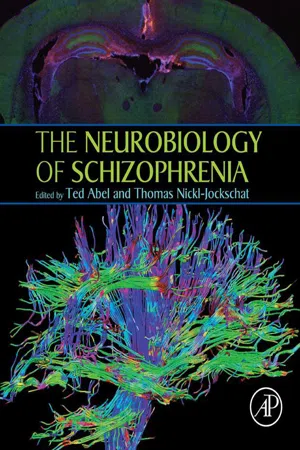
The Neurobiology of Schizophrenia begins with an overview of the various facets and levels of schizophrenia pathophysiology, ranging systematically from its genetic basis over changes in neurochemistry and electrophysiology to a systemic neural circuits level. When possible, the editors point out connections between the various systems. The editors also depict methods and research strategies used in the respective field. The individual backgrounds of the two editors promote a synthesis between basic neuroscience and clinical relevance.
- Provides a comprehensive overview of neurobiological aspects of schizophrenia
- Discusses schizophrenia at behavioral, cognitive, clinical, electrophysiological, molecular, and genetic levels
- Edited by a translational researcher and a psychiatrist to promote synthesis between basic neuroscience and clinical relevance
- Elucidates connections between the various systems depicted, when possible
Trusted by 375,005 students
Access to over 1.5 million titles for a fair monthly price.
Study more efficiently using our study tools.
Information
Part I
Introduction
Outline
Chapter 1
Historical and Clinical Overview
Implications for Schizophrenia Research
T. Nickl-Jockschat1,2 and T. Abel3,4, 1Department of Psychiatry, Psychotherapy and Psychosomatics, RWTH Aachen University, Aachen, Germany, 2Juelich-Aachen Research Alliance–Translational Brain Medicine, Juelich/Aachen, Germany, 3Department of Biology, University of Pennsylvania, Philadelphia, PA, United States, 4Institute for Translational Medicine and Therapeutics, University of Pennsylvania, Philadelphia, PA, United States
Abstract
Schizophrenia is not an etiologically defined disorder, but rather a syndrome. Diagnostic criteria of the two most widely used diagnostic systems, ICD-10 and DSM-V, are based on clinical symptoms and differ between them. Moreover, because of these two distinct classification systems, two patients can be diagnosed with schizophrenia even though they do not share a single symptom at the time of examination. This clinical heterogeneity poses serious challenges for the study of the neurobiological underpinnings of schizophrenia. In this introductory chapter, we briefly review historical definitions of schizophrenia and their influence on current diagnostic criteria. Therapeutic approaches, as well as basic research, have fueled new insight into the pathophysiology of the disorder. We also provide a short overview of the major developments in the history of neurobiological research of schizophrenia. Addressing the clinical heterogeneity found in schizophrenia will be a major challenge for future studies on the disorder.
Keywords
Diagnostic criteria; ICD-10; DSM-V; history of medicine; basic research
Introduction
Schizophrenia is a severe neuropsychiatric disorder that not only causes a high burden of disease but also challenges our understanding of how the mind and brain work. Certainties for healthy subjects (eg, that our thoughts or our actions are controlled by ourselves) are shattered for the schizophrenia patient. Consequently, a better understanding of the neurobiology of this disorder not only might help to identify better strategies for early diagnosis, therapy, and personalized medicine but also may answer some open questions about the biological correlates of our mind and consciousness.
Schizophrenia is defined as a syndrome. The diagnosis is based on a constellation of clinical symptoms and not on a common pathomechanism, as is the case for ischemic stroke or cardiac infarction. The two most widely used diagnostic systems, ICD-10 (International Statistical Classification of Diseases and Related Health Problems, WHO, 2010) and DSM-V (Diagnostic and Statistical Manual of Mental Disorders, American Psychiatric Association, 2013), both provide a catalog of symptoms and demand that a certain number of this pool must to be present over a given period of time for a diagnosis to be made (Table 1.1). It should be noted that because of these two classification systems, two patients can be diagnosed with schizophrenia even though they do not share a single symptom at the time of examination. According to DSM-V, a patient presenting with delusions and hallucinations can be diagnosed with schizophrenia, as can a patient presenting with disorganized speech and negative symptoms. Although both hypothetical patients arguably differ in their clinical presentations, they are both given the same diagnosis. In other words, schizophrenia can manifest with totally different clinical phenotypes.
Table 1.1
Diagnostic Criteria for Schizophrenia According to DSM-V and ICD-10
| DSM-V | ICD-10 |
Two (or more) of the following, each present for a significant portion of time during a 1-month period (or less if successfully treated) At least one of these should include 1–3 | Either at least one of the syndromes, symptoms, and signs listed as 1–4 or at least two of the symptoms and signs listed as 5–8 should be present for most of the time during an episode of psychotic illness lasting for at least 1 month (or at some time during most of the days). |
1. Delusions | 1. Thought echo, thought insertion or withdrawal, or thought broadcasting |
2. Hallucinations | 2. Delusions of control, influence, or passivity, clearly referred to body or limb movements or specific thoughts, actions, or sensations; delusional perception |
3. Disorganized speech | 3. Hallucinatory voices giving a running commentary on the patient’s behavior or discussing him between themselves, or other types of hallucinatory voices coming from some part of the body |
4. Grossly disorganized or catatonic behavior | 4. Persistent delusions of other kinds that are culturally inappropriate and completely impossible (eg, being able to control the weather or being in communication with aliens from another world) |
5. Negative symptoms (ie, diminished emotional expression or avolition) | 5. Persistent hallucinations in any modality occurring every day for at least 1 month, accompanied by delusions (which may be fleeting or half-formed), without clear affective content, or accompanied by persistent overvalued ideas |
6. Neologisms, breaks, or interpolations in the train of thought, resulting in incoherence or irrelevant speech | |
7. Catatonic behavior, such as excitement, posturing or waxy flexibility, negativism, mutism, and stupor | |
8. “Negative” symptoms such as marked apathy, paucity of speech, and blunting or incongruity of emotional responses (it must be clear that these are not due to depression or to neuroleptic medication) |

It should be noted that both diagnostic systems require additional tests, mainly to exclude secondary symptom genesis due to a somatic disorder.
It should be clear that this heterogeneity poses significant challenges for the identification of the neurobiological underpinnings of this disorder. If schizophrenia can present with strikingly distinct symptoms in different patients, then distinct pathophysiological mechanisms with specific etiological factors might be subsumed under the broad concept of “schizophrenia” (cf. Tandon et al., 2013). Consequently, the identification of causal factors might be severely hampered due to this heterogeneity.
To understand the current definition of schizophrenia, it seems inevitable that we must look back at its historical roots. The diagnosis criteria in both ICD-10 and DSM-V are the result of clinical and scientific developments spanning several decades and are founded on descriptions that were published in the first half of the twentieth century. Thus, when speaking of schizophrenia today, we do not refer to an etiologically defined disease but rather to a syndrome with a history of its own.
Here, we briefly summarize the developments that influenced the definitions of this disorder. We point out that we do not claim completeness with regard to medical history; rather, we aim to exemplify the importance—and the inherent challenges—that these definitions pose for current research into the neurobiological basis of schizophrenia.
A Brief History of the Definition of Schizophrenia
Since the beginning of psychiatry as a medical discipline, the syndrome called “schizophrenia” has been a major challenge for clinicians and scientists. Although schizophrenia-like symptoms have been reported by physicians of ancient Greece, we start our brief history of schizophrenia with the work of the German psychiatrist Wilhelm Griesinger (1817–68) (Fig. 1.1). Griesinger’s ideas were influential on a scientific level and a clinical level. In general, he demanded that clinical psychiatry should be based on empirical research rather than speculation, and he highlighted the need for neurobiological (specifically, neuroanatomical) studies. Given his predecessors who stemmed from psychiatry in the era of German Romanticism and, accordingly, emphasized the importance of individual passions and irrational impulses for psychopathology, this concept appeared revolutionary (Hoff and Theodoridou, 2008). The famous phrase attributed to Griesinger that “mental illnesses are illnesses of the brain (“Geisteskrankheiten sind Gehirnkrankheiten”)” is certainly an abbreviation and simplification of his ideas, but this phrase underlines his passionate attempt to further neurobiological research in psychiatry. With regard to schizophrenia, Griesinger formulated the concept of the “unitary psychosis” (Einheitspsycho...
Table of contents
- Cover image
- Title page
- Table of Contents
- Copyright
- List of Contributors
- Acknowledgments
- Part I: Introduction
- Part II: The Genetic and Epigenetic Basis of Schizophrenia
- Part III: The Neurochemical Basis of Schizophrenia
- Part IV: The Biochemical Basis of Schizophrenia
- Part V: The Electro-physiological Basis of Schizophrenia
- Part VI: The Structure and Function of Neural Circuits in Schizophrenia
- Part VII: Modeling Schizophrenia in Animals
- Author Index
- Subject Index
Frequently asked questions
Yes, you can cancel anytime from the Subscription tab in your account settings on the Perlego website. Your subscription will stay active until the end of your current billing period. Learn how to cancel your subscription
No, books cannot be downloaded as external files, such as PDFs, for use outside of Perlego. However, you can download books within the Perlego app for offline reading on mobile or tablet. Learn how to download books offline
Perlego offers two plans: Essential and Complete
- Essential is ideal for learners and professionals who enjoy exploring a wide range of subjects. Access the Essential Library with 800,000+ trusted titles and best-sellers across business, personal growth, and the humanities. Includes unlimited reading time and Standard Read Aloud voice.
- Complete: Perfect for advanced learners and researchers needing full, unrestricted access. Unlock 1.5M+ books across hundreds of subjects, including academic and specialized titles. The Complete Plan also includes advanced features like Premium Read Aloud and Research Assistant.
We are an online textbook subscription service, where you can get access to an entire online library for less than the price of a single book per month. With over 1.5 million books across 990+ topics, we’ve got you covered! Learn about our mission
Look out for the read-aloud symbol on your next book to see if you can listen to it. The read-aloud tool reads text aloud for you, highlighting the text as it is being read. You can pause it, speed it up and slow it down. Learn more about Read Aloud
Yes! You can use the Perlego app on both iOS and Android devices to read anytime, anywhere — even offline. Perfect for commutes or when you’re on the go.
Please note we cannot support devices running on iOS 13 and Android 7 or earlier. Learn more about using the app
Please note we cannot support devices running on iOS 13 and Android 7 or earlier. Learn more about using the app
Yes, you can access The Neurobiology of Schizophrenia by Ted Abel,Thomas Nickl-Jockschat in PDF and/or ePUB format, as well as other popular books in Psychology & Neurology. We have over 1.5 million books available in our catalogue for you to explore.