eBook - ePub
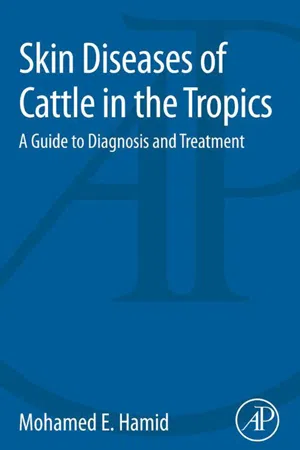
Skin Diseases of Cattle in the Tropics
A Guide to Diagnosis and Treatment
- 98 pages
- English
- ePUB (mobile friendly)
- Available on iOS & Android
eBook - ePub
About this book
Skin Diseases of Cattle in the Tropics: A Guide to Diagnosis and Treatment is a clinical and practical guide to help animal scientists, field veterinarians, veterinary students, and technicians make appropriate and differential diagnoses. It features quizzes of clinical cases, along with multiple images of characteristic lesions and laboratory findings of major skin diseases (and diseases with skin manifestations) that are prevalent in tropical areas, notably the Sub-Saharan African countries.
This self-learning and easy-to-use instructional guide, a unique offering in the field of animal science and veterinary medicine, provides essential and foundational information about relevant skin conditions that are followed by illustrated flow charts of laboratory diagnoses and summaries of respective diseases.
This title makes the subject accessible for practicing veterinarians and animal scientists, and is particularly useful for those who have neither seen nor had the chance to see these diseases in the field or clinics. Such diseases are important not only in the tropics, but may be encountered in many countries in subtropical and temperate zones.
- Features more than 100 images of lesions and laboratory findings of major skin diseases and diseases with skin manifestations that are prevalent in tropical areas
- Includes clinical-case quizzes for self-directed learning
- Covers laboratory diagnosis, clinical presentations, and the summary of all important facts about the disease, including their etiology
Trusted by 375,005 students
Access to over 1.5 million titles for a fair monthly price.
Study more efficiently using our study tools.
Information
Topic
MedicinePart 1
Clinical Presentations, Laboratory Diagnosis and Disease Summaries
Outline
Clinical Quiz No. 1
Abstract
Dermatophilosis (Streptothricosis) is an acute or chronic bacterial infection of the epidermis affecting animals and human. It is characterized by an exudative dermatitis with heavy scab formation and causes significant economic loss especially in cattle in tropical areas. Etiology: Dermatophilus congolensis, a gram-positive facultative anaerobic actinomycete bacterium which is spread by contact with infected animals, via contaminated environmental objects, and probably ticks. The disease is diagnosed by demonstrating branching gram-positive filaments in scabs; or isolating the organism in blood agar containing selective antibiotics and increased carbon dioxide tension. The disease is treated by topical (sulfur lime) or systemic antibiotics (gentamycin or penicillin G or tetracycline) and prevention can be achieved by managing ectoparasites and isolating or culling of infected animals.
Keywords
Dermatophilosis; streptothricosis; dermatitis; scab; Dermatophilus congolensis; actinomycete bacterium
What is your diagnosis?

Laboratory Diagnosis
Specimen
• Scabs (crusts, scales)
• Impression smears of the underneath lesions or biopsy.
Laboratory Tests and Findings
1. Direct detection by microscopic examination (Giemsa or gram stain—see Appendix for details of methods):

2. Culture
a. Fresh uncontaminated scabs or scab emulsions are streaked out directly onto culture media.
b. Blood agar containing 1000 units/mL of polymyxin B is an effective way to prevent overgrowth by contaminants. Plates are incubated at 37°C under 10% CO2 for 2–5 days.

3. Indirect microscopic examination of grown culture (gram stain):

Diagnosis: Dermatophilosis (Streptothricosis, Rain Scald)
Answer and Disease Summary
Etiology
Dermatophilus congolensis
• A gram-positive facultative anaerobic actinomycete bacterium.
• It has two morphologic forms:
• Filamentous hyphae (tramcar line-like) and
• Motile zoospores.
• It grows on sheep-blood enriched agarose media when incubated at 37°C, under a 5–10% CO2 for 2–4 days as small hemolytic gray-yellow colonies.
• Colonies become rough golden with age to enable isolation of the organism from a contaminated source, antifungal (nystatin) and antibacte...
Table of contents
- Cover image
- Title page
- Table of Contents
- Copyright
- Introduction
- Part 1: Clinical Presentations, Laboratory Diagnosis and Disease Summaries
- Appendix
- Further Reading
- Index
Frequently asked questions
Yes, you can cancel anytime from the Subscription tab in your account settings on the Perlego website. Your subscription will stay active until the end of your current billing period. Learn how to cancel your subscription
No, books cannot be downloaded as external files, such as PDFs, for use outside of Perlego. However, you can download books within the Perlego app for offline reading on mobile or tablet. Learn how to download books offline
Perlego offers two plans: Essential and Complete
- Essential is ideal for learners and professionals who enjoy exploring a wide range of subjects. Access the Essential Library with 800,000+ trusted titles and best-sellers across business, personal growth, and the humanities. Includes unlimited reading time and Standard Read Aloud voice.
- Complete: Perfect for advanced learners and researchers needing full, unrestricted access. Unlock 1.5M+ books across hundreds of subjects, including academic and specialized titles. The Complete Plan also includes advanced features like Premium Read Aloud and Research Assistant.
We are an online textbook subscription service, where you can get access to an entire online library for less than the price of a single book per month. With over 1.5 million books across 990+ topics, we’ve got you covered! Learn about our mission
Look out for the read-aloud symbol on your next book to see if you can listen to it. The read-aloud tool reads text aloud for you, highlighting the text as it is being read. You can pause it, speed it up and slow it down. Learn more about Read Aloud
Yes! You can use the Perlego app on both iOS and Android devices to read anytime, anywhere — even offline. Perfect for commutes or when you’re on the go.
Please note we cannot support devices running on iOS 13 and Android 7 or earlier. Learn more about using the app
Please note we cannot support devices running on iOS 13 and Android 7 or earlier. Learn more about using the app
Yes, you can access Skin Diseases of Cattle in the Tropics by Mohamed Elamin Hamid in PDF and/or ePUB format, as well as other popular books in Medicine & Medical Microbiology & Parasitology. We have over 1.5 million books available in our catalogue for you to explore.