- 394 pages
- English
- ePUB (mobile friendly)
- Available on iOS & Android
eBook - ePub
About this book
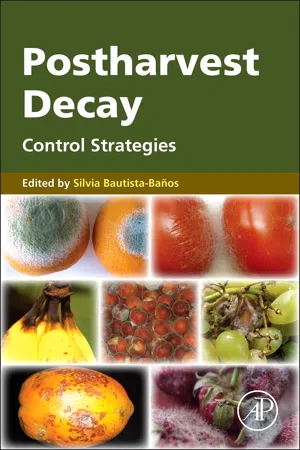
Written by a diverse group of research professionals, Postharvest Decay: Control Strategies is aimed at a wide audience, including researchers involved in the study of postharvest handling of agricultural commodities, and undergraduate and graduate students researching postharvest topics. Growers, managers, and operators working at packinghouses and storage, retail, and wholesale facilities can also benefit from this book. The information in this book covers a wide range of topics related to selected fungi, such as taxonomy, infection processes, economic importance, causes of infection, the influence of pre-harvest agronomic practices and the environment, the effect of handling operations, and the strategic controls for each host-pathogen, including traditional and non-traditional alternatives.
- Includes eleven postharvest fungi causing serious rots in numerous fruits and vegetables
- Offers selected microorganisms including pathogens of commercially important tropical, subtropical and temperate crops worldwide, such as tomatoes, pears, apples, peaches, citrus, banana, papaya, and mango, among others
- Presents content developed by recognized and experienced high-level scientists, working in the postharvest pathology area worldwide
- Provides basic information about each fungus, pre- and postharvest factors that contribute to infection and control measurements, including the use of chemicals and non-traditional methods
Information
Chapter 1
Rhizopus stolonifer (Soft Rot)
, , and 1Centro de Desarrollo de Productos Bióticos, Instituto Politécnico Nacional Carretera Yautepec-Jojutla km. 8.5, Col. San Isidro, Yautepec Morelos, Mexico 2Universidad Autónoma Metropolitana-Iztapalapa, Col. Vicentina, Mexico
Abstract
Rhizopus stolonifer is considered the most important species in the genus Rhizopus. Disease symptoms that characterize R. stolonifer infection are watery areas quickly covered by coarse, gray hairy mycelia forming a mass of black sporangia at their tips. Infection usually occurs during harvest and handling. Due to the wide array of hosts that R. stolonifer can infect and its fast penetration and colonization, it has become an important target to control. Overall, R. stolonifer is controlled using synthetic fungicides; among the various registered fungicides are thiabendazole, benomyl, imazalil, propiconazole and thiocarbamates. The fungicides fluodioxonyl, tebuconazole, fenhexamide and azoxystrobin have also achieved notable control of this fungus. Sanitizers like chlorine, sodium hypochlorite, calcium hypochlorite, ozone and peracetic acid have shown to have good control on Rhizopus. Of the various non-conventional methods under experimentation, antagonists have attracted considerable attention. Bacteria including Pantoe agglomerans, Enterobacter cloacae, Pseudomonas syringae, and Bacillus spp., as well as yeasts of the genera Pichia, Kloeckera, Candida, Cryptoccoccus, Metschnikowia and Acremonium, have exerted a significant control on this fungus. Aqueous plant extracts belonging to the botanical families Amaryllidaceae, Annonaceae, Arecaceae, Bromeliaceae, Caricaceae, Lamiaceae, Lauraceae, Leguminosae, Meliacea, Myrtaceae, Pinaceae, Sapotaceae, Solanaceae and Urticaceae, along with the essential oils of the genera Thymus, Cinnamom, Origanum and Citrus, have also produced excellent results under experimentation. UVC irradiation levels of up to 3.6 kJm2 showed levels of control up to 50% on R. stolonifer. Chitosan, a widely known chitin derivative, alone or in combination with other natural products, has been able to reduce significantly Rhizopus soft rot on various horticultural commodities at various concentrations. Volatiles, hypobaric atmospheres, salts, minerals, plant phenolics, hot water, wax and salicylic acid have resulted in good control methods with promising applications.
Keywords
black mold; rhizopus rot; postharvest control; non-conventional methodsOverall Importance of the Fungus
Rhizopus stolonifer is one of the most common and fastest-growing species in the Zygomycota phylum. Disease caused by this fungus is known as soft rot, black mold and Rhizopus rot. It often grows within a few days in moist and humid conditions because its spores are quite common in the air. Rhizopus stolonifer is an important postharvest pathogen th...
Table of contents
- Cover image
- Title page
- Table of Contents
- Copyright
- Preface
- List of Contributors
- Chapter 1. Rhizopus stolonifer (Soft Rot)
- Chapter 2. Penicillium digitatum, Penicillium italicum (Green Mold, Blue Mold)
- Chapter 3. Crown Rot Disease of Bananas
- Chapter 4. Botrytis cinerea (Gray Mold)
- Chapter 5. Alternaria alternata (Black Rot, Black Spot)
- Chapter 6. Penicillium expansum (Blue Mold)
- Chapter 7. Monilinia fructicola, Monilinia laxa (Monilinia Rot, Brown Rot)
- Chapter 8. Aspergillus spp. (Black Mold)
- Chapter 9. Thielaviopsis paradoxa, Thielaviopsis basicola (Black Rot, Black Root Rot)
- Chapter 10. Lasiodiplodia theobromae in Citrus Fruit (Diplodia Stem-End Rot)
- Chapter 11. Colletotrichum gloeosporioides (Anthracnose)
- Index
Trusted by 375,005 students
Access to over 1.5 million titles for a fair monthly price.
Study more efficiently using our study tools.
Frequently asked questions
Yes, you can cancel anytime from the Subscription tab in your account settings on the Perlego website. Your subscription will stay active until the end of your current billing period. Learn how to cancel your subscription
No, books cannot be downloaded as external files, such as PDFs, for use outside of Perlego. However, you can download books within the Perlego app for offline reading on mobile or tablet. Learn how to download books offline
Perlego offers two plans: Essential and Complete
- Essential is ideal for learners and professionals who enjoy exploring a wide range of subjects. Access the Essential Library with 800,000+ trusted titles and best-sellers across business, personal growth, and the humanities. Includes unlimited reading time and Standard Read Aloud voice.
- Complete: Perfect for advanced learners and researchers needing full, unrestricted access. Unlock 1.5M+ books across hundreds of subjects, including academic and specialized titles. The Complete Plan also includes advanced features like Premium Read Aloud and Research Assistant.
We are an online textbook subscription service, where you can get access to an entire online library for less than the price of a single book per month. With over 1.5 million books across 990+ topics, we’ve got you covered! Learn about our mission
Look out for the read-aloud symbol on your next book to see if you can listen to it. The read-aloud tool reads text aloud for you, highlighting the text as it is being read. You can pause it, speed it up and slow it down. Learn more about Read Aloud
Yes! You can use the Perlego app on both iOS and Android devices to read anytime, anywhere — even offline. Perfect for commutes or when you’re on the go.
Please note we cannot support devices running on iOS 13 and Android 7 or earlier. Learn more about using the app
Please note we cannot support devices running on iOS 13 and Android 7 or earlier. Learn more about using the app
Yes, you can access Postharvest Decay by Silvia Bautista-Baños in PDF and/or ePUB format, as well as other popular books in Technology & Engineering & Food Science. We have over 1.5 million books available in our catalogue for you to explore.