- 442 pages
- English
- ePUB (mobile friendly)
- Available on iOS & Android
eBook - ePub
Handbook of Low Carbon Concrete
About this book
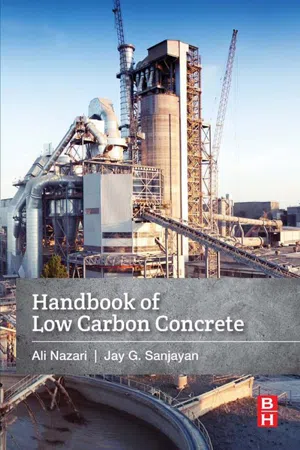
Handbook of Low Carbon Concrete brings together the latest breakthroughs in the design, production, and application of low carbon concrete. In this handbook, the editors and contributors have paid extra attention to the emissions generated by coarse aggregates, emissions due to fine aggregates, and emissions due to cement, fly ash, GGBFS, and admixtures.
In addition, the book provides expert coverage on emissions due to concrete batching, transport and placement, and emissions generated by typical commercially produced concretes.
- Includes the tools and methods for reducing the emissions of greenhouse gases
- Explores technologies, such as carbon capture, storage, and substitute cements
- Provides essential data that helps determine the unique factors involved in designing large, new green cement plants
Trusted by 375,005 students
Access to over 1.5 million titles for a fair monthly price.
Study more efficiently using our study tools.
Information
Chapter 1
Greenhouse Gas Emissions Due to Concrete Manufacture
D.J.M. Flower1 and J.G. Sanjayan2, 1Swinburne University of Technology, Melbourne, Australia, 2Swinburne University of Technology, Hawthorn, VIC, Australia
Abstract
The issues of environmental impacts of concrete have become important since many major infrastructure owners are now requiring environmentally sustainable design (ESD). The carbon dioxide (CO2) emissions are often used as a rating tool to compare the environmental impact of different construction materials in ESD. Currently, the designers are forced to make estimates of CO2 emissions for concrete in ESD based on conjecture rather than data. The aim of this study was to provide hard data collected from a number of quarries and concrete manufacturing plants so that accurate estimates can be made for concretes in ESD
This chapter presents the results of a research project aimed to quantify the CO2 emissions associated with the manufacture and placement of concrete. The life cycle inventory data was collected from two coarse aggregates quarries, one fine aggregates quarry, six concrete-batching plants and several other sources. The results are presented in terms of equivalent CO2 emissions. The potential of fly ash and ground granulated blast furnace slag (GGBFS) to reduce the emissions due to concrete was investigated. A case study of a building is also presented.
Portland cement was found to be the primary source of CO2 emissions generated by typical commercially produced concrete mixes, being responsible for 74–81% of total CO2 emissions. The next major source of CO2 emissions in concrete was found to be coarse aggregates, being responsible for 13–20% of total CO2 emissions. The majority contribution of CO2 emissions in coarse aggregates production was found to come from electricity, typically about 80%. Blasting, excavation, hauling, and transport comprise less than 25%. While the explosives had very high emission factors per unit mass, they contribute very small amounts (<0.25%) to coarse aggregate production, since only small quantities are used. Production of a ton of fine aggregates was found to generate 30–40% of the emissions generated by the production of a ton of coarse aggregates. Fine aggregates generate less equivalent CO2 since they are only graded, not crushed. Diesel and electricity were found to contribute almost equally to the CO2 emissions due to fine aggregates production. Emission contributions due to admixtures were found to be negligible. Concrete-batching, transport, and placement activities were all found to contribute very small amounts of CO2 to total concrete emissions.
The CO2 emissions generated by typical normal strength concrete mixes using Portland cement as the only binder were found to range between 0.29 and 0.32 t CO2-e/m3. GGBFS was found to be capable of reducing concrete CO2 emissions by 22% in typical concrete mixes. Fly ash was found to be capable of reducing concrete CO2 emissions by 13–15% in typical concrete mixes.
The results presented are based on typical concrete manufacturing and placement methods in Australia. The data presented in this chapter can be utilized to compare greenhouse gas emissions due to concrete with those associated with alternative construction materials.
The various rating schemes used to compare alternative construction materials should use models such as the one presented in this chapter, based on hard data so that reliable comparisons can be made. A case study is presented in this chapter demonstrating how the results may be utilized.
Keywords
Carbon dioxide emissions; Portland cement; fly ash; granulated blast furnace slag; concrete; life cycle assessment
1.1 Introduction
Concrete is the most widely used construction material. Current average consumption of concrete is about 1 t/year per every living human being. Human beings do not consume any other material in such tremendous quantities except for water. Due to its large consumption, even small reductions of greenhouse gas emissions per ton of manufactured concrete can make a significant global impact. This chapter presents a systematic approach to estimate carbon dioxide (CO2) emissions due to the various components of concrete manufacture. Reliable estimates of greenhouse gas emission footprints of various construction materials are becoming important, because of the environmental awareness of the users of construction material. Life cycle assessment of competing construction materials (e.g., steel and concrete) [1] can be conducted before the type of material is chosen for a particular construction. This chapter provides greenhouse gas emissions data collected from typical concrete manufacturing plants for this purpose.
The basic constituents of concrete are cement, water, coarse aggregates, and fine aggregates. Extraction of aggregates has considerable land use implications [2]. However, the major contributor of greenhouse emissions in the manufacture of concrete is Portland cement. It has been reported that the cement industry is responsible for 5% of global anthropogenic CO2 emissions [3]. As a result, emissions due to Portland cement have often become the focus when assessing the greenhouse gas emissions of concrete. However, as demonstrated by the data presented in this chapter, there are also other components of concrete manufacture that are responsible for greenhouse gas emissions that need consideration. With users beginning to require detailed estimates of the environmental impacts of the materials in new construction projects, this study was intended to provide the basis for a rating tool for concrete, based on CO2 emissions.
Other cementitious components considered include ground granulated blast furnace slag (GGBFS), a byproduct of the steel industry, and fly ash, a byproduct of burning coal. These two materials are generally used to replace a portion of the cement in a concrete mix. The use of water in concrete leads to minimal CO2 emissions, which leaves cement, coarse and fine aggregates, GGBFS, and fly ash as the main material contributors to the environmental impacts of concrete. In addition to the production of materials, the processing components of concrete production and placement were considered. Transport, mixing, and in situ placement of concrete all require energy input leading to CO2 emissions. Fig. 1.1 shows the system that was considered for this research.

The CO2 emissions from most of the activities involved in concrete production and placement result from the energy consumed to accomplish them. Hence, to find the CO2 emissio...
Table of contents
- Cover image
- Title page
- Table of Contents
- Copyright
- List of Contributors
- Preface
- Chapter 1. Greenhouse Gas Emissions Due to Concrete Manufacture
- Chapter 2. Life Cycle CO2 Evaluation on Reinforced Concrete Structures With High-Strength Concrete
- Chapter 3. Assessment of CO2 Emissions Reduction in High-Rise Concrete Office Buildings Using Different Material-Use Options
- Chapter 4. Eco-Friendly Concretes With Reduced Water and Cement Content: Mix Design Principles and Experimental Tests
- Chapter 5. Effect of Supplementary Cementitious Materials on Reduction of CO2 Emissions From Concrete
- Chapter 6. Binder and Carbon Dioxide Intensity Indexes as a Useful Tool to Estimate the Ecological Influence of Type and Maximum Aggregate Size on Some High-Strength Concrete Properties
- Chapter 7. CO2 Reduction Assessment of Alkali-Activated Concrete Based on Korean Life-Cycle Inventory Database
- Chapter 8. Introducing Bayer Liquor–Derived Geopolymers
- Chapter 9. Alkali-Activated Cement-Based Binders (AACBs) as Durable and Cost-Competitive Low-CO2 Binder Materials: Some Shortcomings That Need to be Addressed
- Chapter 10. Progress in the Adoption of Geopolymer Cement
- Chapter 11. An Overview on the Influence of Various Factors on the Properties of Geopolymer Concrete Derived From Industrial Byproducts
- Chapter 12. Performance on an Alkali-Activated Cement-Based Binder (AACB) for Coating of an OPC Infrastructure Exposed to Chemical Attack: A Case Study
- Chapter 13. Alkali-Activated Cement (AAC) From Fly Ash and High-Magnesium Nickel Slag
- Chapter 14. Bond Between Steel Reinforcement and Geopolymer Concrete
- Chapter 15. Boroaluminosilicate Geopolymers: Current Development and Future Potentials
- Index
Frequently asked questions
Yes, you can cancel anytime from the Subscription tab in your account settings on the Perlego website. Your subscription will stay active until the end of your current billing period. Learn how to cancel your subscription
No, books cannot be downloaded as external files, such as PDFs, for use outside of Perlego. However, you can download books within the Perlego app for offline reading on mobile or tablet. Learn how to download books offline
Perlego offers two plans: Essential and Complete
- Essential is ideal for learners and professionals who enjoy exploring a wide range of subjects. Access the Essential Library with 800,000+ trusted titles and best-sellers across business, personal growth, and the humanities. Includes unlimited reading time and Standard Read Aloud voice.
- Complete: Perfect for advanced learners and researchers needing full, unrestricted access. Unlock 1.5M+ books across hundreds of subjects, including academic and specialized titles. The Complete Plan also includes advanced features like Premium Read Aloud and Research Assistant.
We are an online textbook subscription service, where you can get access to an entire online library for less than the price of a single book per month. With over 1.5 million books across 990+ topics, we’ve got you covered! Learn about our mission
Look out for the read-aloud symbol on your next book to see if you can listen to it. The read-aloud tool reads text aloud for you, highlighting the text as it is being read. You can pause it, speed it up and slow it down. Learn more about Read Aloud
Yes! You can use the Perlego app on both iOS and Android devices to read anytime, anywhere — even offline. Perfect for commutes or when you’re on the go.
Please note we cannot support devices running on iOS 13 and Android 7 or earlier. Learn more about using the app
Please note we cannot support devices running on iOS 13 and Android 7 or earlier. Learn more about using the app
Yes, you can access Handbook of Low Carbon Concrete by Ali Nazari,Jay G. Sanjayan in PDF and/or ePUB format, as well as other popular books in Technology & Engineering & Sustainability in Architecture. We have over 1.5 million books available in our catalogue for you to explore.