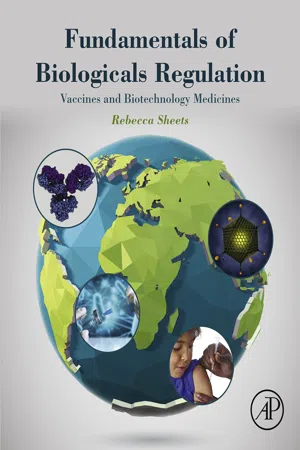
eBook - ePub
Fundamentals of Biologicals Regulation
Vaccines and Biotechnology Medicines
- 450 pages
- English
- ePUB (mobile friendly)
- Available on iOS & Android
eBook - ePub
About this book
Fundamentals of Biologicals Regulation: Vaccines and Biotechnology Medicines serves as an introduction to the international regulatory arena in which biologicals are developed and offers an overview of the processes and insight into the scientific concepts underpinning global regulations. This book will provide multiple levels of readership with guidance on basic concepts, a detailed look at regulatory challenges, and practical insight into how regulators consider regulatory science and regulatory process issues across various regions. With numerous case studies, learning activities, and real-world examples across several classes of biotechnological products, this book is a valuable and comprehensive resource for graduate students, professors, regulatory officials, and industry scientists working with biologicals.
- Provides a broad overview and introduction to the regulatory processes, from product development pathways, through clinical trials and product development stages and beyond
- Includes FDA, EMA, ICH, and WHO recommendations and guidelines so readers can compare and contrast the different regulatory regions with their expectations and understand why they are different
- Contains chapters on some of the exceptions to the process including how biosimilars and in vitro diagnostics are regulated
- Includes numerous case studies, learning activities, and real-world examples across several classes of biotechnological products
Trusted by 375,005 students
Access to over 1.5 million titles for a fair monthly price.
Study more efficiently using our study tools.
Information
Section I
Regulatory Process
Introduction
On the production of antidiphtheria toxin in a horse named Jim, which resulted in 13 deaths from tetanus in 1901:
“This tragedy convinced Congress and the public that producing antitoxin or vaccine was not a simple matter like weighing out the dose of a drug on a scale.”
Dr. Margaret Pittman in “The Regulation of Biological Products, 1902-1970.”
Chapter 1
Introduction to the Regulatory Process for Biologicals
Abstract
The fundamental principles behind why and how medicinal products are regulated worldwide is introduced in this chapter. How biologicals or biologics differ from chemical drugs is described. The processes whereby biologicals are regulated are illuminated by the description of relevant legislative milestones in the history of the U.S. FDA, including the Biologics Control Act, Food and Drug Act, Public Health Service Act, Human Subjects' Protection Regulations, Orphan Drug Act, Prescription Drug User Fee Act (PDUFA), FDA Modernization Act (FDAMA), FDA Amendments Act (FDAAA), Pediatric Research Equity Act (PREA), Best Pharmaceuticals for Children Act (BPCA), FDA Safety and Innovation Act (FDASIA), and FDA Reauthorization Act (FDARA). These legislative acts introduce concepts such as misbranding, adulteration, consistency of manufacture for biologicals, quality controls, and efficacy/effectiveness. The European Medicines Agency has a much shorter history, but relevant aspects are mentioned.
Keywords
Biologics; Biologicals; Biologicals regulation; U.S. FDA milestones in history; IND regulations
1.1 Fundamentals
1.1.1 Introduction to the Text
This text will focus on those biologicals and biotechnology products that are used for medicinal purposes for humans. Biologicals or biologics,1 including those made by biotechnology, are a special category of “drugs” or medicines. They differ from pharmaceutical drugs derived by chemical means in that they are derived biologically by growth of micro-organisms or cells (often mammalian, including human, cells). Most biologicals are large, complex molecules (see Fig. 1.1).

This book will discuss the following kinds of medicinal products. Traditional biologicals include serums, toxins, antitoxins, vaccines, blood,2 and products derived from blood (like plasma-derived Factor VIII or Factor IX). Biotechnology medicinal products can encompass recombinant single protein products (like recombinant Factor VIII, recombinant Factor IX, recombinant interferon, or monoclonal antibodies), gene therapy vectors, cell therapies, subunit or vectored vaccines, in vitro diagnostics, and similar veterinary3 products (particularly vectored vaccines). The term “advanced-therapy medicinal products” (ATMP) is used in Europe to describe some of these biotech products (gene therapies, cell or tissue therapies) and U.S. FDA has taken up this term of Advanced Therapy in lieu of gene therapy recently. Recombinant therapeutic proteins may be formed by a single polypeptide molecule like recombinant insulin, or they may be like recombinant interferons or monoclonal antibodies, made of multiple polypeptides (in the case of the latter, consisting of antibody heavy and light chains). Gene therapy vectors are generally viral, but can be bacterial as well, including DNA plasmids propagated in and purified from bacteria. Various types of RNA may serve as gene therapies too. Cell therapies may be autologous or heterologous and subjected to minimal or considerable manipulation. The latter (considerable manipulation) can entail being engineered with recombinant DNA techniques ex vivo before being returned in vivo. Biotechnology vaccines may be vectored, like gene therapies, or they may be recombinant subunits that have been purified from an engineered cell line, bacteria, or yeast. In Vitro Diagnostics include medical devices like test kits, ELISAs, or tagged antibodies used to diagnose a disease or condition. Veterinary products may be any of these types of products, but are intended to address disease in animals, rather than humans (although protecting animal health often protects human health, but the purpose of the products is for use in animals directly).
Much of the text will focus on the practices and procedures of the U.S. Food and Drug Administration (U.S. FDA) and the European Medicines Agency (EMA). Some consideration will also be given to regulatory practices in developing (low and middle income, LMIC) and other developed countries, and particularly to international standards, such as those recommended by the World Health Organization (WHO) or those agreed upon by the International Council for Harmonisation. These latter two organizations will be the subject of a later Chapter 3. Some examples will come from Health Canada, the Canadian regulatory agency. An exercise in the book will reflect scenarios involving several other regulatory agencies, for which information in English is available on their respective websites. However, the focus will be on the fundamental nature and purposes of the regulatory processes and regulatory science, and in some cases, will be compared and contrasted in order to emphasize these fundamental concepts. Stress will be placed on commonalties, as underscored by general principles. So, while the U.S. FDA or EMA will be used to illustrate the concepts, it is likely that most other National Regulatory Authorities (NRAs) hold the same principles, even if they use different terms or somewhat different procedures.
The U.S. FDA defines a drug as a substance intended for use in the diagnosis, cure, mitigation, treatment, or prevention of disease. Biologicals fall into this definition, although U.S. FDA uses the term “biologics” rather than biologicals. Most other countries term them biologicals. So, technically, biologicals are drugs in U.S. FDA parlance. EMA refers to these products as medicines, rather than as drugs. But, as highlighted earlier, biologics, biologicals, or biotechnological products are very different from chemical drugs. Biologicals are complex and generally large molecules prepared in complex biological systems (generally whole cells).
Consider comparing pharmaceutical drugs to biologicals by comparing a mechanical part being manufactured by a robotic machine to a gourmet chef preparing a meal. Chemical reactions, if you add the right chemicals at the right temperature for the right amount of time in the right proportions and order, will result in the same outcomes consistently. But, like cooking, you and your neighbor can follow the same recipe for a dish and one might come out with something delicious and the other inedible. And it will be difficult to characterize what was the exact difference between the successful dish and the inedible one, other than “taste.” The next time you make the same dish, you might not get the same delicious result you got the first time, because you used slightly different ingredients or sources of ingredients, temperature and time of cooking differed, or the humidity4 in the air was different. The production of biologicals is also susceptible to these problems of inconsistency and difficulty in characterization. This introduces the concepts of the importance of consistency of manufacturing and the importance in characterizing biological products. It also contrasts these concepts against the more readily-characterizable pharmaceutical drugs, i.e., small molecules or small molecular entities (SME).
A mantra of biologicals’ production is “the process is the product; the product is the process.” I like to give the example of several types of dishes made with chicken. All of them are chicken dishes, but what a difference between fried chicken, chicken adobo, and roasted chicken. They taste, smell, and feel (mouth feel) very different from each other. It is difficult to characterize the differences except to use subjective terms to describe what these senses tell the eater. So, with biologicals’ production, how you make the product, the facility5 in which you make it (e.g., like the difference between using an oven, a Dutch oven, and a fryer to cook your chicken), the ingredients you use, and even the order of the processes can make a big difference in the outcome. Thus, the relatively greater emphasis that has been put on the process whereby biologicals are made, in contrast to chemical drugs that can be characterized at the end to determine if the proper product was made. Quality needs to be built into biologicals—it cannot be tested in at the end. This introduces the concept of Quality by Design.
1.1.2 Regulations
Why is regulation of drugs/medicines and biologicals important? Regulations set the expected standards and norms that manufacturers must follow. In a capitalist society, companies are in the business of making money, so you may ask: shouldn’t the free market self-regulate the pharmaceutical and biologicals industries? The answer is no, because with medicines, “buyer beware” can have terrible, deadly consequences even on a large scale. So, standards, often minimal standards, must be met in order to assure that the marketplace does not have such dea...
Table of contents
- Cover image
- Title page
- Table of Contents
- Copyright
- Dedication
- About the Author
- Preface
- Acknowledgments
- How to Obtain Documents From ICH and US
- Section I: Regulatory Process
- Section II: Regulatory Science
- Section III: Product Specific
- Glossary
- International Biologicals Regulation: Vaccines, Biotechnology Medicines By Rebecca L. Sheets Compilation of Weblinks
- Index
Frequently asked questions
Yes, you can cancel anytime from the Subscription tab in your account settings on the Perlego website. Your subscription will stay active until the end of your current billing period. Learn how to cancel your subscription
No, books cannot be downloaded as external files, such as PDFs, for use outside of Perlego. However, you can download books within the Perlego app for offline reading on mobile or tablet. Learn how to download books offline
Perlego offers two plans: Essential and Complete
- Essential is ideal for learners and professionals who enjoy exploring a wide range of subjects. Access the Essential Library with 800,000+ trusted titles and best-sellers across business, personal growth, and the humanities. Includes unlimited reading time and Standard Read Aloud voice.
- Complete: Perfect for advanced learners and researchers needing full, unrestricted access. Unlock 1.5M+ books across hundreds of subjects, including academic and specialized titles. The Complete Plan also includes advanced features like Premium Read Aloud and Research Assistant.
We are an online textbook subscription service, where you can get access to an entire online library for less than the price of a single book per month. With over 1.5 million books across 990+ topics, we’ve got you covered! Learn about our mission
Look out for the read-aloud symbol on your next book to see if you can listen to it. The read-aloud tool reads text aloud for you, highlighting the text as it is being read. You can pause it, speed it up and slow it down. Learn more about Read Aloud
Yes! You can use the Perlego app on both iOS and Android devices to read anytime, anywhere — even offline. Perfect for commutes or when you’re on the go.
Please note we cannot support devices running on iOS 13 and Android 7 or earlier. Learn more about using the app
Please note we cannot support devices running on iOS 13 and Android 7 or earlier. Learn more about using the app
Yes, you can access Fundamentals of Biologicals Regulation by Rebecca Sheets in PDF and/or ePUB format, as well as other popular books in Medicine & Pharmaceutical, Biotechnology & Healthcare Industry. We have over 1.5 million books available in our catalogue for you to explore.