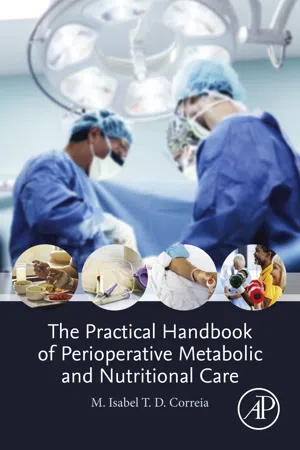
eBook - ePub
The Practical Handbook of Perioperative Metabolic and Nutritional Care
- 338 pages
- English
- ePUB (mobile friendly)
- Available on iOS & Android
eBook - ePub
The Practical Handbook of Perioperative Metabolic and Nutritional Care
About this book
Intended for any healthcare professional working with surgical patients, including medical students, residents, surgeons and internists, nurses, dieticians, pharmacists, and physical therapists, The Practical Handbook of Perioperative Metabolic and Nutritional Care focuses on topics from the history of surgery and metabolism, to organic response to stress. Based on clinical processes, the author explores screening, assessment, and the impact of nutritional status on outcomes, in addition to investigating nutritional requirements, including macronutrients and micronutrients. Chapters examine wound healing as well as metabolic and nutritional surgical preconditioning, including coverage of preoperative counseling, preoperative nutrition, and preoperative fasting. Physical exercise is addressed, as well as nutritional therapy in the form of oral supplements, and enteral and parenteral approaches. Additional topics explored include nutrition therapy complications and immunomodulatory nutrients, pro, pre and symbiotics, postoperative oral, enteral and parenteral nutrition, enteral access, vascular access, fluid therapy, and more. With up-to-date information, practical and cost-effective data, this resource is critical for translating theory to practice.
- Focuses on preoperative metabolic and nutritional preparation for surgery
- Explores processes for intra and postoperatively assessing metabolic and nutritional state to ensure patient progress
- Contains content based on clinical process
Trusted by 375,005 students
Access to over 1.5 million titles for a fair monthly price.
Study more efficiently using our study tools.
Information
1
History of surgery, metabolism, and nutrition therapy
Abstract
Surgery is one of the oldest medical specialties and has through times experienced peculiar/distinct changes, which have impacted patients' outcomes. It is important to be aware of the different phases and how patient care has benefited from essential improvements. According to Rutkow, understanding of surgical history is a way of maturing and continuing the education of surgeons. He also defends that the heuristic value of history is essential to add adjunctive humanistic, literary, and philosophic tastes.
Keywords
Future; History; Metabolism; Nutrition; Surgery
Common questions routinely asked in everyday practice
- 1. Why should I learn about the history of surgery, metabolism, and nutrition therapy?
- 2. How does the history impact patient care?
Response/Introduction
Surgery is one of the oldest medical specialties and has through times experienced peculiar/distinct changes, which have impacted patients’ outcomes. It is important to be aware of the different phases and how patient care has benefited from essential improvements. According to Rutkow [1], understanding of surgical history is a way of maturing and continuing the education of surgeons. He also defends that the heuristic value of history is essential to add adjunctive humanistic, literary, and philosophic tastes.
Initially, surgery was technique oriented, and surgeons performed their acts without worrying about the four big killers of surgery—infection, bleeding, unsafe anesthesia, and the unexpected. As time moved by, it became clear that other aspects, such as metabolism, nutrition, and quality control, were as important as the surgical technique in helping achieve better outcomes. Therefore, the ability to provide adequate surgical care will be enhanced by acknowledging the relevancy history plays in the development of this discipline and, so…here, we go!
The history of surgery
The beginning
The first surgical procedures such as cranial trepanation for relief of cerebral hypertension were performed about 8,000 years before Christ. The Egyptians registered, in papyri in the year 3,000 BC, the use of surgical procedures for diseases of the shoulders, chest, and back, in addition to circumcision, excision of the clitoris, castration, removal of bladder lithiasis, and limb amputation. Operations for the treatment of fractures and complex wounds are also attributed to the Egyptians who used various utensils that are still in use to this day, including knives, scissors, saws, clamps, syringes, needles and dressings. In India, around 2,000 BC, the Hindus also operated on individuals with fractures, bladder stones, and tonsillitis (Fig. 1.1). The accomplishment of the first plastic operations performed for the correction of the nose and ear amputations of criminals who, as punishment, were victims of these acts are also attributed to the Indians [2].

Available at: http://ispub.com/IJPS/4/2/8232.
Hippocrates, the father of Medicine, published, in the 4th century BC, the description of several surgical procedures for the treatment of cranial fractures and injuries. He emphasized the importance of the proper positioning of the surgeons’ hands for the adequate accomplishment of these acts. Surgeons of those times were considered outstanding physicians for the operations they were able to perform, independently of the outcomes, which were marred by the lack of knowledge, the absence of anesthesia, and the adequate infectious control.
The middle ages and up to the 19th century
Surgical practice went into decay between the 5th and the early 14th century and was considered as low-level Medicine. At the time, it was carried out by barbers who traveled from city to city. It was common for them, while cutting hair, to also remove tumors, extract teeth, suture wounds, and perform exsanguination. The importance of the barbers in this activity was so relevant that the striped stick symbol, red and white, found until today in many barbershops, comes from the surgical practice performed by them. Red meant blood and white, dressings.
Surgery recovered its reputation when in 1316 the French surgeon Guy de Chauliac published a book entitled “Chirurgia Magna” in which he described the techniques for abdominal wall hernia correction and fractures, by using weights [3]. In France, the Surgical Order of the so-called “surgeons of long aprons” was created, in contrast to the surgeons of short aprons, which were used by the barbers. For the first time, surgeons were doctors with further expertise in the surgical area. However, the practice of surgery by barbers continued for many more years. In fact, Ambroise Paré, considered one of the fathers of modern surgery, was initially himself a barber [4,5].
It was Paré who successfully used the technique of artery ligation to control bleeding rather than cauterizing the bleeding site with iron or boiling water. It is also attributed to Paré the first observational clinical study. Until then, hot oil was the widely used practice to treat wounds, but one day due to its shortage, Paré treated the wounds by covering them with ointments made of turpentine, egg yolk, and rose oil, which resulted in better outcomes. He registered his observations in his book on wounds.
William Harvey, an English surgeon and anatomist, described the circulatory system in 1628 and published his findings in the book entitled “An Anatomical Study of the Movement of the Heart and Blood in Animals” [6]. Later, also in England, John Hunter, surgeon and anatomist, reported the close relationship between Medicine and surgery by performing various experimental operations in addition to studying the pathophysiological relationship between several systems and the surgical act (this could be acknowledged as the primordium of metabolism) [7]. However, despite the knowledge of the anatomy and control of hemorrhage, there were several limitations that hindered the development of surgery, keeping it restricted to less critical body areas (such as limbs) and superficial lesions. Rarely, the surgeon performed abdominal, thoracic, or brain procedures because of the lack of pain control. So, surgeons dealt with external diseases while the most complex states of “humors, bile, and other disorders” were of responsibility of different physicians, which certainly explains the term “Internal Medicine” carried out by these doctors [8].
The significant advancement of surgery came with anesthesia. In 1846, an American dentist, William Morton, published the first report of the use of inhalational anesthesia with a gas he named “Letheon,” which was in fact ether. Although Morton was credited with the discovery of anesthesia, it was the American surgeon Crawford W. Long who started using anesthetics to remove tumors, in 1842. Despite pain control achievements, infections were still another big challenge at that time [8].
The Hungarian doctor Ignaz Philipp Semmelweis [9] played a relevant role in the control of infections. In 1847, while still a young assistant at the Vienna Hospital, he found that there was a significant difference in the incidence of deaths due to puerperal fever between two obstetric wards: in one, the rate was 9.9%, and in another, it was 3.9%. The entire scientific community believed that the fever was due to “miasmas”—infectious vapors—that were found in the atmosphere. However, Semmelweis never accepted this theory. In his search for the reasons to this discrepant difference, he noticed that one of the infirmaries was attended, primarily, by midwives who cared about strict hygiene control, whereas in the other, medical students and doctors were in charge. These individuals came from autopsy rooms wearing the same dirty clothes and, commonly, did not wash their hands before getting in contact with the women in labor. Reporting to his superiors such findings while at the same time indicating the mandatory practice for every surgeon to wash hands in between procedures raised turmoil in Semmelweis’s Vienna Hospital. In fact, Semmelweis had also had contact with Pasteur in a congress, where the later had presented to the audience the role of streptococci as a cause of infections. Semmelweis’s washing hand attitudes led him not to have his contract renewed, and he was forced to return to Hungary, where he was also highly criticized and persecuted for his ideas. He died of sepsis due to wound infection. It is questioned if it was an accident or suicide.
A new era of infection control was tackled and taken up by Joseph Lister, years later. Lister, in 1865, used the knowledge of infections, reported by Pasteur, to develop the antiseptic techniques used in surgery. He used carbolic acid as a spray not only in surgical rooms but also in wounds and dressings, resulting in a significant decrease in infection rates. It is undoubtedly that infection control tremendously improved the surgical field, but there was yet an important aspect to be overcome—adequate metabolic control of the surgical injury [10,11].
The 20th century
The gradual evolution of surgery was firmly established at the beginning of the 20th century. Four fundamental clinical prerequisites were identified and well understood: (1) knowledge of anatomy; (2) methods to control bleeding and maintain perioperative hemostasis; (3) anesthesia to allow the performance of acts without pain; and (4) explanation of the nature of infections with the development of methods to achieve antisepsis and asepsis. Despite these, surgeons in the early 20th c...
Table of contents
- Cover image
- Title page
- Table of Contents
- Copyright
- Dedication
- Biography
- Foreword
- Preface
- Introduction
- 1. History of surgery, metabolism, and nutrition therapy
- 2. Organic response to stress
- 3. Nutritional status and requirements
- 4. Wound healing
- 5. Metabolic and nutritional surgical preconditioning
- 6. Bowel preparation
- 7. Rational for the use of antibiotics
- 8. Postoperative nutrition therapy
- 9. Nutrition therapy complications
- 10. Immunonutrition
- 11. Pro-, pre-, and symbiotics
- 12. Exercise therapy
- 13. Catheters
- 14. Fluid and electrolyte therapy
- 15. Acute pain management
- 16. Antiemetic agents and motility stimulant medications
- 17. Other multimodal strategies
- 18. Music in the perioperative period
- 19. The special patient
- 20. Interdisciplinary teams
- 21. Quality, safety, and performance improvement
- 22. Clinical and economic impact of protocols
- 23. Knowledge translation
- 24. Patient empowerment
- 25. Ethical considerations
- 26. Evidence-based Medicine in surgery
- Index
Frequently asked questions
Yes, you can cancel anytime from the Subscription tab in your account settings on the Perlego website. Your subscription will stay active until the end of your current billing period. Learn how to cancel your subscription
No, books cannot be downloaded as external files, such as PDFs, for use outside of Perlego. However, you can download books within the Perlego app for offline reading on mobile or tablet. Learn how to download books offline
Perlego offers two plans: Essential and Complete
- Essential is ideal for learners and professionals who enjoy exploring a wide range of subjects. Access the Essential Library with 800,000+ trusted titles and best-sellers across business, personal growth, and the humanities. Includes unlimited reading time and Standard Read Aloud voice.
- Complete: Perfect for advanced learners and researchers needing full, unrestricted access. Unlock 1.5M+ books across hundreds of subjects, including academic and specialized titles. The Complete Plan also includes advanced features like Premium Read Aloud and Research Assistant.
We are an online textbook subscription service, where you can get access to an entire online library for less than the price of a single book per month. With over 1.5 million books across 990+ topics, we’ve got you covered! Learn about our mission
Look out for the read-aloud symbol on your next book to see if you can listen to it. The read-aloud tool reads text aloud for you, highlighting the text as it is being read. You can pause it, speed it up and slow it down. Learn more about Read Aloud
Yes! You can use the Perlego app on both iOS and Android devices to read anytime, anywhere — even offline. Perfect for commutes or when you’re on the go.
Please note we cannot support devices running on iOS 13 and Android 7 or earlier. Learn more about using the app
Please note we cannot support devices running on iOS 13 and Android 7 or earlier. Learn more about using the app
Yes, you can access The Practical Handbook of Perioperative Metabolic and Nutritional Care by M. Isabel T.D Correia in PDF and/or ePUB format, as well as other popular books in Technology & Engineering & Nutrition, Dietics & Bariatrics. We have over 1.5 million books available in our catalogue for you to explore.