eBook - ePub
Development of Packaging and Products for Use in Microwave Ovens
- 396 pages
- English
- ePUB (mobile friendly)
- Available on iOS & Android
eBook - ePub
Development of Packaging and Products for Use in Microwave Ovens
About this book
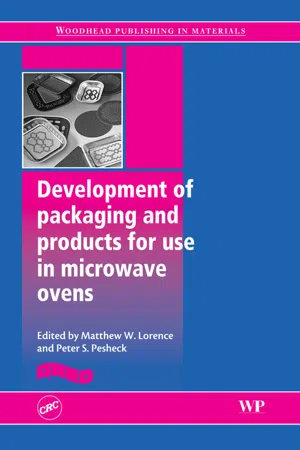
The efficient design of microwave food products and associated packaging materials for optimum food quality and safety requires knowledge of product dielectric properties and associated heating mechanisms, careful consideration of product geometry, knowledge of modern packaging and ingredient technologies, and application of computer simulation, statistics and experimental design. Integrated knowledge and efficient application of these tools is essential for those developing food products in this demanding field.Development of packaging and products for use in microwave ovens provides a focused and comprehensive review for developers. Part one discusses the principles of microwave heating and ovens, with an emphasis on the effect of food dielectric properties and geometry on heating uniformity and optimising the flavours and colours of microwave foods. Microwave packaging materials and design are discussed in Part two; chapters cover rigid packaging, susceptors and shielding. Product development, food, packaging and oven safety is the topic of Part three. Computer modelling of microwave products and active packaging is discussed in Part four.Written by a distinguished team of international contributors, Development of packaging and products for use in microwave ovens is a valuable resource for those in the food and packaging industries.
- Comprehensively reviews the principles of microwave heating and ovens assessing the effect of food dielectric properties on heating uniformity
- Thoroughly reviews microwave packaging materials and design including testing and regulatory issues
- Features a seven page section of colour diagrams to show heat distributions
Trusted by 375,005 students
Access to over 1.5 million titles for a fair monthly price.
Study more efficiently using our study tools.
Information
Subtopic
Materials SciencePart I
Principles
1
Electromagnetic basis of microwave heating
J. Tang; F.P. Resurreccion, Jr. Washington State University, USA
Abstract
This chapter provides the fundamentals of electromagnetic (EM) waves relating to microwave heating and processing of foods. Included are broad discussions on the characteristics of EM waves generated from the source and on to food materials in accordance with Maxwell equations. Important concepts such as electromagnetic wave propagation and penetration, energy associated with EM waves, and conversion to heat relating to the dielectric properties of food materials are discussed in preparation for more detailed discussions in other chapters. In particular, important information relating to electromagnetic field distributions in waveguides, microwave cavities, and foods are presented to the readers to allow a general understanding of complicated physical phenomena associated with heating uniformity in both domestic ovens and industrial scale microwave systems.
Key words
microwaves
electromagnetic
wave equation
dielectric property
oven cavity
microwave heating
1.1 Introduction
Microwave heating of foods results from conversion of electromagnetic energy to thermal energy through increased agitation of water molecules and charged ions when exposed to microwaves. Direct penetration of microwaves into food materials enables us to heat foods much faster than conventional heating methods that rely on surface heating such as countertop stoves or baking ovens. The convenience brought about by fast microwave heating makes microwave ovens a household necessity in modern society. Microwave heating systems are also commonly used in the food service and processing industry for fast heating applications. However, users of microwave ovens or industrial microwave systems also experience various frustrations, in particular non-uniform heating. Factors that influence uneven microwave heating include microwave cavity design, food physical properties, and food geometry. Those factors determine how the microwave field is distributed in ovens and within foods. This chapter will discuss fundamental principles which underlie the unique characteristics of microwaves in air and in foods, thus laying a foundation for discussions in other chapters of the book.
This chapter includes an introduction to microwave heating in a broad context of electromagnetic (EM) energy and Maxwell equations that govern the fundamental behavior of EM waves in air, in microwave cavities and in foods. Several very important equations derived from Maxwell equations, including wave equations, power equation, and Snell’s law, are presented. Those equations provide insights into microwave heating behavior in domestic and industrial microwave ovens and in foods. Finally dielectric properties of foods are briefly discussed in connection with microwave heating and heating uniformity.
1.2 Microwaves
Microwaves are electromagnetic waves at frequencies between 300 and 300,000 MHz (Decareau, 1985), with corresponding wavelengths of 1 to 0.001 m, respectively. Microwaves are used in communication systems and radar (Radio Detection and Ranging). Radar systems were first developed during World War II for detecting enemy aircraft, and are now used for a wide range of remote sensing and motion detection applications, including air-traffic control, missile tracking, weather forecasting, and automobile motion sensing. Microwave communication systems include wireless computer networks, global positioning satellite systems, and cellular video systems (Pozar, 1998). Owing to heavy uses for radar and wireless communication applications, only a limited number of microwave frequency bands are allocated in different countries (in the US by the Federal Communications Commission or FCC) for industrial, scientific, and medical (ISM) applications to avoid interference to radar and wireless communication. Table 1.1 lists ISM bands used in different food applications. Industrial equipment for the listed frequency bands is readily available from commercial suppliers.
Table 1.1
Important microwave frequency allocations for industrial, scientific and medical (ISM) use (Decareau, 1985; Metaxas and Meredith, 1993; Buffler, 1993)
| Frequency (MHz) | Frequency tolerance (MHz) | Example of industrial applications | Countries |
| 896 | ± 10 | Tempering of frozen products | Great Britain |
| 915 | ± 13 | Precooking of bacon, tempering of frozen products | North and South America, China |
| 2375 | ± 50 | Domestic microwave ovens | Albania, Bulgaria, Hungary, Romania, Czechoslovakia, former USSR |
| 2450 | ± 50 | Domestic microwave ovens, industrial precooking of bacon, pasteurization and sterilization of packaged foods | Worldwide, except where 2375 MHz is used |

1.3 EM waves
EM waves propagate in space at the speed of light (~ 3 × 10⁹ m/s). X-rays, visible light, microwave, radio waves, and light are some of the different forms of electromagnetic waves characterized by wavelength and frequency (Fig. 1.1). The microwave portion of the spectrum lies in the fr...
Table of contents
- Cover image
- Title page
- Table of Contents
- Copyright page
- Contributor contact details
- Introduction
- Part I: Principles
- Part II: Microwave packaging materials and design
- Part III: Product development, food, packaging and oven safety
- Part IV: Modelling of microwave heating
- Index
Frequently asked questions
Yes, you can cancel anytime from the Subscription tab in your account settings on the Perlego website. Your subscription will stay active until the end of your current billing period. Learn how to cancel your subscription
No, books cannot be downloaded as external files, such as PDFs, for use outside of Perlego. However, you can download books within the Perlego app for offline reading on mobile or tablet. Learn how to download books offline
Perlego offers two plans: Essential and Complete
- Essential is ideal for learners and professionals who enjoy exploring a wide range of subjects. Access the Essential Library with 800,000+ trusted titles and best-sellers across business, personal growth, and the humanities. Includes unlimited reading time and Standard Read Aloud voice.
- Complete: Perfect for advanced learners and researchers needing full, unrestricted access. Unlock 1.5M+ books across hundreds of subjects, including academic and specialized titles. The Complete Plan also includes advanced features like Premium Read Aloud and Research Assistant.
We are an online textbook subscription service, where you can get access to an entire online library for less than the price of a single book per month. With over 1.5 million books across 990+ topics, we’ve got you covered! Learn about our mission
Look out for the read-aloud symbol on your next book to see if you can listen to it. The read-aloud tool reads text aloud for you, highlighting the text as it is being read. You can pause it, speed it up and slow it down. Learn more about Read Aloud
Yes! You can use the Perlego app on both iOS and Android devices to read anytime, anywhere — even offline. Perfect for commutes or when you’re on the go.
Please note we cannot support devices running on iOS 13 and Android 7 or earlier. Learn more about using the app
Please note we cannot support devices running on iOS 13 and Android 7 or earlier. Learn more about using the app
Yes, you can access Development of Packaging and Products for Use in Microwave Ovens by Peter Pesheck,Matthew Lorence in PDF and/or ePUB format, as well as other popular books in Technology & Engineering & Materials Science. We have over 1.5 million books available in our catalogue for you to explore.