- 196 pages
- English
- ePUB (mobile friendly)
- Available on iOS & Android
eBook - ePub
About this book
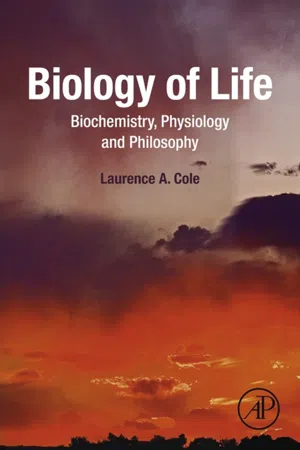
Biology of Life: Biochemistry, Physiology and Philosophy provides foundational coverage of the field of biochemistry for a different angle to the traditional biochemistry text by focusing on human biochemistry and incorporating related elements of evolution to help further contextualize this dynamic space. This unique approach includes sections on early human development, what constitutes human life, and what makes it special.
Additional coverage on the differences between the biochemistry of prokaryotes and eukaryotes is also included. The center of life in prokaryotes is considered to be photosynthesis and sugar generation, while the center of life in eukaryotes is sugar use and oxidative phosphorylation. This unique reference will inform specialized biochemistry courses and researchers in their understanding of the role biochemistry has in human life.
- Contextualizes the field of biochemistry and its role in human life
- Includes dedicated sections on human reproduction and human brain development
- Provides extensive coverage on biochemical energetics, oxidative phosphorylation, photosynthesis, and carbon monoxide-acetate pathways
Trusted by 375,005 students
Access to over 1.5 million titles for a fair monthly price.
Study more efficiently using our study tools.
Information
Section IV
4.5 Billion Years of Evolution

Picture taken by Laurence Cole. Rough and tough street lass in Rawalpindi, Pakistan, 2001.
Chapter 12
Evolution Timeline
Abstract
Here we try and explain evolution in its full magnitude, from the start of chemical life through to humans. The evolution tree that results is massive covering eons of time. It is best covered with a massive table. The dating of the table is in accordance with the time periods laid down by scientists: the Hadean Eon, 4600–4000 million years ago (mya); the Archean Eon, 4000–3000 mya; the Proterozoic Eon, 3000–540 mya; the Paleozoic Era, 540–250 mya; the Mezozoic Era, 250–66 mya; and the Cenzoic Era 66 mya to present.
Keywords
Archean Eon; Cenzoic Era; Evolution; Hadean Eon; Mezozoic Era; Paleozoic Era; Proterozoic Eon
Here we try and explain evolution in its full magnitude, from the start of chemical life through to humans. The evolution tree that results is massive covering eons of time. It is best covered with a massive table. The dating of the table is in accordance with the time periods laid down by scientists: the Hadean Eon, 4600–4000 million years ago (MYA); the Archean Eon, 4000–3000 MYA; the Proterozoic Eon, 3000–540 MYA; the Paleozoic Era, 540–250 MYA; the Mezozoic Era, 250–66 MYA; and the Cenzoic Era 66 MYA to present (Table 12.1).
The following sources of information were sought and pooled for this table:
Timeline of the evolutionary history of life. https://en.wikipedia.org/wiki/Timeline_of_the_evolutionary_history_of_life
Exploring life’s origins. http://exploringorigins.org/timeline.html
Evolution and geological timelines http://www.talkorigins.org/origins/geo_timeline.html
Timeline: The evolution of life https://www.newscientist.com/article/dn17453-timeline-the-evolution-of-life/
Tree of life rewritten: Evolutionary timeline looks more like a giant lollipop - and reveals new species appear every 2 million years http://www.dailymail.co.uk/sciencetech/article-2982564/Tree-life-rewritten-Evolutionary-timeline-looks-like-giant-lollipop-reveals-new-species-appear-2-million-years
It is all very complicated. One massive tree stretches in multiple direction. The key events are:
Formation of planet Earth 4.54 billion years ago
for the last 3.6 billion years, simple cells (prokaryotes);
for the last 3.4 billion years, cyanobacteria performing photosynthesis;
for the last 2 billion years, complex cells (eukaryotes);
for the last 1.2 billion years, eukaryotes which sexually reproduce
for the last 1 billion years, multicellular life;
for the last 600 million years, simple animals;
for the last 550 million years, bilaterians, water life forms with a front and a back;
for the last 500 million years, fish and proto-amphibians;
for the last 475 million years, land plants;
Table 12.1
Evolution, Earth’s Creation–Present
| Hadean Eon (4600–4000 MYA) | |
| Date | Event |
| 4567 MYA | The solar system is formed. |
| 4540 MYA | Planet Earth forms from planetesimal deposits and solar debris. |
| 4450 MYA | The Moon is made when planet Earth collides with smaller planets. |
| 4450 MYA | Initial atmosphere is hydrogen and helium, this then escapes Earth’s gravity. A new atmosphere from volcanic emissions is carbon monoxide, carbon dioxide, water vapor, methane, hydrogen, and ammonia. |
| 4280 MYA | Water lands on Earth from meteors and comets, and oceans are formed. |
| 4000 MYA | Bombardment of Earth by meteors and comets stops. |
| Archean Eon (4000–3000 MYA) | |
| 3900 MYA | The Earth’s crust solidifies. |
| 3800 MYA | Chemical life and RNA molecules appear. |
| 3500 MYA | Cyanobacteria, blue-green algae, shown to have existed. |
| 3200 MYA | Early acritarchs shown to have existed. |
| 3000 MYA | Advanced photosynthesizing cyanobacteria shown to have existed; producing oxygen as a waste product. The oxygen in the atmosphere slowly rises. |
| Proterozoic Eon (3000–540 MYA) | |
| 2800 MYA | It was not until the Earth was 1.7–2.8 billion years old, that a new atmosphere, rich in oxygen, emerged. |
| 2800 MYA | Land continents formed from raised plates known as the Precambrian shields. |
| 2400 MYA | It was not until the Earth was 1.7–2.4 billion years old, that a new atmosphere, rich in oxygen, emerged. Oxygenation of the atmosphere was led by cyanobacteria’s oxygenic photosynthesis, causing the displacement of the carbon monoxide, carbon dioxide, water vapor, methane, and ammonia atmosphere. |
| 2200 MYA | Organisms with mitochondria capable of aerobic respiration appeared. |
| 2000 MYA | Diversification of acritarchs. |
| 1850 MYA | Eukaryotic cells appeared. Eukaryotes contain membrane-bound organelles with diverse functions, probably derived from prokaryotes engulfing each other via phagocytosis. An oxygen atmosphere was an incentive to eukaryotic life. |
| 1850 MYA | Complex ... |
Table of contents
- Cover image
- Title page
- Table of Contents
- Copyright
- Introduction
- Section I. How Life Started
- Section II. DNA and RNA
- Section III. Energetics
- Section IV. 4.5 Billion Years of Evolution
- Section V. Human Development
- Index
Frequently asked questions
Yes, you can cancel anytime from the Subscription tab in your account settings on the Perlego website. Your subscription will stay active until the end of your current billing period. Learn how to cancel your subscription
No, books cannot be downloaded as external files, such as PDFs, for use outside of Perlego. However, you can download books within the Perlego app for offline reading on mobile or tablet. Learn how to download books offline
Perlego offers two plans: Essential and Complete
- Essential is ideal for learners and professionals who enjoy exploring a wide range of subjects. Access the Essential Library with 800,000+ trusted titles and best-sellers across business, personal growth, and the humanities. Includes unlimited reading time and Standard Read Aloud voice.
- Complete: Perfect for advanced learners and researchers needing full, unrestricted access. Unlock 1.5M+ books across hundreds of subjects, including academic and specialized titles. The Complete Plan also includes advanced features like Premium Read Aloud and Research Assistant.
We are an online textbook subscription service, where you can get access to an entire online library for less than the price of a single book per month. With over 1.5 million books across 990+ topics, we’ve got you covered! Learn about our mission
Look out for the read-aloud symbol on your next book to see if you can listen to it. The read-aloud tool reads text aloud for you, highlighting the text as it is being read. You can pause it, speed it up and slow it down. Learn more about Read Aloud
Yes! You can use the Perlego app on both iOS and Android devices to read anytime, anywhere — even offline. Perfect for commutes or when you’re on the go.
Please note we cannot support devices running on iOS 13 and Android 7 or earlier. Learn more about using the app
Please note we cannot support devices running on iOS 13 and Android 7 or earlier. Learn more about using the app
Yes, you can access Biology of Life by Laurence A. Cole in PDF and/or ePUB format, as well as other popular books in Biological Sciences & Biology. We have over 1.5 million books available in our catalogue for you to explore.