- 356 pages
- English
- ePUB (mobile friendly)
- Available on iOS & Android
eBook - ePub
Analytical Electrochemistry in Textiles
About this book
Electrochemistry is the study of chemical reactions with an exchange of electrons, and of the chemical phenomena that are caused by the action of applied currents and voltages. Analytical electrochemistry in textiles provides an overview of the synergy between electrochemistry and textiles, and the possibilities and innovative character of electrochemistry for textiles.Analytical electrochemistry in textiles is divided into four parts. In the first part an overview is given of the theory of electrochemistry as well as of practical considerations. The second part contains chapters in which the development of sensors is described for the optimisation and automation of textile finishing processes. In the third part the fundamentals of textile electrodes, used in a wide variety of applications, are summarised, as well as offering a developed study of a quality control method. Finally, the fourth part of the book is related to the functionalisation of fibres through chemical and electrochemical modification and some applications are given for these types of textile related electrodes.Written so that both non-electrochemists and non-textile specialists can understand it, Analytical electrochemistry in textiles is an important guide for textile, chemist and material science academics. It will also prove of great benefit for textile manufacturers, processors, dyers, colourists and finishers.
- Provides an overview of the synergy between electrochemistry and textiles
- An invaluable reference tool for textile, chemist and material science academics as well as textile manufacturers, processors, dyers, colourists and finishers
Information
II
Electrochemistry in textile finishing
3
Probes for pH measurement and simultaneous cellulose removal and bleaching of textiles with enzymes
P. WESTBROEK and P. KIEKENS
Publisher Summary
This chapter examines various probes for pH measurement such as ion-selective and glass-membrane electrodes as well as simultaneous cellulose removal and bleaching of textiles with enzymes. Ion-selective electrodes belong to the group of potentiometric methods. Many electrode systems, partly well-known, partly in development and under investigation, show a Nernstian relationship between the measured electrode potential and the activity of a species in solution. Important conditions to be fulfilled for the development of ion-selective electrodes are the affinity of a membrane surface for a typical ion or molecule and minimum ion conductivity over the membrane. If possible, but not necessarily, these conditions should be fulfilled at room temperature. The chapter describes a method to remove simultaneously cellulose and bleach fiber products in the same bath with an acidic medium. An account is also given of a sensor system for measuring and controlling the hydrogen peroxide concentration.
3.1 Introduction
This chapter examines various probes for pH measurement such as ion-selective and glass-membrane electrodes as well as simultaneous cellulose removal and bleaching of textiles with enzymes.
3.2 Ion-selective electrodes
3.2.1 What is an ion-selective electrode?
Ion-selective electrodes belong to the group of potentiometric methods. Many electrode systems, partly well known, partly in development and under investigation, show a Nernstian relationship between the measured electrode potential and the activity of a species in solution. Important conditions to be fulfilled for the development of ion-selective electrodes are the affinity of a membrane surface for a typical ion or molecule and a minimum ion conductivity over the membrane. If possible, but not necessarily, these conditions should be fulfilled at room temperature.
In practice (Fig. 3.1), the potential difference, ΔE, is measured over a membrane:
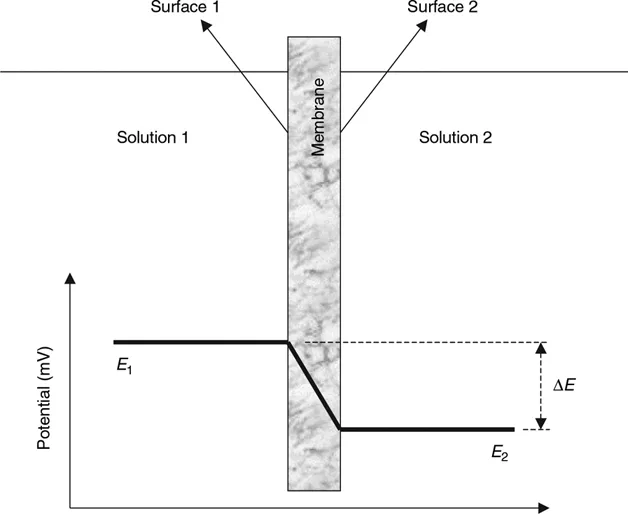

where E2 is the actual potential of the interface solution 2 (membrane surface 2), and E1 is the potential of the interface solution 1 (membrane surface 1). This difference is related...
Table of contents
- Cover image
- Title page
- Table of Contents
- Related titles from Woodhead’s textile technology list
- Copyright
- Author contact details
- Preface
- I: Theoretical considerations
- II: Electrochemistry in textile finishing
- III: Textile electrodes
- IV: Modified fibres and their applications
- Index
Trusted by 375,005 students
Access to over 1.5 million titles for a fair monthly price.
Study more efficiently using our study tools.
Frequently asked questions
Yes, you can cancel anytime from the Subscription tab in your account settings on the Perlego website. Your subscription will stay active until the end of your current billing period. Learn how to cancel your subscription
No, books cannot be downloaded as external files, such as PDFs, for use outside of Perlego. However, you can download books within the Perlego app for offline reading on mobile or tablet. Learn how to download books offline
Perlego offers two plans: Essential and Complete
- Essential is ideal for learners and professionals who enjoy exploring a wide range of subjects. Access the Essential Library with 800,000+ trusted titles and best-sellers across business, personal growth, and the humanities. Includes unlimited reading time and Standard Read Aloud voice.
- Complete: Perfect for advanced learners and researchers needing full, unrestricted access. Unlock 1.5M+ books across hundreds of subjects, including academic and specialized titles. The Complete Plan also includes advanced features like Premium Read Aloud and Research Assistant.
We are an online textbook subscription service, where you can get access to an entire online library for less than the price of a single book per month. With over 1.5 million books across 990+ topics, we’ve got you covered! Learn about our mission
Look out for the read-aloud symbol on your next book to see if you can listen to it. The read-aloud tool reads text aloud for you, highlighting the text as it is being read. You can pause it, speed it up and slow it down. Learn more about Read Aloud
Yes! You can use the Perlego app on both iOS and Android devices to read anytime, anywhere — even offline. Perfect for commutes or when you’re on the go.
Please note we cannot support devices running on iOS 13 and Android 7 or earlier. Learn more about using the app
Please note we cannot support devices running on iOS 13 and Android 7 or earlier. Learn more about using the app
Yes, you can access Analytical Electrochemistry in Textiles by P Westbroek,G Priniotakis,P Kiekens in PDF and/or ePUB format, as well as other popular books in Technology & Engineering & Analytic Chemistry. We have over 1.5 million books available in our catalogue for you to explore.