- 590 pages
- English
- ePUB (mobile friendly)
- Available on iOS & Android
eBook - ePub
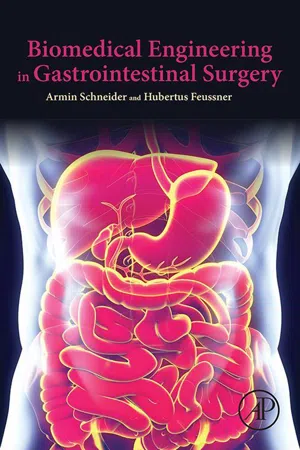
Biomedical Engineering in Gastrointestinal Surgery
About this book
Biomedical Engineering in Gastrointestinal Surgery is a combination of engineering and surgical experience on the role of engineering in gastrointestinal surgery. There is currently no other book that combines engineering and clinical issues in this field, while engineering is becoming more and more important in surgery. This book is written to a high technical level, but also contains clear explanations of clinical conditions and clinical needs for engineers and students. Chapters covering anatomy and physiology are comprehensive and easy to understand for non-surgeons, while technologies are put into the context of surgical disease and anatomy for engineers.
The authors are the two most senior members of the Institute for Minimally Invasive Interdisciplinary Therapeutic Interventions (MITI), which is pioneering this kind of collaboration between engineers and clinicians in minimally invasive surgery. MITI is an interdisciplinary platform for collaborative work of surgeons, gastroenterologists, biomedical engineers and industrial companies with mechanical and electronic workshops, dry laboratories and comprehensive facilities for animal studies as well as a fully integrated clinical "OR of the future".
- Written by the head of the Institute of Minimally Invasive Interdisciplinary Therapeutic Intervention (TUM MITI) which focusses on interdisciplinary cooperation in visceral medicine
- Provides medical and anatomical knowledge for engineers and puts technology in the context of surgical disease and anatomy
- Helps clinicians understand the technology, and use it safely and efficiently
Trusted by 375,005 students
Access to over 1.5 million titles for a fair monthly price.
Study more efficiently using our study tools.
Information
Chapter 1
Surgery and Biomedical Engineering
Abstract
The history of surgery and of engineering sciences is to some extent comparable. Full academic emancipation was acquired relatively late in the end of the 19th century.
Surgery of today is situated in a very competitive situation, since other interventional disciplines (e.g., interventional endoscopy and interventional radiology) have taken over formerly classical surgical domains. To maintain or even extend its impact on medical therapy (and the role in medicine), surgery has to improve continuously its methods and therapeutic strategies, which will only be possible by innovative technological tools and processes. Insofar, biomedical engineering (BME) is the natural partner and ally of surgery today and will be even more so in the future. A close cooperation would be favorable for both sides. Nonetheless, practical team formation is not always easy. The difficulties are demonstrated and some hints for how to overcome them are given.
Keywords
History of surgery; tradition of engineering; biomedical engineering; academic emancipation; translational research
It goes without saying that surgery cannot be performed with bare hands. Accordingly, surgeons were always compelled to use more or less dedicated instruments. Descriptions of specialized tools of the surgeons are found early in the history of mankind. The papyri of ancient Egypt deal in detail with surgical instruments, as do many manuscripts of Greek and Roman antiquity. Often ignored, ancient India had also a profound surgical legacy. In a classical Sanskrit text of Sushruta written in the 6th century BC, more than 100 instruments are described, including saws, needles, scalpels, etc. They certainly reflected the spearhead of contemporary technological innovation.
The obviously high level of surgical care as related to general development was not maintained in the following centuries.
Conservative medicine always remained the reserve of academics. However, this only meant drug oriented noninvasive medicine. Diagnosis and therapy were based upon the humoral pathology of Galenos. Accordingly, the only “invasive” procedure was phlebotomy (bloodletting). Human diseases were treated with drugs, ointments, diets, or similar conservative measures. Surgical tasks, such as the treatment of fractures, open wounds, and hernia, were completely left over to the surgeons. Surgeons at that time were looked down upon and avoided by physicians since they were considered unlettered, lower class men, who learned their graft by apprenticeship (Fig. 1.1). In addition to surgery they often practiced as barbers as well. The situation improved only gradually. In England and in France surgical guilds were created. A main impact came again from the military since it was evident that contemporary warfare needed qualified surgeons. In 1724 a collegium medico chirurgicum was founded in Berlin (Charité) to provide sufficiently educated surgeons for the army. However, it took another century until it developed to academic surgery with full integration into the medical studies at the university. Famous names like Joseph Lister (1827–1912), Bernhard von Langenbeck (1810–87), and Theodor Billroth (1829–94) are representatives of this historical progress. From then on surgery achieved one triumph after another and is still considered today as the spearhead of medicine. However, this formally unchanged position is currently heavily in danger: Interventional medicine of today is characterized by the idea of further trauma reduction. Increasingly, open surgical procedures are replaced by minimally invasive interventions or even by interventional gastroenterology and radiology. In this very competitive environment surgery is forced to improve continuously its own therapeutic armamentarium. Otherwise, surgery may not survive as a discipline of its own right.

As shown in Fig. 1.1, scientific surgery has existed as an academic discipline for only 150 years. Retrospectively, this comparatively short period of time can be subdivided into three different eras (Fig. 1.2).

In the beginning, surgeons learned to master the specific challenges of the different anatomical regions—beginning with the abdomen and ending with the brain. In the next phase, surgery was not any longer confined to resection/amputation, etc. but the focus was now laid on substituting deficits: Destroyed joints were replaced by artificial implants, so-called pouches were developed to take over the role of the stomach, the rectum after resection, etc. The final highlight of the era was the transplantation of whole organs (heart, liver, kidney).
The trend of today is to further minimize the surgical trauma—collateral damage to other organs, functional impairment, and pain. This third era of surgery started with the introduction of laparoscopic surgery. Laparoscopy was, however, only the beginning of a broad development in many medical disciplines toward less trauma and lower invasiveness. Many surgical operations are now substituted by new interventions that do not need skin incisions, general anesthesia, etc. One of the classical surgical emergency cases in former days was, e.g., gastroduodenal bleeding from peptic ulcers, forcing the surgeons frequently to spend another few hours in the operating room (OR) during nighttime. This type of surgery has almost vanished from the surgical departments, since upper gastrointestinal bleedings are now treated successfully by interventional gastroenterologists who have learned to stop the bleeding from inside. Another impressive example of how surgery became superseded by nonsurgical interventions is portal hypertension. Blood perfusion of the liver is impaired in the case of liver cirrhosis. Prehepatic blood is deviated and induces life-threatening bleeding into the esophagus. The surgical answer was to create artificial shunts (portocaval shunts). Admittedly, shunt surgery was highly demanding and complicated. If the patient survived, the functional results usually were not particularly satisfying. Today, shunt surgery is obsolete. It has been successfully replaced by a radiological intervention called transjugular intraparenchymatous shunt. Surgery of portal hypertension is no longer an issue in surgery. Many similar examples exist.
This development will certainly continue and it is doubtful what will be left for traditional surgery (Fig. 1.3). One thing, however, is clear: In order to achieve further progress in medicine, the surgeons and physicians need more than ever the active support of basic sciences, engineers, and computer scientists. Without innovative tools and methods—delivered by biomedical engineering (BME)—the medical doctors will be unable to further improve their armamentarium of interventional therapeutic approaches. This is why an intensive continuous dialogue between science, development, and medicine is today mandatory. It has been shown that the translation of innovative surgical devices into the OR is markedly improved by this interdisciplinary interaction [1].

Fortunately, a corresponding response can be observed on the technical/scientific side: The community of natural sciences developed the concept of BME.
The definition of BME in brief:
“Application of engineering principles and design concepts to medicine for diagnostic or therapeutic purposes.”
Wikipedia
Admittedly, this definition is not very sharp and could include almost everything. As a matter of fact, BME is the intersection of at least three mighty disciplines: medicine, engineering, and basic science. Like surgery or perhaps it would be better to say interventional medicine, many of the natural sciences like chemistry, biology, and the engineering had a long way to go in academic history to achieve the status of becoming their own academic disciplines. Therefore, it is little wonder, that the overlap of these three disciplines appears to be academically doubtful since it resembles too much pure application rather than science for its own right.
It is the question now of whether BME has got the chance at all to achieve in the long run an equal academic status to the other now well-acknowledged disciplines. In other words, whether BME can be released of its ostensibly scientific interiority and gain a well-respected place in the academic community (“academic emancipation”).
Disregard of natural science or even more of engineering is based upon very old traditions. Greece was the cradle of the classical academy. It is well known that only theoretical work like philosophy was considered as science. The reputation of productive physical work like producing food or building houses or ships was considered low. This point of view dominated academic reality in European universities for many centuries. They mainly comprehended only four faculties: Theology, law, medicine, and fine arts. Of course, the societies acquired in parallel considerable technical knowledge in all fields—in particular in mining, ship building, navigation, etc.—but the academic value of these impressive intellectual efforts was not recognized.
It took until the French revolution to come to the first educational institution for practical/technical knowledge. The highly reputative École Polytechnique in Paris was originally founded in 1794 to provide the army with well-trained pioneers for the engineer units, but later on, civilian professions were trained as well (Fig. 1.4).

Table of contents
- Cover image
- Title page
- Table of Contents
- Copyright
- Foreword
- Acknowledgments
- Chapter 1. Surgery and Biomedical Engineering
- Chapter 2. Anatomy, Physiology, and Selected Pathologies of the Gastrointestinal Tract
- Chapter 3. Principles of Gastrointestinal Surgery
- Chapter 4. Preconditions of Successful (Gastrointestinal) Surgery
- Chapter 5. Diagnostic Procedures
- Chapter 6. Classical (Open) Surgery
- Chapter 7. Operative (Surgical) Laparoscopy
- Chapter 8. Interventional Flexible Endoscopy
- Chapter 9. Combined Laparoscopic-Endoscopic Procedures and Natural Orifice Transluminal Endoscopic Surgery (NOTES)
- Chapter 10. Mechatronic Support Systems and Robots
- Chapter 11. Tracking and Navigation Systems
- Chapter 12. Health Informatics/Health Information Technology
- Chapter 13. Training and Simulation
- Chapter 14. Visceral Surgery of the Future: Prospects and Needs
- Epilog: The New Era: “Digitalized Surgery”?
- Index
Frequently asked questions
Yes, you can cancel anytime from the Subscription tab in your account settings on the Perlego website. Your subscription will stay active until the end of your current billing period. Learn how to cancel your subscription
No, books cannot be downloaded as external files, such as PDFs, for use outside of Perlego. However, you can download books within the Perlego app for offline reading on mobile or tablet. Learn how to download books offline
Perlego offers two plans: Essential and Complete
- Essential is ideal for learners and professionals who enjoy exploring a wide range of subjects. Access the Essential Library with 800,000+ trusted titles and best-sellers across business, personal growth, and the humanities. Includes unlimited reading time and Standard Read Aloud voice.
- Complete: Perfect for advanced learners and researchers needing full, unrestricted access. Unlock 1.5M+ books across hundreds of subjects, including academic and specialized titles. The Complete Plan also includes advanced features like Premium Read Aloud and Research Assistant.
We are an online textbook subscription service, where you can get access to an entire online library for less than the price of a single book per month. With over 1.5 million books across 990+ topics, we’ve got you covered! Learn about our mission
Look out for the read-aloud symbol on your next book to see if you can listen to it. The read-aloud tool reads text aloud for you, highlighting the text as it is being read. You can pause it, speed it up and slow it down. Learn more about Read Aloud
Yes! You can use the Perlego app on both iOS and Android devices to read anytime, anywhere — even offline. Perfect for commutes or when you’re on the go.
Please note we cannot support devices running on iOS 13 and Android 7 or earlier. Learn more about using the app
Please note we cannot support devices running on iOS 13 and Android 7 or earlier. Learn more about using the app
Yes, you can access Biomedical Engineering in Gastrointestinal Surgery by Armin Schneider,Hubertus Feussner in PDF and/or ePUB format, as well as other popular books in Technology & Engineering & Biomedical Science. We have over 1.5 million books available in our catalogue for you to explore.