eBook - ePub
Polymer Electrolyte Membrane and Direct Methanol Fuel Cell Technology
Volume 1: Fundamentals and Performance of Low Temperature Fuel Cells
- 430 pages
- English
- ePUB (mobile friendly)
- Available on iOS & Android
eBook - ePub
Polymer Electrolyte Membrane and Direct Methanol Fuel Cell Technology
Volume 1: Fundamentals and Performance of Low Temperature Fuel Cells
About this book
Polymer electrolyte membrane fuel cells (PEMFCs) and direct methanol fuel cells (DMFCs) technology are promising forms of low-temperature electrochemical power conversion technologies that operate on hydrogen and methanol respectively. Featuring high electrical efficiency and low operational emissions, they have attracted intense worldwide commercialization research and development efforts. These R&D efforts include a major drive towards improving materials performance, fuel cell operation and durability. In situ characterization is essential to improving performance and extending operational lifetime through providing information necessary to understand how fuel cell materials perform under operational loads.This two volume set reviews the fundamentals, performance, and in situ characterization of PEMFCs and DMFCs. Volume 1 covers the fundamental science and engineering of these low temperature fuel cells, focusing on understanding and improving performance and operation. Part one reviews systems fundamentals, ranging from fuels and fuel processing, to the development of membrane and catalyst materials and technology, and gas diffusion media and flowfields, as well as life cycle aspects and modelling approaches. Part two details performance issues relevant to fuel cell operation and durability, such as catalyst ageing, materials degradation and durability testing, and goes on to review advanced transport simulation approaches, degradation modelling and experimental monitoring techniques.With its international team of expert contributors, Polymer electrolyte membrane and direct methanol fuel cell technology Volumes 1 & 2 is an invaluable reference for low temperature fuel cell designers and manufacturers, as well as materials science and electrochemistry researchers and academics.
- Covers the fundamental science and engineering of polymer electrolyte membrane fuel cells (PEMFCs) and direct methanol fuel cells (DMFCs), focusing on understanding and improving performance and operation
- Reviews systems fundamentals, ranging from fuels and fuel processing, to the development of membrane and catalyst materials and technology, and gas diffusion media and flowfields, as well as life cycle aspects and modelling approaches
- Details performance issues relevant to fuel cell operation and durability, such as catalyst ageing, materials degradation and durability testing, and reviews advanced transport simulation approaches, degradation modelling and experimental monitoring techniques
Information
Subtopic
Risorse energetichePart I
Fundamentals of polymer electrolyte membrane and direct methanol fuel cell technology
1
Fuels and fuel processing for low temperature fuel cells
D.J.L. Brett and M. Manage, University College London, UK
E. Agante, N.P. Brandon and E. Brightman, Imperial College London, UK
R.J.C. Brown, National Physical Laboratory, UK
I. Staffell, University of Birmingham, UK
Abstract:
This chapter examines the role of the fuel in the operation, performance and degradation of fuel cells. The range of fuels and impurities that are of relevance to low-temperature fuel cells are discussed and the performance from a thermodynamic perspective is analysed. As a route to hydrogen, various fuel processing options are considered along with an overview of the major storage techniques. Issues associated with alternative fuels are covered along with the deleterious properties of fuels and their impurities.
Key words
fuel
hydrogen
methane
methanol
biogas
alkaline fuel cell (AFC)
polymer electrolyte fuel cell (PEFC)
phosphoric acid fuel cell (PAFC)
platinum
catalyst
degradation
sulphur
carbon monoxide
poisoning
particulates
1.1 Introduction
Fuel cells have great potential as high-efficiency energy conversion devices for the production of electricity (and heat for some applications) from chemical fuels. They are applicable across a very broad range of applications and, depending on the type of fuel cell used, can employ a wide variety of fuels. The choice of fuel must consider factors such as:
• availability (national resource and distribution infrastructure)
• cost
• toxicity
• calorific value
• storage (gravimetric and volumetric density)
• fuel cell performance
• effect on performance degradation
• phase (solid, liquid, gas)
• water content (or other non reacting species such as CO2)
• purity
• security of supply, carbon content, etc.
Technically, anything that can be oxidised at an electrode can be used as a fuel in a fuel cell. The range of possible fuels goes well beyond hydrogen, the fuel normally associated with fuel cells. Examples of fuels trialled, often with the use of integrated fuel processors, include:
• gasoline
• diesel and biodiesel
• jet propellant (JP-8, JP-5)
• methane (natural gas)
• propane
• biogas
• ammonia
• methanol
• ethanol
• butanol, etc.
The ability to operate on these fuels depends on the type of fuel cell, the application, and the level of fuel processing required to convert raw fuel into a form conducive to effective operation. A range of fuel cell types exists, each with their own set of materials and temperature of operation. Figure 1.1 summarises the key aspects of the various technologies. Operating conditions range from high temperature, up to 1000 °C for solid oxide fuel cells (SOFCs), to almost ambient conditions, 30–80 °C for polymer electrolyte fuel cells (PEFCs) and alkaline fuel cells (AFCs). These operating conditions and the prevalent materials of construction determine the fuel requirements for each type of fuel cell.
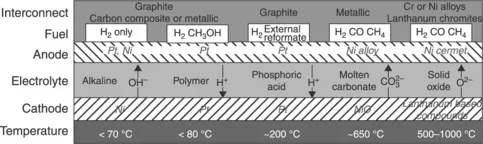
1.1 Materials of construction, typical fuel and operating temperature of the most common fuel cell types.
The most suitable primary sources of hydrogen-rich fuels (i.e. without requiring electrolysis of water) are hydrocarbons (HCs) and alcohols; these require different amounts of pre-processing depending on the fuel cell type. Table 1.1 summarises the fuel tolerance of different fuel cells and Fig. 1.2 shows the stages required to process the fuel. After desulphurisation (covered later in this chapter), HCs normally undergo steam reforming over a suitable catalyst to produce a mixture of H2 and CO, known as ‘syngas’. This can be used directly in high-temperature fuel cells; however, as the platinum (Pt) catalyst in the PEFC is easily poisoned by CO (Cheng et al., 2007), the significant amount of CO in syngas must be removed/converted by further processing, as illustrated in Fig. 1.2. It is clear from Table 1.1 that low-temperature fuel cells present the greatest challenges for fuel quality. For example, sulphur-based impurities bear a huge poisoning risk for polymer electrolyte membrane fuel cells (PEMFCs), which require desulphurisation down to less than 0.1 ppm.
Table 1.1
Summary of fuel tolerance for different fuel cell types
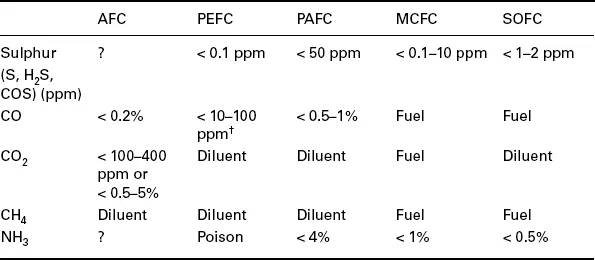
†Standard Pt anode catalysts can only withstand CO concentrations up to 10 ppm, and PtRu alloys up to 30 ppm. These limits can be extended by bleeding air into the anode and using alternative bi-layer catalysts.
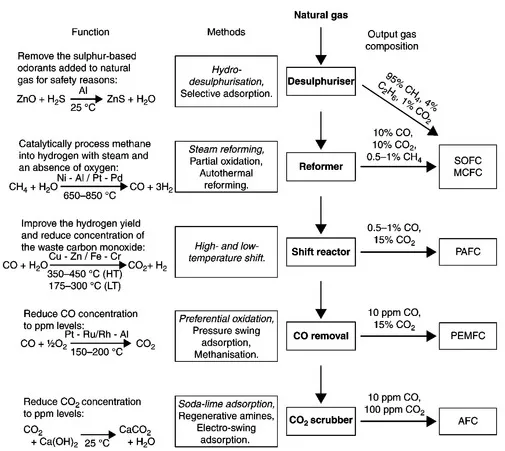
1.2 An overview of fuel processing for fuel cell systems. Each stage is highlighted in bold and given with the most common methods that are used; for each stage, the primary method is highlighted in italics. A description of each stage is given in the function column with the ideal reactions for the primary method. Indicative ranges of gas composition after each stage are given on the right. Following the stages down from natural gas to each type of fuel cell on the right indicates which processing stages are required (Staffell, 2010).
The aim of this chapter is to provide an overview of the issues involved in fuelling fuel cells, starting from the thermodynamics of reactions at the anode, through fuel processing and alternative fuels, and concluding with a look at the deleterious effects of impurities and the fuels themselves on performance.
1.2 Thermodynamics of fuel cell operation and the effect of fuel on performance
Two separate reactions occur in a fuel cell: a reduction at the cathode, and oxidation at the anode. For the common case of operation on hydrogen, and oxygen from air, the overall reaction is:
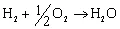
The oxidation and reduction proceed as follows:


For n electrons, the electrical work performed is nFE, where F is Faraday’s constant and E is the cell voltage. This represents the action of moving an electrical charge through an electrical potential field. Under reversible conditions, where no net current flows, the maximum electrical work is performed (nFE°), where E° corresponds to the thermodynamic cell voltage. When maximum work is performed, this corresponds to the change in free energy (ΔG) for the reaction, and consequently:

The free energy is a measure of the affinity and direction of the reaction. For a cell working in galvanic (fuel cell) mode, energy is released from the electrochemical reaction and ΔG is negative. The reaction enthalpy (ΔH) and entropy (ΔS) must also be considered in order to describe the efficiency of an electrolytic or galvanic process. Enthalpy is the heat delivered by a reaction (negative when heat is given out, as occurs for a galvanic process) and entropy describes the change in ‘order’ associated with the reaction (positive is associated with an increase in disorder or randomness of the system). The following well-known equation relates ΔG to ΔH and ΔS:

Therefore, for reactions with a decrease in disorder (negative ΔS), such as the reaction of hydrogen with oxygen to form water, ΔG is less than ΔH. The change in entropy is manifested as the generation of heat associated with the...
Table of contents
- Cover image
- Title page
- Table of Contents
- Copyright
- Contributor contact details
- Woodhead Publishing Series in Energy
- Preface
- Part I: Fundamentals of polymer electrolyte membrane and direct methanol fuel cell technology
- Part II: Performance issues in polymer electrolyte membrane and direct methanol fuel cells
- Index
Trusted by 375,005 students
Access to over 1.5 million titles for a fair monthly price.
Study more efficiently using our study tools.
Frequently asked questions
Yes, you can cancel anytime from the Subscription tab in your account settings on the Perlego website. Your subscription will stay active until the end of your current billing period. Learn how to cancel your subscription
No, books cannot be downloaded as external files, such as PDFs, for use outside of Perlego. However, you can download books within the Perlego app for offline reading on mobile or tablet. Learn how to download books offline
Perlego offers two plans: Essential and Complete
- Essential is ideal for learners and professionals who enjoy exploring a wide range of subjects. Access the Essential Library with 800,000+ trusted titles and best-sellers across business, personal growth, and the humanities. Includes unlimited reading time and Standard Read Aloud voice.
- Complete: Perfect for advanced learners and researchers needing full, unrestricted access. Unlock 1.5M+ books across hundreds of subjects, including academic and specialized titles. The Complete Plan also includes advanced features like Premium Read Aloud and Research Assistant.
We are an online textbook subscription service, where you can get access to an entire online library for less than the price of a single book per month. With over 1.5 million books across 990+ topics, we’ve got you covered! Learn about our mission
Look out for the read-aloud symbol on your next book to see if you can listen to it. The read-aloud tool reads text aloud for you, highlighting the text as it is being read. You can pause it, speed it up and slow it down. Learn more about Read Aloud
Yes! You can use the Perlego app on both iOS and Android devices to read anytime, anywhere — even offline. Perfect for commutes or when you’re on the go.
Please note we cannot support devices running on iOS 13 and Android 7 or earlier. Learn more about using the app
Please note we cannot support devices running on iOS 13 and Android 7 or earlier. Learn more about using the app
Yes, you can access Polymer Electrolyte Membrane and Direct Methanol Fuel Cell Technology by Christoph Hartnig,Christina Roth in PDF and/or ePUB format, as well as other popular books in Tecnologia e ingegneria & Risorse energetiche. We have over 1.5 million books available in our catalogue for you to explore.