- 226 pages
- English
- ePUB (mobile friendly)
- Available on iOS & Android
eBook - ePub
Forensic Plant Science
About this book
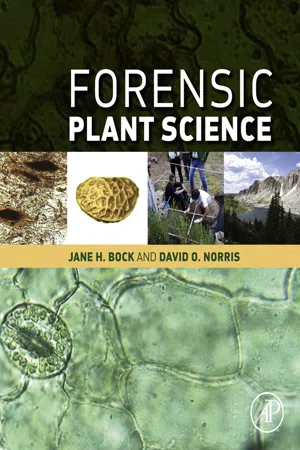
Forensic botany is the application of plant science to the resolution of legal questions. A plant's anatomy and its ecological requirements are in some cases species specific and require taxonomic verification; correct interpretation of botanical evidence can give vital information about a crime scene or a suspect or victim. The use of botanical evidence in legal investigations in North America is relatively recent. The first botanical testimony to be heard in a North American court concerned the kidnapping and murder of Charles Lindbergh's baby boy and the conviction of Bruno Hauptmann in 1935. Today, forensic botany encompasses numerous subdisciplines of plant science, such as plant anatomy, taxonomy, ecology, palynology, and diatomology, and interfaces with other disciplines, e.g., molecular biology, limnology and oceanography.Forensic Plant Science presents chapters on plant science evidence, plant anatomy, plant taxonomic evidence, plant ecology, case studies for all of the above, as well as the educational pathways for the future of forensic plant science.
- Provides techniques, collection methods, and analysis of digested plant materials
- Shows how to identify plants of use for crime scene and associated evidence in criminal cases
- The book's companion website: http://booksite.elsevier.com/9780128014752, will host a microscopic atlas of common food plants
Information
Table of contents
- Cover image
- Title page
- Table of Contents
- Copyright
- Dedication
- Author Biographies
- Foreword by Tom A. Ranker
- Foreword by Haskell M. Pitluck
- Preface
- Acknowledgments
- Chapter 1. Introduction to Forensic Plant Science
- Chapter 2. Suitability of Forensic Plant Science Evidence for Courtroom Presentations
- Chapter 3. Sources for Forensic Plant Science Evidence
- Chapter 4. Forensic Plant Anatomy
- Chapter 5. Cases Using Evidence from Plant Anatomy
- Chapter 6. Forensic Plant Taxonomy
- Chapter 7. Plant Taxonomy Cases
- Chapter 8. Plant Ecology
- Chapter 9. Forensic Plant Ecology Cases
- Chapter 10. Additional Approaches in Forensic Plant Science
- Chapter 11. Summation and a Look to the Future
- Appendix I. Materials Needed for Plant Anatomy Analyses
- Appendix II. Techniques for Slide Preparation to Examine Gastrointestinal Specimens or Fresh/Frozen/Cooked Food Samples with the Compound Light Microscope
- Appendix III. Making Accurate Measurements with the Microscope
- Appendix IV. Composition of Solutions Used in Preparation of Plant Cells for Microscopic Examination
- Appendix V. Methods for Verification of Feces and Vomitus
- Appendix VI. Maceration of Wood Samples for Microscopic Examination
- Appendix VII. Photographic Atlas Contents
- Subject Index
- Vernacular Names Index
- Scientific Names Index
Trusted by 375,005 students
Access to over 1.5 million titles for a fair monthly price.
Study more efficiently using our study tools.
Frequently asked questions
Yes, you can cancel anytime from the Subscription tab in your account settings on the Perlego website. Your subscription will stay active until the end of your current billing period. Learn how to cancel your subscription
No, books cannot be downloaded as external files, such as PDFs, for use outside of Perlego. However, you can download books within the Perlego app for offline reading on mobile or tablet. Learn how to download books offline
Perlego offers two plans: Essential and Complete
- Essential is ideal for learners and professionals who enjoy exploring a wide range of subjects. Access the Essential Library with 800,000+ trusted titles and best-sellers across business, personal growth, and the humanities. Includes unlimited reading time and Standard Read Aloud voice.
- Complete: Perfect for advanced learners and researchers needing full, unrestricted access. Unlock 1.5M+ books across hundreds of subjects, including academic and specialized titles. The Complete Plan also includes advanced features like Premium Read Aloud and Research Assistant.
We are an online textbook subscription service, where you can get access to an entire online library for less than the price of a single book per month. With over 1.5 million books across 990+ topics, we’ve got you covered! Learn about our mission
Look out for the read-aloud symbol on your next book to see if you can listen to it. The read-aloud tool reads text aloud for you, highlighting the text as it is being read. You can pause it, speed it up and slow it down. Learn more about Read Aloud
Yes! You can use the Perlego app on both iOS and Android devices to read anytime, anywhere — even offline. Perfect for commutes or when you’re on the go.
Please note we cannot support devices running on iOS 13 and Android 7 or earlier. Learn more about using the app
Please note we cannot support devices running on iOS 13 and Android 7 or earlier. Learn more about using the app
Yes, you can access Forensic Plant Science by Jane H Bock,David O. Norris in PDF and/or ePUB format, as well as other popular books in Law & Forensic Science. We have over 1.5 million books available in our catalogue for you to explore.