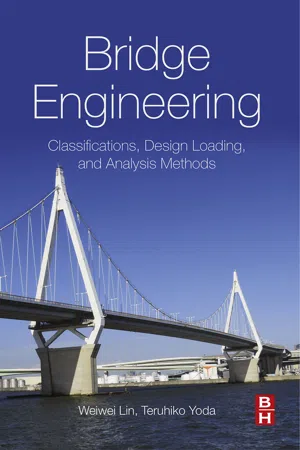
eBook - ePub
Bridge Engineering
Classifications, Design Loading, and Analysis Methods
- 292 pages
- English
- ePUB (mobile friendly)
- Available on iOS & Android
eBook - ePub
About this book
Bridge Engineering: Classifications, Design Loading, and Analysis Methods begins with a clear and concise exposition of theory and practice of bridge engineering, design and planning, materials and construction, loads and load distribution, and deck systems. This is followed by chapters concerning applications for bridges, such as: Reinforced and Prestressed Concrete Bridges, Steel Bridges, Truss Bridges, Arch Bridges, Cable Stayed Bridges, Suspension Bridges, Bridge Piers, and Bridge Substructures. In addition, the book addresses issues commonly found in inspection, monitoring, repair, strengthening, and replacement of bridge structures.
- Includes easy to understand explanations for bridge classifications, design loading, analysis methods, and construction
- Provides an overview of international codes and standards
- Covers structural features of different types of bridges, including beam bridges, arch bridges, truss bridges, suspension bridges, and cable-stayed bridges
- Features step-by-step explanations of commonly used structural calculations along with worked out examples
Trusted by 375,005 students
Access to over 1.5 million titles for a fair monthly price.
Study more efficiently using our study tools.
Information
Chapter One
Introduction of Bridge Engineering
Abstract
A bridge is a construction made for carrying the road traffic or other moving loads in order to pass through an obstacle or other constructions. The required passage may be for pedestrians, a road, a railway, a canal, a pipeline, etc. Obstacle can be rivers, valleys, sea channels, and other constructions, such as bridges themselves, buildings, railways, or roads, etc. Bridges are important structures in modern highway and railway transportation systems, and generally serving as “lifelines” in the social infrastructure systems. Bridge components (superstructure, bearing, substructure, etc.), bridges classification (e.g., according to materials of construction, span length, span type, deck location, usage, geometric shape, and structural form), and selection of bridge types are discussed in this chapter.
Keywords
Bridge components; Superstructure; Bearing; Substructure; Bridge classification; Movable bridges; Bridge type selection
1.1 Introduction
A bridge is a construction made for carrying the road traffic or other moving loads in order to pass through an obstacle or other constructions. The required passage may be for pedestrians, a road, a railway, a canal, a pipeline, etc. Obstacle can be rivers, valleys, sea channels, and other constructions, such as bridges themselves, buildings, railways, or roads. The covered bridge at Cambridge in Fig. 1.1 and a flyover bridge at Osaka in Fig. 1.2 are also typical bridges according to above definition. Bridges are important structures in modern highway and railway transportation systems, and generally serving as “lifelines” in the social infrastructure systems.


Bridge engineering is a field of engineering (particularly a significant branch of structural engineering) dealing with the surveying, plan, design, analysis, construction, management, and maintenance of bridges that support or resist loads. This variety of disciplines requires knowledge of the science and engineering of natural and man-made materials, composites, metallurgy, structural mechanics, statics, dynamics, statistics, probability theory, hydraulics, and soil science, among other topics (Khan, 2010). Similar to other structural engineers (Abrar and Masood, 2014), bridge engineers must ensure that their designs satisfy given design standard, being responsible to structural safety (i.e., bridge must not deform severely or even collapse under design static or dynamic loads) and serviceability (i.e., bridge sway that may cause discomfort to the bridge users should be avoided). Bridge engineering theory is based upon modern mechanics (rational knowledge) and empirical knowledge of different construction materials and geometric structures. Bridge engineers need to make innovative and high efficient use of financial resources, construction materials, calculation, and construction technologies to achieve these objectives.
1.2 Bridge Components
1.2.1 Superstructure, Bearings, and Substructure
Structural components of bridges are based on parametric definitions involving deck types and various bridge properties. Bridge structures are composed of superstructure, bearing, superstructure, and accessories.
(A) Superstructure
In general, the superstructure represents the portion of a bridge above the bearings, as shown in Fig. 1.3. Superstructure is the part of a bridge supported by the bearings, including deck, girder, truss, etc. The deck directly carries traffic, while other portions of the superstructure bear the loads passing over it and transmit them to the substructures. In case, the deck was divided as a separate bridge component, and the structural members between the deck and the bearings are called as bridge superstructure.
The superstructure may only include a few components, such as reinforced concrete slab in a slab bridge, or it may include several components, such as the floor beams, stringers, trusses, and bracings in a truss bridge. In suspension and cable-stayed bridges, components such as suspension cables, hangers, stays, towers, bridge deck, and the supporting structu...
In general, the superstructure represents the portion of a bridge above the bearings, as shown in Fig. 1.3. Superstructure is the part of a bridge supported by the bearings, including deck, girder, truss, etc. The deck directly carries traffic, while other portions of the superstructure bear the loads passing over it and transmit them to the substructures. In case, the deck was divided as a separate bridge component, and the structural members between the deck and the bearings are called as bridge superstructure.
The superstructure may only include a few components, such as reinforced concrete slab in a slab bridge, or it may include several components, such as the floor beams, stringers, trusses, and bracings in a truss bridge. In suspension and cable-stayed bridges, components such as suspension cables, hangers, stays, towers, bridge deck, and the supporting structu...
Table of contents
- Cover image
- Title page
- Table of Contents
- Copyright
- About the Authors
- Chapter One: Introduction of Bridge Engineering
- Chapter Two: Bridge Planning and Design
- Chapter Three: Materials for Bridge Constructions
- Chapter Four: Loads and Load Distribution
- Chapter Five: Bridge Deck Systems
- Chapter Six: Reinforced and Prestressed Concrete Bridges
- Chapter Seven: Steel Bridges
- Chapter Eight: Truss Bridges
- Chapter Nine: Arch Bridges
- Chapter Ten: Cable-Stayed Bridges
- Chapter Eleven: Suspension Bridges
- Chapter Twelve: Bridge Bearings and Substructures
- Chapter Thirteen: Inspection, Monitoring, and Assessment
- Chapter Fourteen: Repair, Strengthening, and Replacement
- Index
Frequently asked questions
Yes, you can cancel anytime from the Subscription tab in your account settings on the Perlego website. Your subscription will stay active until the end of your current billing period. Learn how to cancel your subscription
No, books cannot be downloaded as external files, such as PDFs, for use outside of Perlego. However, you can download books within the Perlego app for offline reading on mobile or tablet. Learn how to download books offline
Perlego offers two plans: Essential and Complete
- Essential is ideal for learners and professionals who enjoy exploring a wide range of subjects. Access the Essential Library with 800,000+ trusted titles and best-sellers across business, personal growth, and the humanities. Includes unlimited reading time and Standard Read Aloud voice.
- Complete: Perfect for advanced learners and researchers needing full, unrestricted access. Unlock 1.5M+ books across hundreds of subjects, including academic and specialized titles. The Complete Plan also includes advanced features like Premium Read Aloud and Research Assistant.
We are an online textbook subscription service, where you can get access to an entire online library for less than the price of a single book per month. With over 1.5 million books across 990+ topics, we’ve got you covered! Learn about our mission
Look out for the read-aloud symbol on your next book to see if you can listen to it. The read-aloud tool reads text aloud for you, highlighting the text as it is being read. You can pause it, speed it up and slow it down. Learn more about Read Aloud
Yes! You can use the Perlego app on both iOS and Android devices to read anytime, anywhere — even offline. Perfect for commutes or when you’re on the go.
Please note we cannot support devices running on iOS 13 and Android 7 or earlier. Learn more about using the app
Please note we cannot support devices running on iOS 13 and Android 7 or earlier. Learn more about using the app
Yes, you can access Bridge Engineering by Weiwei Lin,Teruhiko Yoda in PDF and/or ePUB format, as well as other popular books in Technology & Engineering & Civil Engineering. We have over 1.5 million books available in our catalogue for you to explore.