- 612 pages
- English
- ePUB (mobile friendly)
- Available on iOS & Android
eBook - ePub
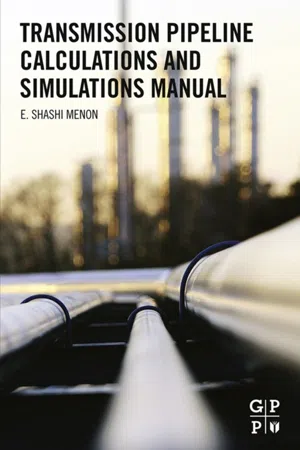
Transmission Pipeline Calculations and Simulations Manual
About this book
Transmission Pipeline Calculations and Simulations Manual is a valuable time- and money-saving tool to quickly pinpoint the essential formulae, equations, and calculations needed for transmission pipeline routing and construction decisions. The manual's three-part treatment starts with gas and petroleum data tables, followed by self-contained chapters concerning applications. Case studies at the end of each chapter provide practical experience for problem solving. Topics in this book include pressure and temperature profile of natural gas pipelines, how to size pipelines for specified flow rate and pressure limitations, and calculating the locations and HP of compressor stations and pumping stations on long distance pipelines.
- Case studies are based on the author's personal field experiences
- Component to system level coverage
- Save time and money designing pipe routes well
- Design and verify piping systems before going to the field
- Increase design accuracy and systems effectiveness
Information
Chapter One
Introduction to Transmission Pipelines
Abstract
Pipelines are used to transport liquids or gases from origin to end users. These pipelines may range from 4 in to 32 in or more in diameter. Over the last several years, pipelines have been built in the World ranging from 48 to 60 in or larger. These pipelines may be short lines, such a few feet to as much as a few thousand miles long. In addition to providing the necessary pipe material, we must also provide the necessary pressure in terms of pumping equipment and drivers as well as other related appurtenances such as valves, regulators, and scraper traps. The Trans-Alaska Pipeline is a well-known large-diameter pipeline built in the United States during the past 40 years at a cost of more than $8 billion (US) dollars.
Pipelines are used to transport liquids or gases from point of origin to point of consumption of liquids or gases. Transmission pipelines may be small diameter such as 4 in or the average size may range from 24 to 32 in or more in diameter. Over the course of several years, much larger pipelines have been built in the United States and abroad ranging from 48 to 60 in or larger diameter. These pipelines may be short lines, such as gathering lines ranging from a few feet to as much as a couple of miles. They may also be long trunk lines a few thousand miles long. In addition to providing the necessary pipe material, we must also provide the necessary pressure in terms of pumping equipment and drivers as well as other related appurtenances such as valves, regulators, and scraper traps. The Trans-Alaska Pipeline is a well-known large-diameter pipeline built in the United States during the past 25 years at a cost of more than $8 (US Billion) dollars.
In this book, we will concentrate on transmission pipelines used to transport liquids such as water, refined petroleum products as well as natural gas or compressible fluids such as propane and ethane. More sophisticated pipelines have also been built to transport exotic gases and liquids such as ethylene or compressed high-density carbon dioxide (CO2). The latter pipelines require extensive hydraulic simulation or modeling taking into account the thermodynamic properties of CO2 including liquid vapor diagrams as well as the complex formulas that define the behavior of high density CO2.
Starting with 1866 in Pennsylvania, United States, when the first practical pipeline was constructed by the entrepreneur and scientist Edwin Drake, the United States set the stage for the proliferation of practical utilization of pipelines ranging from a few miles to tens of thousands of miles all over the world.
It must be noted that although the US pioneered pipeline efforts in the 1800s, credit must be given to engineers, technicians, and scientists t...
Table of contents
- Cover image
- Title page
- Table of Contents
- Copyright
- Preface
- Chapter One. Introduction to Transmission Pipelines
- Chapter Two. Standards and Codes
- Chapter Three. Physical Properties
- Chapter Four. Pipeline Stress Design
- Chapter Five. Fluid Flow in Pipes
- Chapter Six. Pressure Required to Transport
- Chapter Seven. Thermal Hydraulics
- Chapter Eight. Power Required to Transport
- Chapter Nine. Pump Stations
- Chapter Ten. Compressor Stations
- Chapter Eleven. Series and Parallel Piping
- Chapter Twelve. Meters and Valves
- Chapter Thirteen. Pipeline Economics
- Chapter Fourteen. Case Studies
- Appendix
- References
- Index
Trusted by 375,005 students
Access to over 1.5 million titles for a fair monthly price.
Study more efficiently using our study tools.
Frequently asked questions
Yes, you can cancel anytime from the Subscription tab in your account settings on the Perlego website. Your subscription will stay active until the end of your current billing period. Learn how to cancel your subscription
No, books cannot be downloaded as external files, such as PDFs, for use outside of Perlego. However, you can download books within the Perlego app for offline reading on mobile or tablet. Learn how to download books offline
Perlego offers two plans: Essential and Complete
- Essential is ideal for learners and professionals who enjoy exploring a wide range of subjects. Access the Essential Library with 800,000+ trusted titles and best-sellers across business, personal growth, and the humanities. Includes unlimited reading time and Standard Read Aloud voice.
- Complete: Perfect for advanced learners and researchers needing full, unrestricted access. Unlock 1.5M+ books across hundreds of subjects, including academic and specialized titles. The Complete Plan also includes advanced features like Premium Read Aloud and Research Assistant.
We are an online textbook subscription service, where you can get access to an entire online library for less than the price of a single book per month. With over 1.5 million books across 990+ topics, we’ve got you covered! Learn about our mission
Look out for the read-aloud symbol on your next book to see if you can listen to it. The read-aloud tool reads text aloud for you, highlighting the text as it is being read. You can pause it, speed it up and slow it down. Learn more about Read Aloud
Yes! You can use the Perlego app on both iOS and Android devices to read anytime, anywhere — even offline. Perfect for commutes or when you’re on the go.
Please note we cannot support devices running on iOS 13 and Android 7 or earlier. Learn more about using the app
Please note we cannot support devices running on iOS 13 and Android 7 or earlier. Learn more about using the app
Yes, you can access Transmission Pipeline Calculations and Simulations Manual by E. Shashi Menon in PDF and/or ePUB format, as well as other popular books in Technologie et ingénierie & Sciences générales de l'informatique. We have over 1.5 million books available in our catalogue for you to explore.