- 728 pages
- English
- ePUB (mobile friendly)
- Available on iOS & Android
eBook - ePub
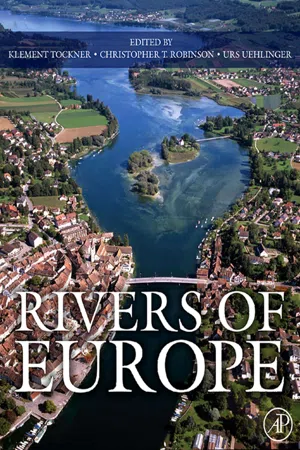
Rivers of Europe
About this book
Based on the bestselling book, Rivers of North America, this new guide stands as the only primary source of complete and comparative baseline data on the biological and hydrological characteristics of more than 180 of the highest profile rivers in Europe. With numerous full-color photographs and maps, Rivers of Europe includes conservation information on current patterns of river use and the extent to which human society has exploited and impacted them. Rivers of Europe provides the information ecologists and conservation managers need to better assess their management and meet the EU legislative good governance targets.
- Coverage on more than 180 European rivers
- Summarizes biological, ecological and biodiversity characteristics
- Provides conservation managers with information to resolve conflicts between recreational use of rivers, their use as a water supply, and the need to conserve natural habitats
- Data on river hydrology (maximum , minimum and average flow rates), seasonal variation in water flow
- Numerous full-color photographs
- Information on the underlying geology and its affect on river behaviour
Information
Topic
Physical SciencesSubtopic
HydrologyChapter 1
Introduction to European Rivers
Klement Tockner, Leibniz-Institute of Freshwater Ecology and Inland Fisheries (IGB), Müggelseedamm 310, Berlin, Germany; Institute of Biology, Freie Universität, Berlin, Germany
Diego Tonolla, Swiss Federal Institute of Aquatic Science and Technology (Eawag), Box 611, 8600 Duebendorf, Switzerland
Urs Uehlinger, Swiss Federal Institute of Aquatic Science and Technology (Eawag), Box 611, 8600 Duebendorf, Switzerland
Rosi Siber, Swiss Federal Institute of Aquatic Science and Technology (Eawag), Box 611, 8600 Duebendorf, Switzerland
Christopher T. Robinson, Swiss Federal Institute of Aquatic Science and Technology (Eawag), Box 611, 8600 Duebendorf, Switzerland
Fabian D. Peter, Swiss Federal Institute of Aquatic Science and Technology (Eawag), Box 611, 8600 Duebendorf, Switzerland
Publisher Summary
Rivers recognize no political boundaries. This is particularly true for Europe, which has over 150 transboundary rivers. For example, the Danube is the 29th longest river globally and it drains parts of 19 countries and 10 ecoregions. Further, 8 of the 10 largest catchments in Europe are in the eastern plains of Russia and the Ukraine and information on their present status is highly limited. Europe also has a long history in river training with most rivers being severely fragmented, channelized, and polluted. The European Union launched an ambitious program called the Water Framework Directive (WFD), which requires a catchment management plan for all major European rivers for achieving “good ecological status” by 2015. This chapter provides a comprehensive overview of all major European catchments included in the book, starting with the bio-geographic setting, with an emphasis on physiography, hydrology, ecology/biodiversity, and human impacts.
1.1 INTRODUCTION
Rivers recognize no political boundaries. This is particularly true for Europe, which has over 150 transboundary rivers (Whitton 1984). For example, the Danube is the 29th longest river globally, and it drains parts of 19 countries and 10 ecoregions. Further, 8 of the 10 largest catchments in Europe (Figures 1.1 and 1.2, Table 1.1) are in the eastern plains of Russia and the Ukraine and information on their present status is highly limited. Europe also has a long history in river training with most rivers being severely fragmented, channelized, and polluted (Petts et al. 1989; Kristensen & Hansen 1994; Tockner & Stanford 2002; UNEP 2004; Nilsson et al. 2005). Recently, the European Union launched an ambitious program called the Water Framework Directive...
Table of contents
- Cover image
- Title page
- Table of Contents
- List of Contributors
- Foreword
- Preface and Acknowledgements
- Chapter 1: Introduction to European Rivers
- Chapter 2: Volga River Basin
- Chapter 3: The Danube River Basin
- Chapter 4: The Iberian Rivers
- Chapter 5: Continental Atlantic Rivers
- Chapter 6: The Rhine River Basin
- Chapter 7: The Rhône River Basin
- Chapter 8: The Fennoscandian Shield
- Chapter 9: Arctic Rivers
- Chapter 10: British and Irish Rivers
- Chapter 11: Rivers of the Balkans
- Chapter 12: The Italian Rivers
- Chapter 13: Western Steppic Rivers
- Chapter 14: Rivers of the Central European Highlands and Plains
- Chapter 15: Rivers of the Boreal Uplands
- Chapter 16: Baltic and Eastern Continental Rivers
- Chapter 17: Rivers of Turkey
- Chapter 18: Ural River Basin
- Chapter 19: European Rivers: A Personal Perspective
- Index
Trusted by 375,005 students
Access to over 1.5 million titles for a fair monthly price.
Study more efficiently using our study tools.
Frequently asked questions
Yes, you can cancel anytime from the Subscription tab in your account settings on the Perlego website. Your subscription will stay active until the end of your current billing period. Learn how to cancel your subscription
No, books cannot be downloaded as external files, such as PDFs, for use outside of Perlego. However, you can download books within the Perlego app for offline reading on mobile or tablet. Learn how to download books offline
We are an online textbook subscription service, where you can get access to an entire online library for less than the price of a single book per month. With over 1.5 million books across 990+ topics, we’ve got you covered! Learn about our mission
Look out for the read-aloud symbol on your next book to see if you can listen to it. The read-aloud tool reads text aloud for you, highlighting the text as it is being read. You can pause it, speed it up and slow it down. Learn more about Read Aloud
Yes! You can use the Perlego app on both iOS and Android devices to read anytime, anywhere — even offline. Perfect for commutes or when you’re on the go.
Please note we cannot support devices running on iOS 13 and Android 7 or earlier. Learn more about using the app
Please note we cannot support devices running on iOS 13 and Android 7 or earlier. Learn more about using the app
Yes, you can access Rivers of Europe by Klement Tockner,Urs Uehlinger,Christopher T. Robinson in PDF and/or ePUB format, as well as other popular books in Physical Sciences & Hydrology. We have over 1.5 million books available in our catalogue for you to explore.