- 178 pages
- English
- ePUB (mobile friendly)
- Available on iOS & Android
eBook - ePub
Crazing Technology for Polyester Fibers
About this book
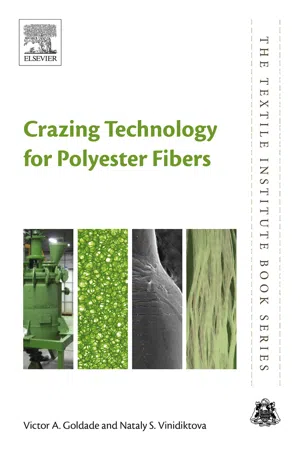
Crazing Technology for Polyester Fibers reviews PET fibers crazing in surface-active liquids and the use of the crazing mechanism for fiber modification by functional additives. The first chapter reviews existing literature, and subsequent chapters present the research of the authors, with an emphasis on how these techniques can be used to create textiles for a wide variety of purposes.
With two highly regarded and very experienced authors bringing together the latest information on polyester crazing technology, this book is essential reading for scientific researchers, engineers, and R&D professionals working on the development of fibers for improving the properties of textiles.
- Explains fiber crazing mechanisms and processes with a view to their use in developing polyester-based high-performance textiles
- Focuses on how this mechanism can be used to confer important characteristics, such as antimicrobial properties, reduced flammability, and repellency, making this essential reading for textile scientists and technicians
- Explores novel techniques and methods for readers who require cutting-edge knowledge of developments in fiber crazing
Information
Subtopic
Scienza dei materiali1
Polymer restructuring at plastic deformation
Abstract
Large forced elastic deformations which cause the total transition of a specimen into the oriented state are a unique property of polymers. Classical representations of this phenomenon which form the core of the orientational drawing as a basic technology for processing the fibers made from synthetic polymers have been complemented by new data on intermediate stages of the drawing which precede the achievement of maximally oriented state by the polymer material. This particularly applies to the emergence of shear bands of finely dispersed fibrillar structure, crazes initiation, and their collapse in the shear flow process which are accompanied by the changes in the polymer internal and free energy. These patterns logically conform to the fundamental concepts on polymers deformation which are summarized in this chapter.
Keywords
Synthetic fibers; Phase state; Deformation; Orientational drawing; Crazes; Collapse
The process of plastic deformation of solid polymers, which is well studied and described in numerous encyclopedic and reference books, takes place by physical and chemical mechanisms which are not similar at different stages of deformation. Since, in most cases, the final result of deformation is of primary importance, its intermediate stages and the corresponding polymer restructuring are therefore often neglected.
Let us take the following example. At drawing a polymer specimen up to the yield point (the Hookean region in the stress-strain curve), the elastic deformations are evenly distributed throughout the specimen volume. After the yield point has been reached (the curve area from the yield point to the point where the constant value of stress in the specimen is reached), the distribution of deformations becomes uneven. Areas with different extents of deformation divided according to the so-called shear bands are formed in the specimen. This means that the polymer material structure has lost its stability in the mechanical stress field. Appearance of the yield “drop” on the stress-strain curve is a sign of loss in stability. A neck is formed in the specimen, followed by a period of forced yielding when orientation of supramolecular formations and free macromolecules along the axis of tension takes places. The multistage transition to the flow is another type of the loss in structural stability by the material.
Most often, only materials scientists pay attention to such details, since the designers and technologists are interested primarily in integral indicators of strength and deformation of polymer material. However, the processes of loss in stability are of great practical interest as the basis for development of methods to modify the polymers with substances which are thermodynamically incompatible with them. Physico-chemical mechanisms of loss in stability (which are called “the self-organization phenomenon in polymers at deformation” in Ref. [1]) are discussed later. They constitute the scientific basis for technologies of target modification of chemical fibers covered in the book.
1.1 Terminology
At first glance, it seems superfluous to pay attention to basic terms of physics and materials science of polymers as their definitions can be found in encyclopedic publications. However, analysis of the works on physical chemistry of polymers shows that numerous nuances related to establishment of new patterns in polymer materials deformation have emerged in interpretation of these terms in recent decades. In addition, many similar terms, often buzzwords, taken from the translated literature with a close but slightly different meaning have appeared.
When presenting the book material, the authors seek to give the most correct description of physical and chemical mechanisms of the polymer structure transformation in the process of deformation. The reliability of scientific rationales for new industrial technologies described in this book depends, to a great extent, on the accuracy of such assessments. We believe that the refined interpretation of the terms given below will allow us to present more convincingly the physico-chemical background for new technologies.
The crystalline state is energetically the most favorable condition of the substance, therefore the natural change in time of the structure of solid bodies inevitably brings them to varying degrees of orderliness.
In principle, synthetic polymers consisting of flexible macromolecules of various lengths (molecular-weight distribution is one of the most important characteristics of their structure) cannot be completely crystalline. Crystallization occurs by the mechanism of chain folding at nanodimensional areas, thus leading to formation of crystallites which form the crystal phase registered by X-ray diffraction techniques. The chains that have not been incorporated into the crystallite constitute the adjacent amorphous phase.
The thermodynamic impossibility to obtain 100% crystallinity of synthetic polymers was a reason behind naming the polymers capable of crystallization as “partially crystalline” or “amorphous-crystalline.” This stipulates, firstly, the availability of significant free volume in their structure and, secondly, the potential possibility to fill it with target modifiers; this fact was first noted by the outstanding Lithuanian physicist-chemist and materials scientist A.N. Machulis [2].
The high-elasticity state is a physical condition of polymer materials in which they are capable of huge (about hundreds of percent) reversible deformations at strain. Unlike inorganic crystals which deformation is accompanied by the change of interatomic and intermolecular distances, high-elastic deformation of polymers is related to expansion of flexible macromolecules and movement of their links. The force that returns the chains into the initial position does not result from intermolecular interactions, but is generated by thermal motion of links. At thermal motion, flexible macromolecules can be in different conformations; these are possible due to availability of free volume in the polymer structure. Conformational transition occurs at rotation of the chain links around individual bonds and is accompanied by the changes in free energy W=U−TS and entropy S, while the internal energy of macromolecule is U=const.
Forced high elasticity, which has recently been named “shear yielding,” develops in the process of deformation of polymer specimens under stresses exceeding the yield point. It is a piece of the polymer material flow on the stress-strain curve.
The glassy state is the nonequilibrium state of the solid substance which occurs at hardening of its overcooled melt. When heated, the substances in the glassy state are softened and change into the high-elasticity state. Reversibility of this transition at the temperature decrease is a feature which distinguishes the glassy state from the other noncrystalline states. The emergence of the glassy state is accompanied with the decrease in the substance internal energy. The crystalline state is a steady-state condition corresponding to the absolute minimum of energy. Therefore, materials in the glassy state are metastable, and their structure is becoming ordered in the course of time.
High-molecular compounds belong to the class of substances which can go into the glassy state. This develops in polymers with primary irregularity of molecular structure: irregular sequence of monomer units in a macromolecule [polystyrene, polypropylene (PP), polyethylene terephthalate (PET)] and branching in macromolecules. Flexibility of macromolecules decreases as the melt of such polymers cools down. This interferes with arrangement of the macromolecule segments into crystallites, and deep supercooling of the melt results in “freezing” of the short-range order in the chain links arrangement. The number of conformational states of macromolecules reduces and, respectively, the entropy of fusion drops dramatically or vanishes. The loss in yielding flow and high-elastic deformation capability by the polymer material stipulates a transition to the glassy state.
At temperatures below the melting temperature (T<Tm), three relaxation transitions γ, β, and α (designated according to the temperature increase) take place in the amorphous-crystalline polymers. The α-transition is usually associated with the mobility of segments in crystallites; the β-transition—with the mobility of large segments and γ-transition—small segments in noncrystalline areas. When heated, polymer glass acquires high elasticity, unlike the low-molecular glassy substances, which melt upon heating.
The amorphous state is the solid noncrystalline state of the substance which is characterized by isotropy of physical properties, lack of melting...
Table of contents
- Cover image
- Title page
- Table of Contents
- Copyright
- Preface
- Abbreviations and denotations
- 1: Polymer restructuring at plastic deformation
- 2: Modification of synthetic fibers
- 3: Antimicrobial fibers
- 4: Fibers of reduced combustibility
- 5: Aromatized and repellent fibers
- 6: Fibers for securities protection from counterfeit
- 7: Novel crazing technology applications
- Conclusion
- Index
Trusted by 375,005 students
Access to over 1.5 million titles for a fair monthly price.
Study more efficiently using our study tools.
Frequently asked questions
Yes, you can cancel anytime from the Subscription tab in your account settings on the Perlego website. Your subscription will stay active until the end of your current billing period. Learn how to cancel your subscription
No, books cannot be downloaded as external files, such as PDFs, for use outside of Perlego. However, you can download books within the Perlego app for offline reading on mobile or tablet. Learn how to download books offline
Perlego offers two plans: Essential and Complete
- Essential is ideal for learners and professionals who enjoy exploring a wide range of subjects. Access the Essential Library with 800,000+ trusted titles and best-sellers across business, personal growth, and the humanities. Includes unlimited reading time and Standard Read Aloud voice.
- Complete: Perfect for advanced learners and researchers needing full, unrestricted access. Unlock 1.5M+ books across hundreds of subjects, including academic and specialized titles. The Complete Plan also includes advanced features like Premium Read Aloud and Research Assistant.
We are an online textbook subscription service, where you can get access to an entire online library for less than the price of a single book per month. With over 1.5 million books across 990+ topics, we’ve got you covered! Learn about our mission
Look out for the read-aloud symbol on your next book to see if you can listen to it. The read-aloud tool reads text aloud for you, highlighting the text as it is being read. You can pause it, speed it up and slow it down. Learn more about Read Aloud
Yes! You can use the Perlego app on both iOS and Android devices to read anytime, anywhere — even offline. Perfect for commutes or when you’re on the go.
Please note we cannot support devices running on iOS 13 and Android 7 or earlier. Learn more about using the app
Please note we cannot support devices running on iOS 13 and Android 7 or earlier. Learn more about using the app
Yes, you can access Crazing Technology for Polyester Fibers by Victor Goldade,Nataly Vinidiktova in PDF and/or ePUB format, as well as other popular books in Tecnologia e ingegneria & Scienza dei materiali. We have over 1.5 million books available in our catalogue for you to explore.