eBook - ePub
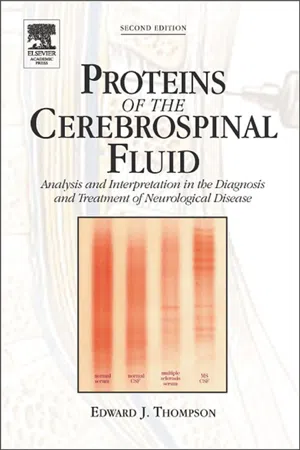
Proteins of the Cerebrospinal Fluid
Analysis & Interpretation in the Diagnosis and Treatment of Neurological Disease
- 300 pages
- English
- ePUB (mobile friendly)
- Available on iOS & Android
eBook - ePub
Proteins of the Cerebrospinal Fluid
Analysis & Interpretation in the Diagnosis and Treatment of Neurological Disease
About this book
The analysis of the protein content of the Cerebrospinal Fluid (CSF) is a central tool in the diagnosis of a number of diseases, including Multiple Sclerosis and Encephalitis. Proteins of the Cerebrospinal Fluid is a complete revision of the first edition published 16 years ago and reflects the advances in the field in that period. Containing the most comprehensive reference list available today with over 1300 references cross-indexed according to topics, it also includes many classical works that cannot be easily found through the public literature database (like PubMed). This book covers new areas of research such as the use of the analysis of protein content in the CSF to guide the prognosis of patients with severe head injury and/or stroke (currently being tested using technology which can be applied at the bedside to yield results within 15 minutes).
With many new or completely revised illustrations, this book serves as not only a reference on the topic, but also a lab manual for bench work with recipes, and a clinical reference on individual diseases.
- Introduces the Eastern blotting, the technique considered the "gold standard" by the US Food & Drug Administration (FDA) for the demonstration of IgG by immunofixation following isoelectric focusing
- Provides numerous tables for ease-of-use
- Extensively cross-referenced with over 1300 references
Trusted by 375,005 students
Access to over 1.5 million titles for a fair monthly price.
Study more efficiently using our study tools.
Information
Subtopic
NeurologyIndex
Biological SciencesCHAPTER 1
Brief historical review of CSF proteins
Publisher Summary
This chapter outlines the history of cerebrospinal fluid (CSF) protein. It also reviews several studies done for practical analysis of CSF. Tourtellotte’s was one of the first to recognize the importance of immunofixation for the study of CSF proteins. The idea of molecular size as a relevant factor during the process of CSF filtration was popularized. It was shown that the bands in the gamma region on CSF electrophoresis are IgG. Although there had been previous immunochemical work on brain-specific proteins, Link showed, using biochemical analyses, which the beta trace and gamma trace, were neither IgG nor its fragments. Elizabeth Bock showed that brain-specific antigens could be found in the CSF. She later showed that one of Blake Moore’s original brain-specific proteins was in fact enolase, an enzyme in the Emden–Meyerhoff pathway of extra-mitochondrial glycolysis. This now plays a role in Sydenham’s chorea. Carl-Bertil Laurell, developed “rocket” method of quantitative immunochemical precipitation enhanced by an electrophoretic technique.
Introduction
CSF is somewhat like a Cinderella fluid, but continuing interest is seen by the publication of several books on the subject [202, 279, 282, 903]. The brief review given in this chapter is not intended to be exclusive but rather a short catalogue of some of the present facts concerning CSF which we take for granted, as well as some implications to further our understanding of this subject. While some may take umbrage at not being included, I have opted mainly for the ‘communicators’, who in some cases were better at promulgating particular ideas than were the ‘originators’.
By a strange quirk of fate, I now find myself in the same institution (UCLH) as the late Dr Essex-Wynter, who was a medical registrar at the Middlesex Hospital over a hundred years ago. When Quincke wrote his classical paper in September 1891 [894], he referred to the earlier paper of Essex-Wynter published in May 1891 [258] saying that he (Quincke) followed the technique of Essex-Wynter. Although people typically think of Quincke as measuring total protein and specific gravity, in fact Essex-Wynter measured not only ‘albumen’ and specific gravity but also sugar, chloride, and pH (alkaline). It is therefore appropriate to show a picture (Figure 1.1) of Essex-Wynter as the first man to measure proteins in human CSF.
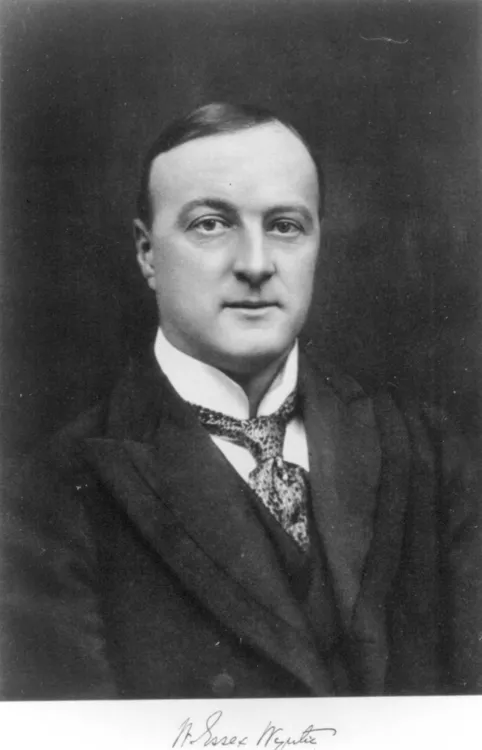
Investigators of CSF proteins
Although one can always return to the past and reawaken some of the earliest interests in the ‘water of the brain’, a clear start to modern biochemical analysis began in 1942 [515]. Elvin Kabat, a biochemist working at Columbia Presbyterian Hospital in New York City, showed, using the Tiselius electrophoresis apparatus, that CSF differed from serum in that prealbumin (which he termed protein ‘X’) was specific to spinal fluid. For these analyses, he required up to 70 ml of CSF – i.e. approximately half of a patient’s total fluid volume (about 125 ml)! Hence he used mainly pooled CSF samples. The next major step, again taken by Kabat [514], was the quantitative immunochemical precipitation of albumin and IgG, thereby reducing the volume of CSF required to about 2 ml. This heralded the beginning of routine CSF analysis, and not only allowed large numbers of patients to be studied but also led to practical aids for the diagnosis of individual patients. Another early investigator of CSF was Scheid, who also performed electrophoresis in 1944 (see [268]).
Although many previous workers had performed electrophoresis on a micro-scale using paper [46, 180], it was Armand Lowenthal, a neurologist working in the Institute Bunge in Berchem-Antwerp, Belgium, who wrote the classic book Agar Gel Electrophoresis in Neurology [671]. This plus his seminal paper [677] focused attention on the CSF in MS, showing that the presence of bands in the gamma region was an important clue to the pathogenesis of the disease. Yet again, a technique of qualitative analysis would lead to practical diagnosis. The careful work of Denise Karcher (with Lowenthal) showed that the individual bands in the gamma region from patients with subacute sclerosing panencephalitis in fact represented individual idiotypes of IgG [534, 1104].
Over a similar course of time another neurologist, Wallace Tourtellotte, working in Ann Arbor, Michigan, was amassing data to show that plaques of MS brain contained higher amounts of IgG than could be found in the corresponding CSF compared with parallel serum [1175, 1176], thus leading via a different route to the same seminal notion of local synthesis of IgG within the brain. On a more practical level, but nonetheless of fundamental relevance to clinical practice, there are still too few physicians who realize the value of Tourtellotte’s little book Post-lumbar Puncture Headaches [1170], in which he showed convincingly that the small size of the needle is more important than all of the other machinations which have been performed in vain attempts to alleviate the headache which sometimes follows lumbar puncture. Using the ‘needle within a needle’ technique [1171] the incidence of headache was not 30 per cent (as with an 18-gauge needle) or even 3 per cent (as with a 21-gauge needle), but only 0.3 per cent with a 25-gauge needle. Some would argue that no pressure reading is obtained, since the CSF is removed by syringe. This is circumvented by prior filling of the monitor with saline to 300 mm, and if the fluid goes down, the pressure is normal. Slightly more worrying is the notion carried by some younger neurologists that to perform a lumbar puncture is rather old-fashioned, especially if they are accustomed to MRI or PET scans. Neither the most powerful magnet nor the most oblique X-ray will visualize the bacterium or the virus, and hence the possible diagnosis of infection should always be sought from the spinal fluid as a matter of priority for a potentially curable inflammatory disorder. Returning to practical CSF analysis, Tourtellotte’s other classic contribution must be his use of the Laurell rocket technique [1182] whereby both albumin and IgG estimation are performed on the same agar dish (and since they carry opposite charges he arranged for them to migrate in opposite directions), which again allowed him to amass a large number of results from his bank of tissue samples. Last but not least, he was also one of the first to recognize the importance of immunofixation for the study of CSF proteins [127].
Another neurologist, Klaus Felgenhauer, working in Cologne, Germany, popularized the idea of molecular size as a relevant factor during the process of CSF filtration; namely that small molecules in serum enter CSF more readily than larger proteins [271]. Although there was previous work by Rosenthal and Soothill [951], the wider audience was more often drawn to the author of ‘Protein size and CSF composition’, than of ‘An immunochemical study of the proteins in the CSF’. Felgenhauer also wrote a mini-classic (in German) on acrylamide electrophoresis, where he successfully combined quantitative scanning of the gel following the qualitative fractionation of up to 40 CSF proteins. He also showed that high molecular weight haptoglobin oligomers were not present in normal CSF, and this remains one of the most subtle but definite abnormalities to be found in CSF, long before any gross elevation of the level of CSF total protein [268]. His basic discovery of the important role of alpha-2-macroglobulin as a parameter of barrier function is still insufficiently appreciated.
Bodvar Vandvik, a neurologist working in Oslo, Norway showed that more than 90 per cent of the antibody in SSPE CSF was specifically anti-measles, using adsorption to measles-infected Vero cells [1228]. However, in MS the amount was trivial (less than 5 per cent).
Hans Link, a neurologist working in Linkoping, Sweden, showed in his MD thesis that the bands in the gamma region on CSF electrophoresis were in fact IgG [641]. Although there had been previous immunochemical work on brain-specific proteins [220, 455] Link showed, using biochemical analyses, that the beta trace and gamma trace were neither IgG nor its fragments.
Elizabeth Bock, a psychiatrist working in Copenhagen, Denmark, showed that brain-specific antigens could be found in the CSF [71]. She later showed that one of Blake Moore’s [772] original brain-specific proteins (14–3–2) was in fact enolase [74], an enzyme in the Emden–Meyerhoff pathway of extra-mitochondrial glycolysis. This now plays a role in Sydenham’s chorea.
Magnhild Sandberg-Wollheim, a neurologist/neuro-ophthalmologist working in Lund, Sweden, showed that CSF lymphocytes from patients with MS synthesized radiolabelled proteins which migrated in the gamma region after incubation of the CSF cells in tissue culture [976]. Once again, there had been prior work of similar nature by Cohen and Bannister [161].
Christian Laterre, a neurologist working in Louvain, Belgium, wrote his postdoctoral thesis on an extensive survey of abnormalities of CSF proteins (which had been separated by agar gel electrophoresis) in several diseases, which was rather encyclopedic in its day [616]. He then condensed this into quite a readable article ...
Table of contents
- Cover image
- Title page
- Table of Contents
- Foreword
- Acknowledgement
- Introduction
- Abbreviations
- Chapter 1: Brief historical review of CSF proteins
- Part 1: Normal CSF proteins, an overview
- Part 2: Normal CSF proteins, detailed discussion
- Part 3: Individual diseases, and the future
- Part 4: Appendices
- Chapter 16: Cross-index of references
- References
- Index
Frequently asked questions
Yes, you can cancel anytime from the Subscription tab in your account settings on the Perlego website. Your subscription will stay active until the end of your current billing period. Learn how to cancel your subscription
No, books cannot be downloaded as external files, such as PDFs, for use outside of Perlego. However, you can download books within the Perlego app for offline reading on mobile or tablet. Learn how to download books offline
Perlego offers two plans: Essential and Complete
- Essential is ideal for learners and professionals who enjoy exploring a wide range of subjects. Access the Essential Library with 800,000+ trusted titles and best-sellers across business, personal growth, and the humanities. Includes unlimited reading time and Standard Read Aloud voice.
- Complete: Perfect for advanced learners and researchers needing full, unrestricted access. Unlock 1.5M+ books across hundreds of subjects, including academic and specialized titles. The Complete Plan also includes advanced features like Premium Read Aloud and Research Assistant.
We are an online textbook subscription service, where you can get access to an entire online library for less than the price of a single book per month. With over 1.5 million books across 990+ topics, we’ve got you covered! Learn about our mission
Look out for the read-aloud symbol on your next book to see if you can listen to it. The read-aloud tool reads text aloud for you, highlighting the text as it is being read. You can pause it, speed it up and slow it down. Learn more about Read Aloud
Yes! You can use the Perlego app on both iOS and Android devices to read anytime, anywhere — even offline. Perfect for commutes or when you’re on the go.
Please note we cannot support devices running on iOS 13 and Android 7 or earlier. Learn more about using the app
Please note we cannot support devices running on iOS 13 and Android 7 or earlier. Learn more about using the app
Yes, you can access Proteins of the Cerebrospinal Fluid by Edward J. Thompson in PDF and/or ePUB format, as well as other popular books in Biological Sciences & Neurology. We have over 1.5 million books available in our catalogue for you to explore.