eBook - ePub
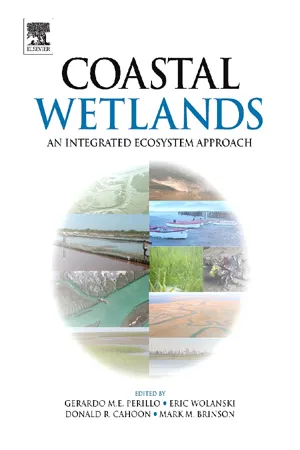
Coastal Wetlands
An Integrated Ecosystem Approach
- 974 pages
- English
- ePUB (mobile friendly)
- Available on iOS & Android
eBook - ePub
Coastal Wetlands
An Integrated Ecosystem Approach
About this book
Coastal wetlands are under a great deal of pressure from the dual forces of rising sea level and the intervention of human populations both along the estuary and in the river catchment. Direct impacts include the destruction or degradation of wetlands from land reclamation and infrastructures. Indirect impacts derive from the discharge of pollutants, changes in river flows and sediment supplies, land clearing, and dam operations. As sea level rises, coastal wetlands in most areas of the world migrate landward to occupy former uplands. The competition of these lands from human development is intensifying, making the landward migration impossible in many cases. This book provides an understanding of the functioning of coastal ecosystems and the ecological services that they provide, and suggestions for their management. In this book a CD is included containing color figures of wetlands and estuaries in different parts of the world.
- Includes a CD containing color figures of wetlands and estuaries in different parts of the world.
Information
Topic
Physical SciencesSubtopic
Geology & Earth SciencesTable of contents
- Cover Image
- Table of Contents
- Copyright Page
- Preface
- List of Contributors
- List of Reviewers
- Chapter 1. Coastal Wetlands
- Chapter 2. The Morphology and Development of Tropical Coastal Wetlands
- Chapter 3. Temperate Coastal Wetlands
- Chapter 4. Polar Coastal Wetlands
- Chapter 5. Intertidal Eco-Geomorphological Dynamics and Hydrodynamic Circulation
- Chapter 6. Tidal Courses
- Chapter 7. Heat Energy Balance in Coastal Wetlands
- Chapter 8. Hydrodynamics and Modeling of Water Flow in Mangrove Areas
- Chapter 9. Mathematical Modeling of Tidal Flow over Salt Marshes and Tidal Flats with Applications to the Venice Lagoon
- Chapter 10. Geomorphology and Sedimentology of Tidal Flats
- Chapter 11. Intertidal Flats
- Chapter 12. Biogeochemical Dynamics of Coastal Tidal Flats
- Chapter 13. Productivity and Biogeochemical Cycling in Seagrass Ecosystems
- Chapter 14. Tidal Salt Marshes
- Chapter 15. Ecosystem Structure of Tidal Saline Marshes
- Chapter 16. Salt Marsh Biogeochemistry – An Overview
- Acknowledgments
- 1. Introduction
- 2. Carbon
- 3. Nitrogen
- 4. Iron and Sulfur
- 5. Phosphorus
- 6. Marshes in Transition and Directions for Future Work
- Chapter 17. The Role of Freshwater Flows on Salt Marsh Growth and Development
- Chapter 18. Tidal Freshwater Wetlands
- Chapter 19. Biogeochemistry of Tidal Freshwater Wetlands
- Chapter 20. Geomorphology and Sedimentology of Mangroves
- Chapter 21. Geomorphology and Sedimentology of Mangroves and Salt Marshes
- Chapter 22. Paradigm Shifts in Mangrove Biology
- Chapter 23. Ecogeomorphic Models of Nutrient Biogeochemistry for Mangrove Wetlands
- Chapter 24. Seagrass Restoration
- Chapter 25. Tidal Marsh Creation
- Chapter 26. Salt Marsh Restoration
- Chapter 27. Managed Realignment
- Chapter 28. Methods and Criteria for Successful Mangrove Forest Restoration
- Chapter 29. Evaluation of Restored Tidal Freshwater Wetlands
- Chapter 30. Surface Elevation Models
- Chapter 31. Salt Marsh–Mangrove Interactions in Australasia and the Americas
- Chapter 32. Wetland Landscape Spatial Models
- Subject Index
Trusted by 375,005 students
Access to over 1.5 million titles for a fair monthly price.
Study more efficiently using our study tools.
Frequently asked questions
Yes, you can cancel anytime from the Subscription tab in your account settings on the Perlego website. Your subscription will stay active until the end of your current billing period. Learn how to cancel your subscription
No, books cannot be downloaded as external files, such as PDFs, for use outside of Perlego. However, you can download books within the Perlego app for offline reading on mobile or tablet. Learn how to download books offline
Perlego offers two plans: Essential and Complete
- Essential is ideal for learners and professionals who enjoy exploring a wide range of subjects. Access the Essential Library with 800,000+ trusted titles and best-sellers across business, personal growth, and the humanities. Includes unlimited reading time and Standard Read Aloud voice.
- Complete: Perfect for advanced learners and researchers needing full, unrestricted access. Unlock 1.5M+ books across hundreds of subjects, including academic and specialized titles. The Complete Plan also includes advanced features like Premium Read Aloud and Research Assistant.
We are an online textbook subscription service, where you can get access to an entire online library for less than the price of a single book per month. With over 1.5 million books across 990+ topics, we’ve got you covered! Learn about our mission
Look out for the read-aloud symbol on your next book to see if you can listen to it. The read-aloud tool reads text aloud for you, highlighting the text as it is being read. You can pause it, speed it up and slow it down. Learn more about Read Aloud
Yes! You can use the Perlego app on both iOS and Android devices to read anytime, anywhere — even offline. Perfect for commutes or when you’re on the go.
Please note we cannot support devices running on iOS 13 and Android 7 or earlier. Learn more about using the app
Please note we cannot support devices running on iOS 13 and Android 7 or earlier. Learn more about using the app
Yes, you can access Coastal Wetlands by Gerardo M.E. Perillo,Eric Wolanski,Donald R. Cahoon,Mark M. Brinson in PDF and/or ePUB format, as well as other popular books in Physical Sciences & Geology & Earth Sciences. We have over 1.5 million books available in our catalogue for you to explore.