- 656 pages
- English
- ePUB (mobile friendly)
- Available on iOS & Android
eBook - ePub
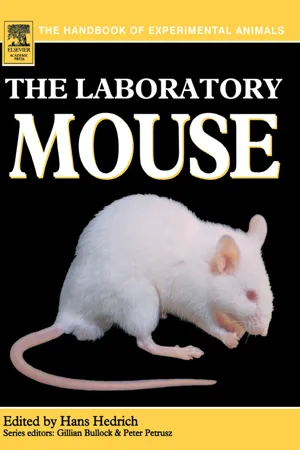
The Laboratory Mouse
About this book
Among animals used in research, teaching and testing, mice are now widely recognized as the most important model for human diseases and disorders. They comprise the majority of all experimental mammals and tend to be the model of choice used for research into many diseases/disorders including cancer, heart disease, asthma, Alzheimer's, Down syndrome, deafness, osteoporosis, obesity, diabetes and even mental health research. Additionally the laboratory mouse continues to play a widely publicized vital role in the human genome project.One of the most time-consuming activities in research laboratories is looking up information specific to the species or strain of animal being used. This book, part of the highly successful Handbook of Experimental Animals series, allows the user quick access to any point of interest on the mouse as an experimental model.* Edited by Hans Hedrich, Hannover Medical School* Comprehensive reference source written by international experts* Well-illustrated with high quality detailed images* Two-color, user-friendly format combined with color plate sections
Information
Subtopic
ZoologyTable of contents
- Cover Image
- Title page
- The Handbook of Experimental Animals
- List of Editorial Advisory Board
- Copyright
- List of Contributors
- Foreword
- Preface
- Table of Contents
- Part 1: History, Development and Genetics of the Mouse as a Laboratory Model
- Part 2: Anatomy and Developmental Biology
- Part 3: Pathophysiology (Including Non-infectious Diseases)
- Part 4: Infectious Agents and Diseases
- Part 5: Animal Husbandry and Production
- Part 6: Procedures
- Glossary
- Index
- Color Plates
Trusted by 375,005 students
Access to over 1.5 million titles for a fair monthly price.
Study more efficiently using our study tools.
Frequently asked questions
Yes, you can cancel anytime from the Subscription tab in your account settings on the Perlego website. Your subscription will stay active until the end of your current billing period. Learn how to cancel your subscription
No, books cannot be downloaded as external files, such as PDFs, for use outside of Perlego. However, you can download books within the Perlego app for offline reading on mobile or tablet. Learn how to download books offline
We are an online textbook subscription service, where you can get access to an entire online library for less than the price of a single book per month. With over 1.5 million books across 990+ topics, we’ve got you covered! Learn about our mission
Look out for the read-aloud symbol on your next book to see if you can listen to it. The read-aloud tool reads text aloud for you, highlighting the text as it is being read. You can pause it, speed it up and slow it down. Learn more about Read Aloud
Yes! You can use the Perlego app on both iOS and Android devices to read anytime, anywhere — even offline. Perfect for commutes or when you’re on the go.
Please note we cannot support devices running on iOS 13 and Android 7 or earlier. Learn more about using the app
Please note we cannot support devices running on iOS 13 and Android 7 or earlier. Learn more about using the app
Yes, you can access The Laboratory Mouse by Hans Hedrich in PDF and/or ePUB format, as well as other popular books in Technology & Engineering & Zoology. We have over 1.5 million books available in our catalogue for you to explore.