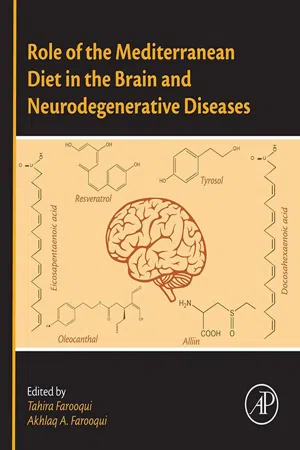
eBook - ePub
Role of the Mediterranean Diet in the Brain and Neurodegenerative Diseases
- 484 pages
- English
- ePUB (mobile friendly)
- Available on iOS & Android
eBook - ePub
Role of the Mediterranean Diet in the Brain and Neurodegenerative Diseases
About this book
Role of the Mediterranean Diet in the Brain and Neurodegenerative Disease provides a comprehensive overview of the effects of all components of the Mediterranean diet on the brain, along with its beneficial effects in neurodegenerative diseases. It covers topics on neurodegenerative diseases (Alzheimer disease (AD), Parkinson disease, (PD) Huntington disease (HD) and Amyotrophic Lateral Sclerosis (ALS), also providing information on how cardiovascular disease, Type 2 Diabetes, and Metabolic Syndrome become risk factors for neurodegenerative diseases. This book focuses on how the Mediterranean diet suppresses oxidative stress and neuroinflammation in neurodegenerative diseases as well as signal transduction.
The Mediterranean diet is characterized by the abundant consumption of olive oil, high consumption of plant foods (fruits, vegetables, pulses, cereals, nuts and seeds); frequent and moderate intake of wine (mainly with meals); moderate consumption of fish, seafood, yogurt, cheese, poultry and eggs; and low consumption of red meat and processed meat products. High consumption of dietary fiber, low glycemic index and glycemic load, anti-inflammatory effects, and antioxidant compounds may act together to produce favorable effects on health status. Collective evidence suggests that Mediterranean diet not only increases longevity by lowering cardiovascular disease, inhibiting cancer growth, but also by protecting the body from age-dependent cognitive decline.
- Comprehensively provides an overview of the effects of the Mediterranean diet on the brain and its beneficial effects in neurodegenerative diseases
- Discusses the relationship among Type 2 Diabetes, Metabolic Syndrome and Alzheimer's Disease, and the effect of the Mediterranean diet on normal aging, longevity, and other neurodegenerative diseases
- Focuses on how the Mediterranean diet suppresses oxidative stress and neuroinflammation in neurodegenerative disease
Trusted by 375,005 students
Access to over 1.5 million titles for a fair monthly price.
Study more efficiently using our study tools.
Information
Topic
Scienze biologicheSubtopic
NeurologiaChapter 1
Effects of Mediterranean Diet Components on Neurodegenerative Diseases
Akhlaq A. Farooqui1 and Tahira Farooqui2, 1Department of Molecular and Cellular Biochemistry, The Ohio State University, Columbus, OH, United States, 2Department of Entomology, The Ohio State University, Columbus, OH, United States
Abstract
Consumption of Mediterranean diet not only contributes to significant improvements in health status, but also delays the onset of chronic visceral and neurodegenerative diseases. The Mediterranean diet is characterized by a high intake of fresh fruits, vegetables, legumes, and whole grains, moderate to high intake of fish; a low intake of saturated lipids and high intake of olive oil, low intake of meat, and a modest intake of red wine. Mediterranean diet not only increases longevity by lowering cardiovascular disease, inhibiting cancer growth, but also by protecting the body from age-dependent cognitive decline. Studies on beneficial effects of Mediterranean pattern on human population have been controversial. However, it is becoming increasingly evident that long-term, double blind and randomized controlled trials on large human population are needed to know the beneficial effects of Mediterranean diet on human population.
Keywords
Mediterranean diet; vegetables and fruits; olive oil; resveratrol; docosahexaenoic acid; S-allyl-L-cysteine; allicin; oxidative stress; neuroinflammation
Introduction
Diet consumed in Mediterranean area (e.g., Italy, Spain, Greece, and Turkey) is called as Mediterranean diet. Components of Mediterranean diet include vegetables, legumes, fruits, whole grains, fish, olive oil, fresh garlic, low levels of dairy products (cheese and yogurt), nuts, and modest intake of red wine (Fig. 1.1).1 Fruits and vegetables are enriched in vitamins, carotenoids, flavonoids, fiber, potassium, magnesium, and other minerals. These components prevent age-related neurologic dysfunction not only by preventing free radical damage and neuroinflammation but also by protecting the body from age-dependent cognitive decline and increasing longevity (Fig. 1.1).1,2 Less information is available on the synergistic effects of various components of Mediterranean diet.3 A number of recent cross-sectional and prospective studies have attempted to gain further insight into the relationship between adherence to the overall Mediterranean diet pattern and age-related cognitive function.4,5 Thus Mediterranean diet has been reported to significantly decrease cognitive dysfunction and mortality in 182 men and women aged 70 years.6 This study has been recently extended to larger population in Greece (more than 22,000 adults) displaying a significant reduction in total mortality with greater adherence to the traditional Mediterranean diet.6 Recently meta-analysis of several studies has indicated that greater adherence to a Mediterranean-style diet not only contributes to longevity, but also shows reduction in risk for cardiovascular mortality and cancer incidences.7 These findings are promising. However, the results on cognitive function have been inconsistent. Some studies report a significant association between the Mediterranean diet consumption and age-related cognitive function,4,5,8 and others reveal no link.8–10 The individual components of the Mediterranean diet (tyrosol, hydroxytyrosol, oleocanthal, resveratrol, alliin, and docosahexaenoic and eicosapentaenoic acids) produce beneficial effects in human and animal models of chronic and acute neurological disorders such as Alzheimer disease (AD), Parkinson disease (PD), Huntington disease (HD), amyotrophic lateral sclerosis (ALS) and stroke by inhibiting oxidative stress, neuroinflammation, normalizing mitochondrial dysfunction, improving endothelial function, and increasing cognitive function.2 Although the above mentioned neurodegenerative diseases have different clinical and pathological features, the signal transduction mechanisms at the molecular level appear to overlap considerably.2,11 In several neurodegenerative diseases, the accumulation of proteins (typically, beta-amyloid (Aβ) in AD, and alpha-synuclein (α-S) in PD, mutated huntingtin in HD, and mutated Cu/Zn-superoxide dismutase, SOD, in ALS) misfolds and self-assembles via a nucleated-growth mechanism to form transient, low-molecular-weight soluble oligomers, later converting into β-sheet-rich protofibrils and finally stabilizes as highly ordered fibrillar structures. The shared mechanism of an aberrant conversion of the native, nontoxic structure of a protein into toxic aggregates, hence, classifies most neurodegenerative diseases as “protein misfolding disorders.”12

Long-term consumption of Mediterranean diet not only decreases oxidative stress and neuroinflammation in neurodegenerative diseases (Fig. 1.1), but also results in the increase in longevity through maintenance of the telomeres length and prevention of brain atrophy.13–15 Telomeres are essential and dynamic regulators of cellular life span and chromosome integrity in eukaryocyte. They are composed of guanine-rich sequence-TTAGGG. Each cell division is accompanied by shortening of telomeres into replicative senescence, which becomes susceptible to apoptosis when exposed to increased oxidative stress.16 DNA telomere length is maintained mainly by telomerase, and regulated by proinflammation cytokines and oxidative stress.16,17 Significant information has been published on beneficial effects of components of Mediterranean diet such as fish oil, olive oil, red wine pigment (resveratrol), garlic, and green and colored vegetables and fruits on brain. The purpose of this chapter is to provide information on molecular mechanism of beneficial effects of various components of Mediterranean diet and Mediterranean diet pattern not only on normal aging brain, but also in patients and animal models of neurodegenerative diseases.
Beneficial Effects of Fresh Vegetables and Fruits on the Brain
Long-term consumption of diet enriched in fresh vegetables and fruits in Mediterranean diet not only protects brain from acute and chronic neurological diseases, but also produces beneficial effects in a number of chronic visceral diseases, such as cancer, diabetes, and heart disease. These beneficial effects are not only due to the presence of antioxidants (α-tocopherol, ascorbic acid, and β-carotene), but also due to the effects of flavonoids (polyphenols and anthocyanins), which are present in fresh vegetable and fruits.18 Components of vegetables and fruits have been reported to modulate polyol pathway leading to the reduction in the development and intensity of oxidative stress, and consequently the development of diabetic complications. Furthermore, polyphenols (flavonoids, phenolic acids, proanthocyanidins, and tannins), which are present in vegetables and fruits, have been reported to alter glycemia by inhibiting carbohydrate digestion, reducing carbohydrate absorption in the intestines, stimulating the release of insulin from pancreatic β-cells, and modulating hepatic glucose output.19,20 Vegetable and fruits contain soluble and insoluble fibers, which affect intestinal tract time, absorption of macronutrients, alter the action of digestive enzymes and secretion of gastrointestinal and pancreatic hormones.21 Insoluble fiber can decrease intestinal tract time, potentially reducing time for the carbohydrates to be absorbed in the jejunum.22 Soluble fiber delays gastric emptying by slowing the absorption and digestion of carbohydrates potentially delaying the insulin response.22 In addition, nondigestive fiber is fermented by the microflora of the colon to produce short chain fatty acids. The production of short chain fatty acids also impacts on carbohydrate metabolism.23 Among vegetables, cruciferous vegetables such as broccoli, Brussels sprouts, cabbage, kale, and cauliflower contain isothiocyanates and indole-3-carbinol, which have been reported to produce anticancer effects. Vegetables and fruits contain high amounts of magnesium, potassium, and nitrate. These ions produce beneficial effects not only on circulatory system, but also on the brain and visceral tissues. Thus dietary magnesium regulates many kinases including tyrosine kinase, but also magnesium-dependent ATPase, and enzymes of glycolytic pathways. Tyrosine kinase is a component of the beta subunit of the insulin receptor. It increases insulin sensitivity by promoting translocation of GLUT4 leading to the uptake of glucose into the cell (Fig. 1.2). In addition, magnesium not only modulates vascular tone and responsiveness, but also influences acetylcholine-induced endothelium-dependent relaxation. Magnesium can also act by stabilizing cell membranes and functions as a signal transducer supporting the view that...
Table of contents
- Cover image
- Title page
- Table of Contents
- Copyright
- Dedication
- Book Quote
- List of Contributors
- Preface
- Acknowledgments
- Chapter 1. Effects of Mediterranean Diet Components on Neurodegenerative Diseases
- Chapter 2. The Mediterranean Diet and Healthy Brain Aging: Innovations From Nutritional Cognitive Neuroscience
- Chapter 3. Molecular and Intracellular Signaling Mechanisms of Herbs, Spices, and Food Components in the Mediterranean Diet in Improving Cognitive Function
- Chapter 4. The Molecular Basis for Protective Effect of Mediterranean Diet in Neurodegenerative Disorders
- Chapter 5. Multinutrient Approach to Slow Down Brain Aging and Related Neurodegenerative Disorders
- Chapter 6. Effect of Mediterranean Diet on Healthy Brain Aging: Involvement of Telomerase
- Chapter 7. Mediterranean Diet and Dementia: Can This Be a Preventive Approach?
- Chapter 8. Effects of Dietary Components on Microglia Inactivation in Alzheimer’s Disease
- Chapter 9. Contribution of Mediterranean Diet in the Prevention of Alzheimer’s Disease
- Chapter 10. Mediterranean Diet and Its Impact on Cognitive Functions in Aging
- Chapter 11. Mediterranean Diet and Diabetic Retinopathy
- Chapter 12. Mediterranean Diet as a Potential Strategy to Reduce Cognitive Decline and Dementia in Elderly
- Chapter 13. Effect of Mediterranean Diet Components on Type 2 Diabetes and Metabolic Syndrome
- Chapter 14. Interactions Between Age, Diet, and Insulin and Their Effect on Cognition: Implications for Alzheimer’s Disease
- Chapter 15. The Use of Polyphenols for the Treatment of Alzheimer’s Disease
- Chapter 16. Neuroprotective Effects of Garlic in Model Systems of Neurodegenerative Diseases
- Chapter 17. Neuroprotective Properties of Wine: Implications for the Prevention of Cognitive Impairment
- Chapter 18. Red Wine Retards Abeta Deposition and Neuroinflammation in Alzheimer’s Disease
- Chapter 19. Contribution of Diabetes and Metabolic Syndrome in the Pathogenesis of Alzheimer’s Disease
- Chapter 20. Effects of Western, Mediterranean, Vegetarian, and Okinawan Diet Patterns on Human Brain
- Chapter 21. Mediterranean Diet Is Beneficial: But, How, and Why?
- Chapter 22. Multinutrient Intervention in the Prevention and Treatment of Dementia
- Chapter 23. Cardioprotective Properties of Wine: Implications for the Management of Neurodegenerative Diseases
- Chapter 24. Antiinflammatory Properties of Dietary n-3 Polyunsaturated Fatty Acids Protect Against Cognitive Decline in Aging and Neurodegenerative Diseases
- Chapter 25. Effects of Dietary Omega-3 Fatty Acid Consumption
- Chapter 26. Interplay Between Lipid Mediators and Immune System in the Promotion of Brain Self-Repair
- Chapter 27. Importance of Fruit and Vegetable-Derived Flavonoids in the Mediterranean Diet: Molecular and Pathological Aspects
- Chapter 28. Perspective and Directions for Future Research
- Index
Frequently asked questions
Yes, you can cancel anytime from the Subscription tab in your account settings on the Perlego website. Your subscription will stay active until the end of your current billing period. Learn how to cancel your subscription
No, books cannot be downloaded as external files, such as PDFs, for use outside of Perlego. However, you can download books within the Perlego app for offline reading on mobile or tablet. Learn how to download books offline
Perlego offers two plans: Essential and Complete
- Essential is ideal for learners and professionals who enjoy exploring a wide range of subjects. Access the Essential Library with 800,000+ trusted titles and best-sellers across business, personal growth, and the humanities. Includes unlimited reading time and Standard Read Aloud voice.
- Complete: Perfect for advanced learners and researchers needing full, unrestricted access. Unlock 1.5M+ books across hundreds of subjects, including academic and specialized titles. The Complete Plan also includes advanced features like Premium Read Aloud and Research Assistant.
We are an online textbook subscription service, where you can get access to an entire online library for less than the price of a single book per month. With over 1.5 million books across 990+ topics, we’ve got you covered! Learn about our mission
Look out for the read-aloud symbol on your next book to see if you can listen to it. The read-aloud tool reads text aloud for you, highlighting the text as it is being read. You can pause it, speed it up and slow it down. Learn more about Read Aloud
Yes! You can use the Perlego app on both iOS and Android devices to read anytime, anywhere — even offline. Perfect for commutes or when you’re on the go.
Please note we cannot support devices running on iOS 13 and Android 7 or earlier. Learn more about using the app
Please note we cannot support devices running on iOS 13 and Android 7 or earlier. Learn more about using the app
Yes, you can access Role of the Mediterranean Diet in the Brain and Neurodegenerative Diseases by Tahira Farooqui,Akhlaq A. Farooqui in PDF and/or ePUB format, as well as other popular books in Scienze biologiche & Neurologia. We have over 1.5 million books available in our catalogue for you to explore.