eBook - ePub
The Corn Wolf
About this book
Collecting a decade of work from iconic anthropologist and writer Michael Taussig, The Corn Wolf pinpoints a moment of intellectual development for the master stylist, exemplifying the "nervous system" approach to writing and truth that has characterized his trajectory. Pressured by the permanent state of emergency that imbues our times, this approach marries storytelling with theory, thickening spiraling analysis with ethnography and putting the study of so-called primitive societies back on the anthropological agenda as a way of better understanding the sacred in everyday life.
The leading figure of these projects is the corn wolf, whom Wittgenstein used in his fierce polemic on Frazer's Golden Bough. For just as the corn wolf slips through the magic of language in fields of danger and disaster, so we are emboldened to take on the widespread culture of academic—or what he deems "agribusiness"—writing, which strips ethnography from its capacity to surprise and connect with other worlds, whether peasant farmers in Colombia, Palestinians in Israel, protestors in Zuccotti Park, or eccentric yet fundamental aspects of our condition such as animism, humming, or the acceleration of time.
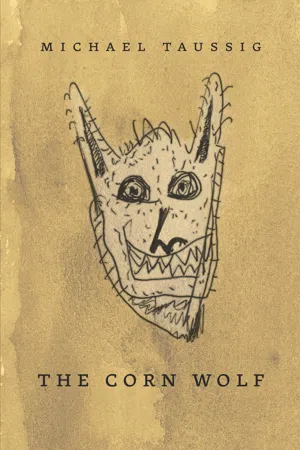
A glance at the chapter titles—such as "The Stories Things Tell" or "Iconoclasm Dictionary"—along with his zany drawings, testifies to the resonant sensibility of these works, which lope like the corn wolf through the boundaries of writing and understanding.
The leading figure of these projects is the corn wolf, whom Wittgenstein used in his fierce polemic on Frazer's Golden Bough. For just as the corn wolf slips through the magic of language in fields of danger and disaster, so we are emboldened to take on the widespread culture of academic—or what he deems "agribusiness"—writing, which strips ethnography from its capacity to surprise and connect with other worlds, whether peasant farmers in Colombia, Palestinians in Israel, protestors in Zuccotti Park, or eccentric yet fundamental aspects of our condition such as animism, humming, or the acceleration of time.
A glance at the chapter titles—such as "The Stories Things Tell" or "Iconoclasm Dictionary"—along with his zany drawings, testifies to the resonant sensibility of these works, which lope like the corn wolf through the boundaries of writing and understanding.
Frequently asked questions
Yes, you can cancel anytime from the Subscription tab in your account settings on the Perlego website. Your subscription will stay active until the end of your current billing period. Learn how to cancel your subscription.
No, books cannot be downloaded as external files, such as PDFs, for use outside of Perlego. However, you can download books within the Perlego app for offline reading on mobile or tablet. Learn more here.
Perlego offers two plans: Essential and Complete
- Essential is ideal for learners and professionals who enjoy exploring a wide range of subjects. Access the Essential Library with 800,000+ trusted titles and best-sellers across business, personal growth, and the humanities. Includes unlimited reading time and Standard Read Aloud voice.
- Complete: Perfect for advanced learners and researchers needing full, unrestricted access. Unlock 1.4M+ books across hundreds of subjects, including academic and specialized titles. The Complete Plan also includes advanced features like Premium Read Aloud and Research Assistant.
We are an online textbook subscription service, where you can get access to an entire online library for less than the price of a single book per month. With over 1 million books across 1000+ topics, we’ve got you covered! Learn more here.
Look out for the read-aloud symbol on your next book to see if you can listen to it. The read-aloud tool reads text aloud for you, highlighting the text as it is being read. You can pause it, speed it up and slow it down. Learn more here.
Yes! You can use the Perlego app on both iOS or Android devices to read anytime, anywhere — even offline. Perfect for commutes or when you’re on the go.
Please note we cannot support devices running on iOS 13 and Android 7 or earlier. Learn more about using the app.
Yes, you can access The Corn Wolf by Michael Taussig in PDF and/or ePUB format, as well as other popular books in Social Sciences & Latin American & Caribbean History. We have over one million books available in our catalogue for you to explore.
Information
Publisher
University of Chicago PressYear
2015Print ISBN
9780226310855, 9780226310718eBook ISBN
9780226310992Index
abattoir, 169
Abufarha, Nasser (author of The Making of a Human Bomb), 126
Abu Nidal (Palestinian “organic communist” peasant farmer), 124–25, 128–29
Adamo, Ayesha, 78, 79
Adorno, Theodor, 5, 34, 42, 99
Afifi, Alex, 78, 85
Agee, James, 118
Al-Azza, Mohammad (Palestinian photographer), 121–22, 130–31
Alonso, Danny, 78, 94, 106, 109
Alvear, Efraín, 64–66
animation, 12–14, 27
animism and transgression, 160
ANUC (peasant organization in Colombia), 195
apotropaic magic, 7–8, 178
Assali, Hadeel, 114
Balbungu, Allan, 37
Baragan, Yesenia, 78
Barthes, Roland, 9, 158–59
Bataille, Georges, 9, 49, 73, 118, 144, 145–46, 149, 163, 169
Battir village, West Bank of Palestine, 123
Beckett, Samuel, 142
bees, 31–32
Benjamin, Walter, 16, 21, 26, 35, 38, 45, 54, 87, 104, 107, 117, 126, 143, 157
Berman, Marshall, 92
Bey, Hakim (“temporary autonomous zone”), 83
Bishara, Amahl (anthropologist of West Bank, Palestine), 130
Bohannan, Laura, 47
Brecht, Berthold, 1, 18, 172
Bright, Alec (director of the Gold Museum), 183, 187
Brown, Norman O., 107
Bucher, Karl, 48
Burroughs, William, 8, 35, 75
Bush Christmas (Australian film), 164
Cage, John, 31, 108, 111
Canetti, Elias, 45
Casement, Roger, 8, 58
Cavafy, Constantine, 55–56
Chamberlain, Leslie, 37
Clifford, James, 55, 75
Colombian violencia, 180, 182, 190
Communist Manifesto, The, 92
Concorde, Place de la, 159
conjurors, 29–30
Conrad, Joseph, 117, 131
contagion and proliferation, 160
Cowan, Michael, 48
craft, 16, 25–26
Cramer, Louise, 47
Deas, Malcolm, 188
Death Ship, The, 17–27
Denkbilden, 117. See also Benjamin, Walter
Deren, Maya, 45
devil in the cane fields, 46
dialectical image, 35, 122. See also Benjamin, Walter
Dickinson, Emily, 172, 179
Dionysian states, 36
Dolan, Clare, 36
Downey, Juan, 15–16
Durkheim, Emile (Elementary Forms of Religious Life), 171
Echeverri, Juan Alvaro, 57–58
Eisenstein, Sergei, 33, 38
erotic materialism, 106
fairy tale, 26
Fals-Borda, Orlando, 62, 189
Faulkner, William, 56–57
fieldwork, 1–2, 181, 194. See also participant-observation; writing: and writingwork
Foucault and lightning of transgression, 157–58
Fourier, Charles, 32
Fox News, 82
Frazer, Sir James George, 2
Gandy Dancer, 48
García, Juan Felipe (human Rights lawyer in Colombia), 55
Genet, Jean, 13
G...
Table of contents
- Cover
- Title Page
- Copyright Page
- Contents
- Author’s Drawings
- The Corn Wolf: Writing Apotropaic Texts
- Animism and the Philosophy of Everyday Life
- The Stories Things Tell and Why They Tell Them
- Humming
- Excelente Zona Social
- I’m So Angry I Made a Sign
- Two Weeks in Palestine: My First Visit
- The Go Slow Party
- Iconoclasm Dictionary
- The Obscene in Everyday Life
- Syllable and Sound
- Don Miguel
- Index
