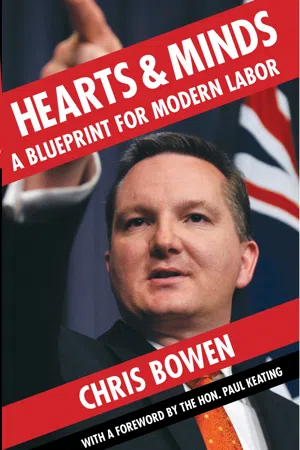
In Hearts & Minds: A Blueprint for Modern Labor, Treasurer Chris Bowen writes a passionate clarion call to Labor's heartland, making the powerful argument that the Labor project is far from complete and it is time for a radical program of renewal and reform for the party.
Hearts & Minds is a manifesto to secure the ALP's position as the dominant force in Australian politics. It advocates for governing alone or not at all, opening up the election of the parliamentary leader to party members as well as caucus, and support for the carbon tax. Bowen argues for instituting primaries wherever there is no sitting ALP member and allowing a broader range of groups to affiliate with the party.
Bowen writes that the measures he suggests will see the ALP become a bigger, stronger and more inclusive party, delivering economic growth and improved opportunity, reflecting the aspirations of all Australians. Hearts & Minds: A Blueprint for Modern Labor offers Bowen's insights for the party he believes can create a better and fairer nation.
- 168 pages
- English
- ePUB (mobile friendly)
- Available on iOS & Android
eBook - ePub
About this book
Trusted by 375,005 students
Access to over 1.5 million titles for a fair monthly price.
Study more efficiently using our study tools.
Information
Labor: The Party of Growth
Labor has always been a party of economic growth and we should always remain one. From its earliest days, Labor believed in nation building and growing our economy, through the building of railways, the establishment of the Commonwealth Bank and other measures to build a national economy almost from scratch.
It is true that Labor tore itself apart during the Great Depression, but James Scullin was searching for a path to economic growth in the most difficult of circumstances. Curtin and Chifley had a vision about economic growth post war. While focused on winning the war, they were preparing measures to ‘win the peace’ with a visionary (and controversial) high migration program and the establishment of the huge Snowy Mountains Hydro-Electric Scheme.
And, of course, the Hawke-Keating Government unleashed twenty-one years (so far) of uninterrupted economic growth by implementing a bold program of micro-economic reform including financial deregulation, the floating of the dollar, tariff reform and competition policy. Floating the dollar meant that the economy would better respond to international shocks like the Asian financial crisis, the dot-com bubble and the GFC. Tariff reform was painful but, over time, made our industrial sector more competitive and benefited consumers. And, importantly, national competition policy provided an appropriate level of regulation to ensure that consumers benefited from rigorous competition for their business.
The Grattan Institute has identified ten big economic-policy reforms which have improved the economic efficiency of the nation and led to our record economic growth (I’ve noted the party which, in my view, can claim credit for each reform):1
- Medicare: Labor
- Floating the dollar: Labor
- Tariff reduction: Labor
- Government enterprise privatisation: Labor (continued by the Coalition)
- Setting interest rates independently through the Reserve Bank: Labor (formalised by the Coalition)
- National competition policy: Labor (supported by some Liberal states)
- Superannuation: Labor
- Broadening the income tax base: Labor
- The goods and services tax (GST): the Coalition
- Changes to the structure and funding of the higher education sector: Labor
Labor can claim complete ownership of six of the ten major reforms of the last forty years. Labor and the Coalition can claim shared credit for three of them. Complete ownership of just one can be claimed by the conservatives.
When Paul Keating was recalibrating Australian foreign policy towards greater engagement in the Asian region, he was engaging in an economic as well as geo-political play, foreseeing the importance of the growth in Asia for our trade and economic performance.
When the history of the Rudd and Gillard years comes to be written, maintenance of that uninterrupted growth against the odds and in the most difficult of circumstances will be up there with our greatest achievements. While the rest of the world contracted and then flatlined, Australia kept growing. At the time of writing, the Australian economy is 13 per cent bigger than it was during the global financial crisis. By way of comparison, the economies of the United Kingdom, Japan, Italy and France are still smaller than they were before the global financial crisis and many countries have barely grown economically since the financial crisis. During the time of the Rudd and Gillard Governments, Australia has overtaken three other countries (Mexico, Spain and South Korea) in terms of the size of our economy. Australia, which has the fifty-first-largest population in the world, now has the twelfth-largest economy. During the Howard years, despite the mining boom, Australia went backwards by three places in the world economic rankings.
This period of uninterrupted growth is an extraordinary achievement. Never before has Australia experienced such a period. The previous longest period of growth was the post–Korean War boom, which lasted thirteen years, from 1961 to 1974, and even this period was broken by two consecutive quarters of negative growth, in December 1971 and March 1972. And while the Howard Government can rightly claim some credit for maintaining economic growth between 1996 and 2007 (against the backdrop of a huge mining boom), it is Labor which unleashed the forces of growth with the Hawke-Keating reforms, and Labor which maintained the growth against the odds during the global financial crisis.
Of course, the resources boom and the growth of the Asian economies have been important in the economic growth of the last two decades. But it is the economic reforms of the Hawke and Keating years which put Australia in a good position to capitalise on these opportunities. Without those liberalising reforms, Australia would have been much more likely to go into recession during the fallout from the Asian financial crisis of the last years of the 1990s and the dot-com bubble of the early 2000s.
And this commitment to growth is not about growth for growth’s sake. Growth means jobs, security and opportunities for millions of people. The economic-growth story of Australia has translated into Australia being a low-unemployment economy. It’s easy to forget how anaemic Australia’s employment performance was before the economic reforms of the 1980s and 1990s. In 1983, Australia’s unemployment rate averaged 10 per cent. In the late 1970s and early 1980s, unemployment hovered between 8.5 per cent and 10.3 per cent.
The micro-economic reforms of the Hawke and Keating years effectively reduced what we economists affectionately call the NAIRU, or the non-accelerating inflation rate of unemployment. It is difficult to overemphasise the scale of this achievement. An economy is a trade-off between unemployment and inflation. Measures to boost employment are often inflationary. Inflation eats away at the competitiveness of an economy and reduces the living standards of those who rely on fixed incomes and those with limited bargaining power to increase their wages. By improving the efficiency of our economy, the Labor micro-economic reforms meant that we can have lower unemployment at the same time as lower inflation.
The combination of this groundwork and the Rudd Government’s stimulus during the global financial crisis means that, at the time of writing, Australia has an unemployment rate of 5.4 per cent, compared with 7.6 per cent for the United States, 11 per cent for the euro zone and 7.9 per cent for the United Kingdom. In the last twenty years Australia’s real gross domestic product has doubled. Over the same period, the nominal value of household wealth in Australia has increased more than four-fold.
Thus Australia has avoided the debilitating impact of high unemployment: the hollowing out of skills that goes with long periods out of the labour force, the social impact of high rates of depression and even suicide among the unemployed, the loss of self-esteem and hope among young unemployed people and the inter-generational impacts of long-term unemployment, where children have no role model of a working parent to look up to. This is why Labor Premier of New South Wales Neville Wran was right when he described Labor’s top three priorities as ‘jobs, jobs, jobs’.
This period of economic growth has also proved to be a fertile breeding ground for people of aspiration to begin small businesses. Of course, many small businesses fail. This has always been the way in a capitalist society, and it always will be the way. Some of the ideas of putative small business people will just not fly. Other new small business people won’t have the skills and experience necessary to successfully run a small business. But the increased small business formation rate is a good thing. The owners of those businesses that survive gain more independence and achieve their aspiration to ‘make their own way’. Owning a small business is not an easy life. But it is a lifestyle that many people want to pursue, and economic growth gives them a chance to do so.
Economic growth is good for the budget bottom line. And that means government has the resources to invest in good projects and do good things. In my time as a minister, including three years on the cabinet’s Expenditure Review Committee, I saw many good and worthy projects proposed by ministers which would have made a positive difference in so many ways but which just couldn’t be afforded because of the necessity for fiscal restraint. Slowing economic growth has a huge impact on government revenue due to reduced tax receipts and increased social-security expenditure. If growth is higher, government has more opportunity to do good things. As the Grattan Institute has said:
Economic growth, appropriately managed, expands the range of options open to individuals and government. It can free individuals and communities to make choices about their lives, support businesses and shareholders to prosper, buffer the Australian economy against a potential future end to the mining boom, and provide the resources to support other major policy reforms—such as mitigation of climate change, and better care for an ageing population.2
Of course, this book is not about arguing that Labor should promote economic growth at all costs. There will be projects that will promote economic growth but that are rejected because of their adverse environmental or social impact. There are tax changes that are likely to promote growth but are rejected because of an unacceptably regressive impact. But Labor’s objective and predilection in government should always be policies that promote economic growth.
International Economic Growth
Just as economic growth lifts living standards in Australia, so it does around the world. Especially since the adoption of the United Nations Millennium Development Goals in 2000 there has been a big focus on foreign aid and developed countries doing their bit by pledging a minimum proportions of their national income as foreign aid. This is right and appropriate.
But the focus on aid can sometimes distract from an important truth: trade is at least as important as aid. In fact, I believe it is even more important. Millennium Goal eight sets the target of developing ‘an open, rule-based, predictable, non-discriminatory trading and financial system’.
In the last twenty years we have watched the biggest poverty-alleviation program in human history: the development of China. This has been the result of economic growth due to the reintroduction of market principles to the Chinese economy. The long and iterative process of market reform, which began in 1978 with the breaking up of collective farms and re-introduction of private family farms, led to a rapid increase in productivity. Agricultural production surged by a third in the short period between 1978 and 1984. This, in turn, created a rural market for consumer items and generated investment in rural developments.
Agricultural reform was followed by the opening of the economy to foreign investment and trade in 1979, with local enterprises being allowed to keep some of their export earnings to purchase imports. China hasn’t looked back. Since then, it has become the world’s largest recipient of foreign investment, and in 2010 it accounted for 30 per cent of the world’s economic growth.
The living standards of millions of people have been lifted as a result of this introduction of free-market principles. Health outcomes have been improved, educational attainment has been massively lifted and average incomes have skyrocketed. Has all this come at a cost to the environment? Of course it has. Could this have been better handled? Yes. But if you believe in improving people’s lives, if you believe in alleviating poverty, then you believe in economic growth and unleashing the forces of the market.
Of course this story has been repeated, on a smaller scale, around the world. India’s pro-market reforms, initiated by then Finance Minister (and now Prime Minister) Singh in the early 1990s, began the economic-growth and poverty-alleviation story of the world’s second-most-populous country. More pro-market reforms in India could have further positive impacts. There is a similar moral to the story of Indonesia’s reforms in the 1990s. And, despite considerable adjustment pain, economic growth in the former Eastern bloc countries since the introduction of market forces in the early 1990s carries the same unmistakable message.
A positive development in the world aid story has been the adoption of the notion of ‘Aid for Trade’, which emerged at the World Trade Organization ministerial meeting in 2005. Developing countries need assistance to develop their trading capabilities and infrastructure in order to increase their ability to participate in growth-engendering international trade. There has been a big increase in ‘Aid for Trade’ funding since 2005, but there is still much more to be done. The world’s forty-nine least developed countries account for just 1.2 per cent of global trade.
A combination of more aid to assist increasing trade capabilities and measures for freer trade to allow less developed countries to compete has the greatest potential to lift many more millions of people out of poverty around the world.
What Does This Mean for Australian Politics?
Belief in economic growth as a key objective is one of the key differences of approach between the Labor Party and the Greens to our left. The Greens represent, by and large, a well-off, well-educated constituency which doesn’t value economic growth because they don’t need economic growth to be comfortable. Manufacturing workers, finance workers and workers in the service industry more generally recognise that economic growth is the key to them keeping their job and their aspirations for a better life for their families.
The Greens have anti-growth policies. The Greens’ published principles outline that: ‘The Australian Greens believe…the pursuit of material-based economic growth is incompatible with the planet’s finite resources. In order to provide for the needs of present and future generations, economic management should prioritise improving the quality of life rather than the production and consumption of material output’.
Not only are the Greens’ principles against growth, their policies would stifle growth even if that weren’t their intention. Whether it’s their policy of increasing company tax at the same time as broadening its base, whether it’s their fetish for corporate regulation (including their nonsensical policy of private sector salary–setting by government), whether it’s their policy of phasing out coal exports or whether it’s their inexplicable hatred for skilled migration, they seem hell bent on wrecking the economic model which has led to twenty-one years of unparalleled economic growth.
The Greens also mistrust free-trade deals and globalisation. Of course, any free-trade arrangement should ensure that less developed countries are not exploited as a result. But the opportunity for economic growth and poverty alleviation that comes from freer trade should never be forgotten and, in fact, should be prioritised.
Labor Policies for Growth
Labor governments of the past have actively promoted growth. The key economic achievement of the Rudd and Gillard years has been to avoid recession while the rest of t...
Table of contents
- Acknowledgements
- Foreword
- Introduction
- What Does Labor Believe In? Reclaiming Liberalism for the Left
- Labor: The Party of Growth
- Labor: The Party of Opportunity
- You’re Invited: An Open and Inclusive Party
- Conclusion
- Appendix: ADDRESS TO THE SYDNEY INSTITUTE—THE GENIUS OF AUSTRALIAN MULTICULTURALISM
- Notes
Frequently asked questions
Yes, you can cancel anytime from the Subscription tab in your account settings on the Perlego website. Your subscription will stay active until the end of your current billing period. Learn how to cancel your subscription
No, books cannot be downloaded as external files, such as PDFs, for use outside of Perlego. However, you can download books within the Perlego app for offline reading on mobile or tablet. Learn how to download books offline
Perlego offers two plans: Essential and Complete
- Essential is ideal for learners and professionals who enjoy exploring a wide range of subjects. Access the Essential Library with 800,000+ trusted titles and best-sellers across business, personal growth, and the humanities. Includes unlimited reading time and Standard Read Aloud voice.
- Complete: Perfect for advanced learners and researchers needing full, unrestricted access. Unlock 1.5M+ books across hundreds of subjects, including academic and specialized titles. The Complete Plan also includes advanced features like Premium Read Aloud and Research Assistant.
We are an online textbook subscription service, where you can get access to an entire online library for less than the price of a single book per month. With over 1.5 million books across 990+ topics, we’ve got you covered! Learn about our mission
Look out for the read-aloud symbol on your next book to see if you can listen to it. The read-aloud tool reads text aloud for you, highlighting the text as it is being read. You can pause it, speed it up and slow it down. Learn more about Read Aloud
Yes! You can use the Perlego app on both iOS and Android devices to read anytime, anywhere — even offline. Perfect for commutes or when you’re on the go.
Please note we cannot support devices running on iOS 13 and Android 7 or earlier. Learn more about using the app
Please note we cannot support devices running on iOS 13 and Android 7 or earlier. Learn more about using the app
Yes, you can access Hearts & Minds by Chris Bowen in PDF and/or ePUB format, as well as other popular books in Politics & International Relations & Democracy. We have over 1.5 million books available in our catalogue for you to explore.