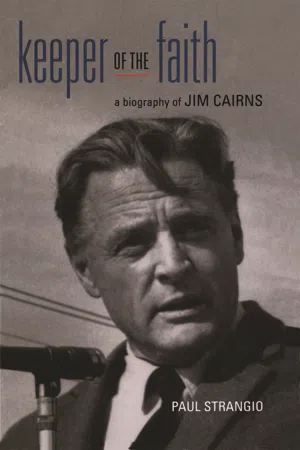
Jim Cairns is a familiar sight around the markets of Melbourne, seated at a table stacked with copies of his latest book. It seems an unlikely occupation for a man who was once the driving force and major thinker in the Labor Party Left, a man who reached the positions of Deputy Prime Minister and Treasurer in Australia's most reformist government under Gough Whitlam.Cairns' post-1975 trajectory bewildered many of his one-time followers, not least the significant section of the baby-boomer generation who rallied behind him during the Moratoriums against the Vietnam War. To some he is a tragic fallen hero; to others, a relic of an earlier age of idealism.But Cairns was never a conventional politician. In this mature and sophisticated biography, Paul Strangio draws a compelling picture of the inner man, revealing a consistent thread running through the apparent contradictions of Cairns' public career. He explains how a policeman turned into a counter-culture guru; how an opponent of capitalism became Treasurer of Australia; how a devoted husband could feel 'a kind of love' for Junie Morosi.Both highly readable and carefully researched, Keeper of the Faith reassesses the part Cairns played in shaping Australian public life. In tracing his ideological and political rivalry with Whitlam, it challenges the popular nostalgia that surrounds his former leader.Strangio argues that Cairns' contribution to public life, especially as a voice of dissent against the established order, has been seriously underestimated. Drawing on a rich range of archival and oral sources, and recounting many fascinating anecdotes, this is a masterly portrait of one of those rare people who never waver in their search for truth.
- English
- ePUB (mobile friendly)
- Available on iOS & Android
eBook - ePub
About this book
Trusted by 375,005 students
Access to over 1.5 million titles for a fair monthly price.
Study more efficiently using our study tools.
Information
Print ISBN
9780522850024
1 ‘the victim of a great wrong’
1914–1931
[CAIRNS] WAS A WRONGS RIGHTER—A MAN WHO HAD BEEN THE VICTIM OF A GREAT WRONG, WHO ELEVATED THE CURING OF HIS OWN WOUND INTO A NATIONAL CAUSE. BUT I NEVER KNEW WHAT THAT WOUND WAS. I STILL PONDER WHETHER PERHAPS HE DID NOT KNOW, OR, IF HE DID, THAT IT WAS TOO PAINFUL FOR HIM TO TALK ABOUT . . .
Manning Clark, The Quest for Grace, p. 155.
THE FUTURE MAN OF PEACE arrived in war. The only child of James John Cairns and Letitia Cairns (née Ford), James Ford Cairns was born in a terrace house at 22 Drummond Street Carlton on 4 October 1914. Only two months had passed since the commencement of hostilities in Europe—not enough time to diminish the tide of imperial patriotism that had swept up the bulk of Australians. The nation was transfixed by the news of the fighting on the Western Front in Belgium and Northern France. The day before Cairns was born, the Argus commented: ‘All men are talking war and hearing war talked, thinking war, and dreaming war, and reading war. The war picture fills the mind to the exclusion of everything else . . . [it] has dislocated all the regular annual output of thought and ideas’.1
Although Cairns was only four years of age when armistice was declared in November 1918, his life was irrevocably stamped by the events of World War I. His father, James Cairns, enlisted in the Australian Imperial Force (AIF) on 5 July 1915.2 He was described in his enlistment papers as having a fresh complexion, blue eyes and brown hair, physical features that his son inherited. After training with the 59th Depot Company at Seymour, James Cairns was deployed to the 29th Battalion, 8th Infantry Brigade. On 10 November 1915 he embarked for the Middle East aboard the Ascanieus. He never returned.
According to his AIF service record, James Cairns was stationed in Egypt for several months. In March 1916 he was promoted to corporal and transferred to the 5th Divisional headquarters at Tel el Kebir on clerical duties. In June he embarked for France, where the 5th Division was to be committed to the Somme campaign on the Western Front. The following March James Cairns was selected to attend a training course at the Officers’ Cadet School at Cambridge in England. While there he received ‘special mention’ in Sir Douglas Haig’s despatches of 9 April 1917. He returned to France in August and was appointed as adjutant to the 31st Battalion, stationed in the field on the Western Front. His star continued to rise, and he was promoted to the rank of lieutenant in November 1917. When hostilities ended, James Cairns remained with the 31st Battalion in France. Soon after, the troubles began that were to ruin what up until that point had been a successful, if unspectacular, service record. In January 1919 on leave in Belfast, where he was visiting his sister, he was arrested by military authorities for drunkenness. He was released after several days, officially censured, and sent to rejoin his unit. This was a minor misdemeanour and hardly unusual in the context of the AIF’s reputation for unruly behaviour away from the battle front. Nonetheless, for an officer it was probably regarded as an incident of considerable dishonour.
Worse was to come. In May 1919 James Cairns was reported absent without leave in France and declared an illegal absentee. On 5 August 1919 he surrendered himself to military authorities in London and was placed under close arrest. The next month he was tried by General Court Martial on four charges. The first three alleged that he had misapplied regimental money for ‘his own use with intent to defraud’ on three separate occasions between 20 March and 2 May 1919. The amounts involved totalled 5535 francs and 85 centimes, equivalent to almost two years’ pay for an AIF private.3 The final charge related to his absence without leave between 9 May and 5 August. James Cairns pleaded guilty to all four charges, and was sentenced to be cashiered and his pay stopped until he had made good the money that he had defrauded. He was due to embark for Australia aboard the Aeneas on 22 November 1919. He failed to do so, and an entry in his service record bluntly states that ‘no further action will be taken to arrange his passage to Australia’. On 15 March 1920, on the letterhead of the steamship Llanstephan Castle, he wrote to the AIF requesting an official statement of his service record and asking whether he was entitled to any medals in respect of his period of service. In a postscript he added that he was ‘not quite sure of my final destination but a letter addressed to me c/o this steamer at Durban [South Africa] should find me sooner or later’.4
From there the trail goes cold. As Paul Ormonde discovered when researching his biography of Cairns in the mid-1970s, there was great reticence within the family about James Cairns’ fate. Until her death in 1964, Letitia Cairns appears to have maintained the pretence that her husband was killed in the war. Jim Cairns did not learn otherwise until he was middle-aged. He too has often seemed reluctant to acknowledge that his father abandoned both himself and his mother, and is remarkably vague about what happened to him after the war. The most reliable account is that James Cairns was killed in a car crash in Kenya in 1927, although Cairns claims to have heard dozens of other versions.5
The reason James Cairns did not return to Australia in 1919 seems less mysterious. His decision to head for Africa was probably motivated by a desire to find a place to start life afresh, where he would not be haunted by the stigma of the events of the preceding twelve months. Yet this may be only part of the explanation. Born in Hillhead in Glasgow in Scotland, James Cairns had been in his early thirties when he arrived in Australia aboard the one-class ship, the Benalla, in May 1913. According to Jim Cairns, his father had been ‘part of the establishment for the greater part of his life’. It is true that James Cairns sprang from a conservative and comfortable middle-class family. He was the eldest son of a Glasgow police inspector and had apparently received a public school education. After leaving school, he found secure employment in the Town Clerk’s Office in the Glasgow Town Hall. He remained there for some eighteen years and had reached the grade of senior clerk when last listed as an employee of the City of Glasgow in 1912.6 What prompted him to come to Australia the following year is unclear. Possibly it was a sense of wanderlust and adventure, or perhaps he was escaping something.
The reason behind the Ford family’s decision to emigrate to Australia is far more obvious. The Fords were ‘poor farmers’ from Lancashire. Letitia’s father, John Thomas Ford, had started work at a cotton mill when he was nine years old. He and his wife, Elizabeth Ann, and other members of the family later worked as tenant farmers on a small dairy holding not far outside Blackpool. In 1912, weary of the family’s continuing economic struggle, John Ford decided to begin a new life in Australia. After sailing from Britain, he spent a brief spell working in Western Australia, then arrived in Victoria, where he found a job as manager of a pig farm in Keilor, 20 kilometres north-west of Melbourne. He sent for his wife and daughters, Eleanor, Letitia (Letty) and Sara. It was on the voyage to Australia aboard the Benalla that 19-year-old Letty met James Cairns.7
Despite their disparate social backgrounds and substantial age difference, romance blossomed between James and Letty. Shortly after their arrival in Melbourne the Fords moved into 22 Drummond Street, Carlton, while James Cairns found lodgings nearby in Victoria Parade, East Melbourne. James and Letty continued to see one another, and early in 1914 Letty fell pregnant. Although fundamentally tolerant and generous spirited, John and Elizabeth Ford conscientiously abided by a puritan Methodist ethic; they believed in the virtue of hard work and austerity, and shunned the sins of the flesh. The discovery that their middle daughter had become pregnant out of wedlock must have come as a shock and a source of anguish.
On 30 April 1914 James and Letty were married in a simple ceremony at the home of a Baptist minister in East Melbourne, with John Ford and Letty’s elder sister Eleanor as witnesses.8 James Cairns moved into the Ford home in Carlton, but predictably it was not long before tensions surfaced between the Fords and their new son-in-law. In September James Cairns secured a position in the Melbourne Town Hall Clerk’s Office with a handsome starting salary of £200 per annum. Because his duties included the organisation of social functions and official entertainments, as his son later explained, he ‘was at dinners, banquets, parties and so forth a great deal’. In effect, James Cairns’ job afforded him the opportunity to mix in Melbourne social circles and indulge his taste for the high life. His weakness for alcohol created special consternation at home. Referring to the reticence that had surrounded his father’s memory, Jim Cairns noted one reason was that ‘at more than one stage of his life he drank too much. My mother and grandparents didn’t drink at all. I think they were more than a little ashamed of it.’ 9
It is conceivable, then, that another factor behind James Cairns’ desertion of his family was that once the initial flush of romance between him and Letty faded, and their social differences became more apparent, he no longer saw the marriage as a compelling reason to return to Australia after the war. While there is no evidence that he had actually been coerced into the marriage after Letty became pregnant, it is feasible that the war offered him a way out of a domestic situation he had inadvertently stumbled into.10
If this is speculation, the crucial impact of James Cairns’ abandonment of his wife and son in determining the nature of Jim Cairns’ upbringing is beyond question. The first consequence of his father’s absence was that Cairns was not raised in a conventional nuclear family. Not long after James Cairns departed for the war, Lefty’s parents leased a property known as Victoria Farm on Macedon Road, Sunbury. For the next four years or so the farm was home to John and Elizabeth Ford, Letty Cairns and her baby son, Eleanor and Sara Ford, their cousin Mattie Smith and the Fords’ domestic Lizzie Salthouse. Life in this extended family was to be a consistent pattern of Jim Cairns’ childhood and adolescence, although he was too young to remember much about the years at Victoria Farm. His mother remained the centre of his universe and his principal recollection of this period was of being physically close with her.11
When Cairns was about five years of age the family moved to Melton, where his grandfather had leased a property called Nook Farm. It was not long after this that Cairns was told his father was dead. He claims the news made little impression on him. Cairns later explained this muted response, saying: ‘He [his father] was never there, a thing has to have been before you can miss it’. He insisted that, throughout his childhood and adolescence, he felt little sense of loss at not having a father. The most distinct impression Cairns had of his father was as he appeared in photographs in his army uniform. Cairns remembers he looked ‘impressive, something to be proud of’. When about fifteen he read some of the letters James Cairns had written to Letty while serving in France. He was struck by his father’s ‘beautiful handwriting’ and the descriptions of trench fighting, which he claims left him with an enduring sense of the futility and irrational nature of war.12
Whether the news that his father would not be returning affected Cairns far more strongly than his memory permits him to admit is impossible to know For Letty, however, the realisation brought not only great heartbreak, but also concern about the future for both herself and her son. Soon after receiving the news she began seeking work to help supplement the family’s income. Although the war had led to an influx of women into the paid workforce, opportunities were still limited. When Letty eventually found work in October 1921, it was as a cook at the Sunbury Mental Hospital.13
Letty’s job at ‘The Hill’, as it was commonly known, required her to live in. She was able to return to the farm only every second weekend. With no husband to support her and little hope of alternative employment, she was to continue working at ‘The Hill’ for the remainder of the 1920s. Thus, from the time he turned seven, Jim Cairns had to come to terms with regular and lengthy separations from his mother, which were painful for both mother and child. In 1996 Cairns noted: ‘[the] saddest experience for me was on Sunday nights when she drove back to work in a jinker and I sat on the gatepost gazing long after she was out of sight’. Interviewed by Dr John Diamond in 1968, he recalled that his mother enjoyed being on the farm and resented having to return to the hospital. He also remembered wishing that his mother had ‘been able to give up work altogether and not be involved in that routine . . . I would have preferred her to have been out in the open air in the country like I was, rather than having to go off every Sunday night to work in this machine for another fortnight.’ Pressed by Diamond about whether he came to feel that ‘the system’ was depriving him of his mother, Cairns agreed.14
Inevitably, these regular separations changed the relationship between Cairns and his mother. The physical closeness that he remembered from the period at Sunbury came to an end. Cairn sums up the change: ‘I became a little man. So our relationship was a talking one . . . Whenever my mother and I met, we shook hands.’ Letty impressed on him that ‘little men never went beyond shaking hands’. Another factor lay behind the physical barriers that she erected between her and young Jim. It was more of the negative inheritance of James Cairns. Letty had contracted syphilis from her husband and feared passing it on to her son. The disease, initially undiagnosed and then apparently untreated for many years, remained another of the dark secrets of the family. Cairns did not speak publicly about it until he was aged in his mid-eighties. Along with the physical estrangement between mother and child came an emotional distance. Cairns admits that his relationship with his mother was not close. Asked in a 1990 newspaper interview whether he had loved his mother, Cairns shied away from the word, preferring to say that he had respected and admired her.15
With both his mother and Aunt Eleanor living in at the Sunbury Mental Hospital, Cairns was left in the company of his grandparents, Sara Ford, Mattie Smith and Lizzie Salthouse. The same physical and emotional reserve that now existed between him and Letty appears to have characterised his interaction with the other members of the household. Cairns again identifies respect as having been the key element of his relationship with his grandparents, and explains that it was ‘a relationship of communication by words’. His dealings with Sara, Lizzie and Mattie were little different. He played cricket with Mattie, but insists that he wasn’t close to anyone in particular. ‘It was all similar’, he notes, ‘we always talked. That was the extent and limit of it. It was conversation. It wasn’t doing things together’ 16
Eleanor Ford also attests to the emotional and physical remoteness of the family. Ormonde quotes her observation that young Jim was ‘obedient, attentive and courteous to his elders, but never one for a lot of kissing’. She added: ‘We might be a funny family, but we don’t let our emotions run away with us’. Cairns himself hesitates at the suggestion that from about the age of five his interaction with family members was conducted primarily on an ‘intellectual’ basis, claiming this to be too ‘high and esoteric’ a description. Nonetheless, he agrees that those interactions were measured and rational, rather than spontaneous and emotional. He concedes, too, that this pattern of dealing with those around him in a non-demonstrative and analytical manner became a fixed element of his character.17
Although he received little emotional succour as a child, Cairns’ intellectual development was nurtured. No doubt sensitive to their own lack of formal education, Letty and the other members of the family were determined to instil in young Jim a thirst for learning. From an early age his growing sense of inquiry was given serious attention. He was encourag...
Table of contents
- keeper of the faith
- CONTENTS
- ILLUSTRATIONS
- ACKNOWLEDGEMENTS
- ABBREVIATIONS
- introduction
- 1 ‘the victim of a great wrong’ 1914–1931
- 2 ‘an intellectual seeker’ 1932–1947
- 3 political apprentice 1948–1955
- 4 the member for yarra 1956–1964
- 5 vietnam: the great moral crusade 1962–1967
- 6 ‘a symbol of participatory democracy’ 1968–1970
- 7 ‘feelings of profound disillusionment’ 1970–1972
- 8 a ‘new jim cairns’? 1972–1974
- 9 ruin and liberation 1974–1975
- 10 ‘some wacko theory’ 1976–1990
- epilogue
- NOTES
- SELECT BIBLIOGRAPHY
- INDEX