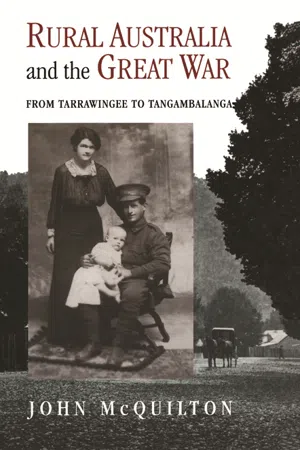
In the cities and in the countryside of Australia, the Great War of 1914 - 1918 marched to somewhat different tempos. John McQuilton evokes the wartime experience of all rural Australians by capturing the moods of the country towns and hamlets of North Eastern Victoria.
Every aspect of the war - recruiting, fund-raising and, eventually, homecoming and the design of the war memorial - was marked by a mixture of small-minded local politics, heroism and sacrifice, and grief. Individuals, whether journalists, town councillors or leading local citizens, shaped the recurring battles on the home front.
The conscription debates were particularly vicious, as the countryside exhausted its pool of volunteers long before the cities. In small communities the 'shirker' could not hide; everyone knew which families had sent men to the front, and who had genuine reasons for staying home. This intimacy worked in favour of the many German Australians: country people knew them as trusted neighbours, but in the cities they were reviled as enemy aliens.
Rural Australia and the Great War is unique among writing on the First World War in creating a richly detailed picture of wartime in a particular part of country Australia. For country and city readers alike, this is fascinating social history.
- English
- ePUB (mobile friendly)
- Available on iOS & Android
eBook - ePub
Rural Australia and the Great War
About this book
Trusted by 375,005 students
Access to over 1.5 million titles for a fair monthly price.
Study more efficiently using our study tools.
Information
1 The Region in 1914
Perhaps IRONICALLY, there were many in North Eastern Victoria who believed that they had reached a turning point in their history by 1914.1 For a decade the men and women who had come to the region in the immediate aftermath of the gold rushes (and even before the 1850s) began to ‘cross the bar’. The columns of the newspapers were filled with respectful in memoriam notices for the ‘pioneers’ who had laid the foundations for the region’s European settlement. The North East was also reminded of the passing of a more notorious aspect of its history in 1914, the Kelly Outbreak. Three men associated with the Kelly story died that year: amongst them was Sergeant Steele, the policeman who had brought down the bushranger at Glenrowan with shotgun blasts to the legs.2
The North East was a predominantly Protestant society. The Church of England claimed the largest number of adherents, 37 per cent of the population. Catholics accounted for 27 per cent of the population, a proportion above the state average. The denominations, however, were not evenly spread throughout the region. The Church of England was particularly strong in the eastern reaches, especially in the Upper Murray. The Catholic population was concentrated in the central and western reaches, where there were several clearly identified ‘Catholic’ communities—Greta, Moyhu, Myrtleford, Whorouly and Chiltern, for example. Within one local government area, North Ovens Shire, they were the largest denomination. Heavy concentrations of Methodists were found in the Ovens valley, especially at Wandiligong, where Cornish immigrants had brought their skills and their faith to the mines of the Upper Ovens, and in Rutherglen borough.3
In terms of birthplace, the region was overwhelmingly native and Victorian born.4 However, two distinctive ethnic minorities had established themselves in the region during the nineteenth century. The Chinese had come to the region with the gold rushes of the 1850s, and there were still pockets of Chinese settlement in the regional mining towns, especially Beechworth and Rutherglen, and the mining communities in Bright Shire. The majority were miners although some combined mining with store-keeping or market gardening. A number had taken up land as selectors, like the Quonoeys, and had intermarried with the local community. German settlers had arrived in the region from South Australia during the 1870s, taking up land under the Selection Acts. They brought with them their Lutheran faith and their German-language schools. They settled mainly in the Kiewa and Mitta valleys covered by parts of the Wodonga, Towong and Yackandandah shires. The barriers between the Germans and the general community had substantially crumbled by 1914. The children and grandchildren of the original settlers had Anglicised their Christian names and married outside the ‘German’ community. Many were members of the loyalist and nativist organisations in the North East, like the Australian Natives’ Association (ANA), and served as shire councillors. Even the Kaiser’s sabre-rattling did little to disturb the high regard the region generally held for its German Australians. The majority were farmers although some, like Dr Rudolph Schlink in Wodonga and Bernhard Wilksch in Yackandandah, were professional and business men.
Branches of national and state organisations, like the ANA, were found in most towns. Religious and mutual help societies, like the Masons and the Oddfellows, were also well represented. Both the Loyal Orange Lodge and the Hibernians had branches in Beechworth. Many towns boasted mutual improvement and literary and debating societies and some, like Rutherglen, ran eisteddfods that attracted entrants from Melbourne. Extension lectures offered by the University of Melbourne were well attended. Each town had its Athenaeum and public library. Temperance organisations, like the Band of Hope, the Mayflower Lodge and the Junior Rechabites, also had chapters scattered across the region but were strongest in the mining centres. Ladies’ Benevolent Societies dispensed frugal assistance to the deserving poor in the major towns, and each year the region’s two major hospitals in Beechworth and Wangaratta, and Beechworth’s Ovens Benevolent Asylum, ran successful appeals for funds.
The staple of social life in the region, especially in rural districts, was the combined euchre and dance night. These evenings were usually run as fund-raising ventures although the new dances managed to rattle some. Scriptus, a columnist for the Ovens and Murray Advertiser, hoped that the new American dance crazes, like the Turkey Trot, the Chicago Hug and the Romping Booster, would remain in Melbourne where they belonged!5 Visiting entertainments were always well patronised. Concert parties, the newly discovered medium of film, midgets, tenors and baritones, chamber and symphony orchestras, touring repertory companies, demonstrations by the legendary Walter Lindrum—all did good business in the region. The highlight probably belonged to Dame Nellie Melba, who toured the region in a series of farewell concerts in 1906, although Peter Dawson’s tour in 1913 ran a close second, despite the fact that the regional press described him as English (one paper even described him as a soprano).6 The local show was also an important part of the region’s social calendar. Once a year, the region’s farming and mining achievements were put on public display, farming innovations and new technology were disseminated, and concerts and dances were held.
Sport played a major part in regional life. Cricket was the dominant summer sport although tennis, golf, polo and bowls were also popular. Rutherglen ran a nationally recognised regatta on Lake Moodemere every New Year’s Day and had done so since 1861. Rifle clubs conducted regional competitions, which were often hotly contested. Horse-racing was an important part of the regional sporting calendar and the North East held over 150 meetings each year. St Patrick’s Day was a popular date for race meetings, and the towns and rural districts where they were held reflected the presence of a strong local Catholic population. Football was the pre-eminent winter sport and regional teams often played teams from Melbourne’s Victorian Football League. When the local triumphed over their Melbourne rivals the regional papers were insufferably smug. The game, however, worried regional leaders of the temperance movement, especially when Sunday matches were introduced. Drink, gambling and desecration of the Sabbath were seen to go hand in hand with Sunday football.7 Easter was also a major sporting date in the regional calendar and most towns ran Easter sports. Events included the woodchop, pony races and foot racing. In some districts, like Tallangatta, these sports were run by the local Catholic church, in others by the miners. Rutherglen, for example, had been running an Easter Miners’ Sports Carnival since the 1890s.
The Miners’ Sports reflected the growing importance of organised labour in the region. The Amalgamated Miners’ Association (later the Amalgamated Mining Employees’ Association) had strong branches in Rutherglen and Chiltern. The Federated Engine Drivers’ and Firemen’s Association had branches in the Bright district. The Victorian Railways Union had branches in the towns along the North Eastern railway line and was particularly strong in Wodonga. Rural labour, however, was not highly organised, and the Rural Workers’ Union (later incorporated into the Australian Workers’ Union) began a long campaign in 1900 to recruit members. Their principal targets were the men involved in seasonal work like harvesting and grape-picking. It was slow going, mainly because most of the labour used was local, and local loyalties blunted the drive to unionise these men.
The regional press was deeply ambivalent about the place of organised labour within regional society. Although most papers accepted that unions had a right to exist, they consistently condemned industrial action like the strikes that had become endemic in the mining industry as miners sought better conditions. The activities of the Rural Workers’ Union and the Australian Workers’ Union were viewed with even more alarm because they threatened the harvest. The attempted strike by some grape-pickers at Rutherglen in 1914 was viewed seriously enough for extra police to be posted to the town, especially when local winegrowers set up a vigilante group of 100 armed horsemen to repel union representatives attempting to enter vineyards declared ‘black’. The strike was easily broken. Logs of claims submitted by the unions were invariably seen as unreasonable, threatening the regional economy, and workers were urged to think of the greater regional good. ‘Labor and Capital were allies in the march of progress’, not enemies, Thomas Drenen argued in his paper, the Rutherglen Sun.8
The Regional Economy
The regional economy was a mixed one in 1914, based on dairying and butter, fat cattle, wheat, wool, viticulture, mining, timber and tourism. The region boasted no major industrial works. The largest industrial enterprise was Zwar’s tannery in Beechworth, which had been founded in the nineteenth century when the town’s population was larger and poor transport connections with Melbourne had provided a measure of protection from metropolitan competition. There was marked variation within the region’s pattern of economic activity. Farming was the predominant economic activity in the eastern shire of Towong and the western shires of Oxley and North Ovens. The farming shires were separated by a belt of shires with mixed farming and mining economies—Rutherglen, Chiltern, Yackandandah and Wodonga. In Chiltern, mining was still an important part of the local economy. Wine production was particularly important in Rutherglen. To the south lay the two shires still dependent on mining, Bright and Beechworth, especially Bright where miners accounted for 34 per cent of the male workforce. But the regional economy in 1914 was a troubled one. Mining, which had been the mainstay of economic activity in the latter half of the nineteenth century, was in decline. Gold resources were dwindling and other minerals, like tin, faced stiff international competition. The farming shires, however, welcomed the decline. Tons of infertile subsoil and tailings had been swept into the region’s river systems and dumped on farming land beyond the mining districts. Farmers had mounted a vigorous campaign against the pollution of their environment, forcing the government to set up a Sludge Abatement Board. Feelings could run high on the issue. In 1914, for example, Bright State School cancelled its annual excursion to Wangaratta because of the activities of Wangaratta’s Anti-Sludge Association.9
Sludge was not the only environmental problem facing the region’s farmers. The sparrow had long ceased to be the ‘cheerful little companion’ introduced by the Victorian Acclimatisation Society to remind people of home. It had become a major pest. Local councils solved the problem by offering a bounty for the number of birds killed. Sparrow shooting clubs were formed in the towns and many a boy learnt to shoot (and to earn pocket money) through them. Rabbits had been a problem since the late 1870s, destroying valuable farming land. Governments had made some half-hearted attempts to control the plague, mainly by insisting that landholders take responsibility for the destruction of the vermin. However, they took few, if any, measures to control rabbits on Crown lands, much to the irritation of regional farmers. Still, eradicating rabbits did provide work for many of the rural working class, and the rabbiter became a regular fixture in rural communities. The meat was sold for food, the skins were cured for use by the leather and clothing industry. Noxious weeds like the blackberry, thistle and bracken were also a constant problem. Once again, the government insisted that landholders bear the responsibility for their eradication—and did little about the weeds on Crown land. The most intractable weed was ‘the Wort’. St John’s Wort was planted at Wandiligong and Harrietville in the 1850s. By 1914, it was found in every shire across the region. Once established, it proved almost impossible to eradicate. Salt was used to control the pest, a measure that did little for the quality of the soil.
The strongest indication of a troubled regional economy was the region’s steady loss of its share of Victoria’s population from the 1890s. Local government bodies with a mining component in their economy were the worst affected. Some, like Rutherglen Borough and the Chiltern and Beechworth shires, registered net losses between 1890 and 1914.10 The drought in 1914 also contributed to outward migration although its impact, especially in farming communities, was often overstated in the regional press. Changes in the farming sector of the economy, where farmers increasingly invested their capital in labour-saving machinery, also played their part. As a consequence, unemployment and underemployment became common in rural districts. Outward regional migration was dominated by the younger men. Not all drifted to Melbourne. Men from the mining districts preferred Western Australia, the Philippines and South Africa, where their skills could be used.
The region’s urban centres were small. Wangaratta, with a population of 3482, was the North East’s largest urban centre. Beechworth (and its suburbs) with a population of 3409 was the next largest town and was followed by Chiltern, Rutherglen and Wodonga. Smaller towns, with a population between 500 and 1000, included Bright, Corryong, Harrietville, Myrtleford, Oxley, Tallangatta, Wahgunyah, Wandiligong and Yackandandah. Yackandandah, Bright and Oxley were all the seats of local government areas.11 Electricity and a reticulated water supply had been introduced to boroughs like Rutherglen.
The region mounted vigorous campaigns seeking government help to solve the North East’s problems. Councils and progress associations lobbied their local members of parliament; they pushed for an extension of the rail net into the Upper Murray and Kiewa valleys; they argued against the Factories and Shops Acts, designed to serve the needs of a metropolitan working class, not the needs of a rural community. Above all they called for decentralisation to diversify the regional economy and boost regional urban growth. They had little success. Despite lip-service to the contrary, especially during elections, Melbourne’s politicians had little interest in the problems of rural Victoria. Regional interests were, and would remain, subservient to the needs of the metropolis.
Politics
Echoes of nineteenth-century political controversies still haunted the region during the early 1900s. Selection was capable of stirring passions, especially in Towong Shire. Any attempts to reduce the size of grazing commons in the mining districts because of a decline in population were accompanied by allegations of preference for the district’s squatters. Indeed, Towong’s larger landholders had even invented a new form of dummying. They side-stepped the limits placed on the number of stock any individual could graze on the commons by employing men and women who had no stock at all to graze livestock for them.12 Yet these were old issues. The North East also looked forward.
Branches of the Political Labour Council (PLC) were established in the region from 1903, beginning with the mining centres like Rutherglen, Chiltern and Bright. The PLC had twenty branches in the North East by 1909. Some had been founded by leading Labor men including Thomas Mann, Frank Anstey and a future prime minister, J. H. Scullin. Others were founded by locals. Membership of PLC branches was broad enough to include local farmers like John Moyle in Tallangatta and one of the district’s largest property holders in Walwa. PLC members were found on most regional shire and borough councils. Thomas Howes combined his activities as president of the Amalgamated Miner...
Table of contents
- Contents
- Illustrations
- Acknowledgements
- Abbreviations
- Conversions
- Introduction
- 1 The Region in 1914
- 2 British First, Australian Second
- 3 How Can You Stay?
- 4 Free Men or Shirkers?
- 5 By the Scruff of the Neck
- 6 Whose War?
- 7 To ‘wait and weep’?
- 8 True Britons
- 9 Doing Their Share?
- 10 Who Are You?
- 11 He Saw His Duty
- 12 Only Peace?
- Conclusion
- Tables
- Notes
- Bibliography
- Index
Frequently asked questions
Yes, you can cancel anytime from the Subscription tab in your account settings on the Perlego website. Your subscription will stay active until the end of your current billing period. Learn how to cancel your subscription
No, books cannot be downloaded as external files, such as PDFs, for use outside of Perlego. However, you can download books within the Perlego app for offline reading on mobile or tablet. Learn how to download books offline
Perlego offers two plans: Essential and Complete
- Essential is ideal for learners and professionals who enjoy exploring a wide range of subjects. Access the Essential Library with 800,000+ trusted titles and best-sellers across business, personal growth, and the humanities. Includes unlimited reading time and Standard Read Aloud voice.
- Complete: Perfect for advanced learners and researchers needing full, unrestricted access. Unlock 1.5M+ books across hundreds of subjects, including academic and specialized titles. The Complete Plan also includes advanced features like Premium Read Aloud and Research Assistant.
We are an online textbook subscription service, where you can get access to an entire online library for less than the price of a single book per month. With over 1.5 million books across 990+ topics, we’ve got you covered! Learn about our mission
Look out for the read-aloud symbol on your next book to see if you can listen to it. The read-aloud tool reads text aloud for you, highlighting the text as it is being read. You can pause it, speed it up and slow it down. Learn more about Read Aloud
Yes! You can use the Perlego app on both iOS and Android devices to read anytime, anywhere — even offline. Perfect for commutes or when you’re on the go.
Please note we cannot support devices running on iOS 13 and Android 7 or earlier. Learn more about using the app
Please note we cannot support devices running on iOS 13 and Android 7 or earlier. Learn more about using the app
Yes, you can access Rural Australia and the Great War by John McQuilton in PDF and/or ePUB format, as well as other popular books in History & World History. We have over 1.5 million books available in our catalogue for you to explore.