The Long Haul distils a series of practical lessons on leadership and public life from John Brumby's thirty years in politics. It offers insights into the challenges and opportunities Australia currently faces and argues for real political reform, a different future for our federation and strong leadership in a world in transition.
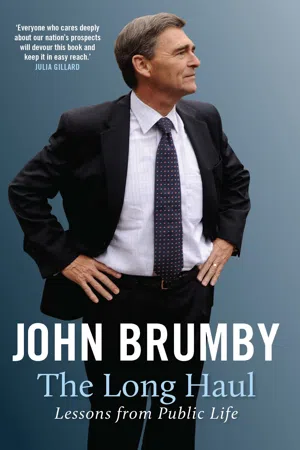
- 355 pages
- English
- ePUB (mobile friendly)
- Available on iOS & Android
eBook - ePub
About this book
Trusted by 375,005 students
Access to over 1.5 million titles for a fair monthly price.
Study more efficiently using our study tools.
Information
1
Experience: The View from Inside
In late 1992, I was on the deck of a cruise ship in Sydney Harbour, waiting for my boss to finish a speech. After spending the best part of a year working for the Bendigo Building Society, I’d been persuaded to return to Canberra. Alan Griffiths was Minister for Resources and Tourism in the Keating Government, and I had become his chief of staff. I had previously served as the federal Member for Bendigo for seven years, before narrowly losing my seat in the 1990 election. I was pleased to be back in the world of hard policy development and implementation.
I liked Alan. He was a good friend and a person of great ability, who was elected to parliament in 1983—the same year as I was. He was smart, quick on his feet and had a great way with people. Alan liked to begin every speech the same way. His mother, he said, told him he had one mouth and two ears, and he should use them in that proportion. Good advice—though often ignored by Alan!
Given Alan’s tendency to go off script, this time I decided to make my way to the deck where I could smoke a surreptitious cigarette and make a phone call or two.
In the event, it was my phone that rang. Senator Robert Ray (leader of the Labor Unity faction of the Victorian Labor Party) was calling to tell me that a long-serving Labor member of the Victorian Upper House, Bill Landeryou, was about to retire for health reasons. Would I be interested in standing for the Legislative Council province of Doutta Galla?
The question came out of the clear blue sky. I’d always been interested in state politics, but I’d spent the best part of a decade concentrating on federal issues. Mentally and emotionally, I’d moved on from politics. My mind was on new career opportunities, more time with my wife Rosemary and the kids, and more time on our farm at Harcourt. On the other hand, a Victorian Upper House seat would offer a number of advantages. For a start, it would put an end to the punishing travel and gruelling schedules associated with federal politics in a regional seat. I would be somewhat removed from the nitty-gritty of day-to-day electorate work, and could concentrate my energies on some of the big policy questions for Labor in the aftermath of a massive state election defeat. And while I had no immediate interest in the leadership, I assumed that in a few years’ time, when Labor’s Upper House leader (David White) might want to move on, I could be a viable candidate for his position.
I couldn’t give Robert an answer straight away. I had to talk to Rosemary. We needed to carefully consider the impact this would have on our lives and careers. I asked him to give me twenty-four hours to think about it. His reply was typically direct: ‘How about one hour’. Fortunately, I was able to reach Rosemary, and just a few hours later I called Robert back and said yes.
Beginnings
Some people know they want to go into politics from an early age. I was not like that; I had no grand plan. I have always believed that to succeed in life you have to be light on your toes, ready to seize opportunities, work hard and keep moving. In life—and especially in politics—road maps are hard to come by, but serendipity can be a marvellous thing.
I did not have a political mentor, but I did have a role model. Along with countless other young Australians of my generation, I was awed and inspired by the political colossus that was Gough Whitlam. Gough assumed leadership of the Australian Labor Party in 1967, when I was fourteen years old. Over the next five years, he transformed the party—but more than this, he offered my generation a vision of what public leadership could be. This was something sorely lacking in the tired, two-decade-old, conservative government in 1972. Gough’s slogan proclaimed, ‘It’s Time’, and it was—time to modernise Australia, engage positively with Asia, and get out of the Vietnam War. No government is ever perfect, but Gough demonstrated that positive change can be achieved through politics. In so doing, he attracted many young people, students and white-collar workers to the Australian Labor Party.
I did not join—not yet—but I was certainly heading in that direction. In a broader life sense, my direction was less clear. I attained a Bachelor of Commerce from Melbourne University, worked in a number of part-time jobs pumping petrol, selling shoes and cleaning factories, and also helped out on my parents’ farm at Coleraine, carting hay and dipping sheep. But I had no idea what I wanted to do with my life or who I wanted to be. At Dad’s urging, I undertook a comprehensive ‘psychometric’ career aptitude test at a well-known human relations firm, which concluded that I should seek a career in the fine arts! It is perhaps to the art world’s loss that I spotted an advertisement for university graduates with a mathematics and commerce background, who would be willing to train as teachers and then work in secondary schools around the state. I signed up, and in 1975 completed a Graduate Diploma of Education at Rusden State College, which was then co-located with Monash University. Rusden had great lecturers, and I loved teaching. I worked hard and gained first-class honours in virtually every subject.
My girlfriend and I applied to teach at several small country schools across the state. In January 1976, I was sent to a place I’d never heard of—Eaglehawk. When I looked it up in the street directory, I couldn’t find it. I wondered if the Education Department had made a mistake. But it turned out that landing in one of the most disadvantaged areas in Victoria was the best thing that could have happened to me. Not only did it make me as a teacher, but it also gave me the opportunity to get involved in the local community. I began to learn how to work for change at a grassroots level. A couple of other teachers at the high school were members of the ALP, and they encouraged me to join. In 1978, with the help of other teachers from the school, we established Victoria’s first regional group of Amnesty International. In those days this was not as easy as it sounds. The secretary of the Bendigo RSL, having seen some of our publicity in the local paper, rang to quiz me about our ‘links’ to the Communist Party.
Thanks to my involvement with community groups, I learnt to speak to audiences and think on my feet. I started to see the kind of positive change that can occur when committed people work together under effective leadership; and further, I began to envision a role for myself in providing that kind of leadership. In late 1978, I had the opportunity to test myself on a larger scale: as Labor candidate for the seat of Midlands in the Parliament of Victoria.
Although I enjoyed overwhelming branch support, I was lucky to win preselection as I hadn’t been in the party for two years. If any member of more than two years had nominated against me, they would have won automatically—that was the rule. I found out later, from ALP State Secretary Bob Hogg, that someone did nominate against me, but the application was apparently lost in the mail. Serendipity again. As the officially endorsed ALP candidate, I needed a 12 per cent swing to win. I worked extremely hard, door-knocking every house I could find and addressing any meeting that would have me. In the end, the swing was around 10 per cent—not enough to get me over the line, but enough to impress a number of important party people. This would come in handy later.
After four years’ teaching, and no promotion opportunities, I had itchy feet. I successfully applied for a job with the Victorian Teachers Union in the Eastern suburbs (Knox region). This took me away from Eaglehawk for a time, until the position of Regional Organiser for Bendigo became vacant. I was keen to get back to Bendigo, which felt like home. I liked the area and had many friends there. I successfully applied for the position, and moved back. While I certainly hadn’t returned with the intention of standing for ALP preselection for the federal seat of Bendigo, some months later I was urged by a number of party members to throw my hat into the ring. We had all expected Labor’s 1980 candidate, Dr Vic Dolby, to stand again after a very strong performance. But for personal reasons, Vic wasn’t able to stand—so the field was wide open. Not surprisingly, there was a large field of contenders for the most marginal federal seat in Australia.
Again, fate was on my side. I was a late entrant to the process, and most party members had already committed themselves to a candidate. I was not a member of any faction, which to this day can make life difficult in the ALP. There were certainly some quality candidates in the field. However, my hard work as a state candidate began to pay dividends. When a number of senior Labor Unity people learnt that I had entered the race, they persuaded their factional colleagues to refrain from officially backing any candidate. I defeated Stewart Anderson, the Socialist Left candidate, by 38 votes to 32 to become the Labor candidate for Bendigo, and went on to win the seat. Around ten years later, when Stewart passed away, I was honoured to deliver the eulogy at his funeral and thank his family for his lifetime of service to the ALP.
Very little of all this could have been planned. Life is dynamic, and a rigid plan can fail to capture the full range of possibilities generated by a constantly changing world. This is even truer in the first decades of the twenty-first century than it was in the last decades of the twentieth. I advise young people today to stay hungry for opportunity: be light on your toes and work hard at whatever chances you get. An ounce of luck doesn’t hurt either—but you have to be alert and active to take advantage of it.
The Hawke Government
One of the more memorable exchanges of the 1983 federal election campaign came when Prime Minister Malcolm Fraser warned that if Labor were elected, the people of Australia would be better off hiding their money under their beds than trusting his opponent’s management of the economy. The Leader of the Opposition made a brilliant reply: ‘You can’t keep your money under the bed—that’s where the Commies are!’ The day Bob Hawke delivered that line I was waiting for him to arrive in Bendigo. I had an enormous crowd waiting with me. There we were: the 29-year-old, fresh-faced Labor candidate, along with hundreds of people hoping to catch a glimpse of the most popular political leader in living memory. Even though plane engine trouble made him many hours late, there were still 600 or so people waiting to greet Hawke by the time he arrived. It’s difficult to imagine a politician today who could command such an audience, let alone a crowd willing to hang around unexpectedly for half a day.
But Bob Hawke had more than just charisma. He had a clarity of foresight and an approach to government that allowed him—along with Paul Keating as treasurer and perhaps the most talented Cabinet since Federation—to fundamentally reshape the Australian economy. To sit on the backbench of the Hawke/Keating Government in the 1980s was to learn from the best. I soaked up every lesson they had to offer.
The first, and perhaps most important, lesson: reform or perish. This was a federal Labor government that saw clearly the need to encourage economic growth by the creation of a dynamic, efficient market economy. As Bob Hawke later put it: ‘Economic reform was not the enemy of social progress, but rather the necessary condition for it. Without economic reform we were facing the certainty of social regression’. He and his government understood that this goal was in no way opposed to Labor’s traditional objectives of fairness and opportunity for all.
A second lesson I learnt in the federal parliament was that conservatism does not only exist on the other side of the chamber. Rather, the tendency to want to cling to outmoded structures and systems—whether economic, social, or legislative—is widely prevalent and can be dangerous. If we are committed to economic growth and social progress, then it follows that as long as the world changes and the sources of growth evolve, reform must be ongoing.
The economy inherited by the Hawke Government in 1983 was stagnant and sclerotic, largely incapable of responding to global trends, and in danger of being left behind in the emerging global economy. Our so-called ‘lucky country’ had been drifting for far too long. Nothing that the Hawke Government did to change this was easy—not the floating of the dollar, the deregulation of financial markets, the cutting of tariffs or changes to the tax code. But all of it was necessary, and it paid off in the form of more than two solid decades of economic growth and rising standards of living.
One difficult but necessary reform was the introduction of an assets test on pensions. Under previous governments, a person could have millions of dollars tucked away in a bank account, trust or superannuation fund, and still collect the full aged pension. I fully supported changing that, even though my electorate contained more pensioners who were affected than any other. Led by Andrew Peacock, the Coalition fought the entire 1984 election campaign on just two issues: the assets test and the taxation of lump-sum superannuation. Thirty years later, in a tight fiscal environment, there’s no debate about the importance of an assets test; indeed, the debate has shifted towards further tightening, and whether the family home should remain exempt.
Another difficult reform that has served Australia well is the introduction of the Higher Education Contribution Scheme (HECS). Free university education sounds like a progressive policy, but in reality it meant a widening gap between the number of places the government could afford to provide and the number of places needed. Prime Minister Hawke and Education Minister John Dawkins commissioned former New South Wales premier Neville Wran to review the situation, and Wran recommended a scheme by which graduates would repay some of the costs of their education once their income reached a certain level. With the additional contribution made by students, many more places in higher education could be offered. John Dawkins asked me to chair the caucus committee tasked with examining the report and making recommendations. Our recommendation was unequivocal: HECS should be introduced. It was, and hundreds of thousands more people received a university education because of it—but it was certainly controversial at the time, and would not have been achieved without the reformist zeal of John Dawkins, coupled with caucus support.
As the federal Member for Bendigo, I was acutely aware of the effect on the ground of some of the Hawke Government reforms. In 1983, townships in my electorate, such as Bendigo, Castlemaine, Maryborough and St Arnaud, were heavily dependent on manufacturing and textiles—the very industries that benefitted most from a pegged Australian dollar and high tariff walls. Of the almost 60 000 people in my electorate, more than 4000 were employed in textiles, clothing and footwear, and I suspect the vast majority would have been Labor voters. So dragging down tariff walls was hard; hard for families, hard for communities, and hard for me.
But fortunately the Minister for Industry and Commerce—the late John Button—proved himself a master of the ‘industry plan’. In areas as diverse as textiles and clothing, pharmaceuticals and motor vehicles, he made stakeholders aware of the time frame for change; supported families with retraining and job placement; and ensured direct intervention where necessary to attract new industries and job opportunities to affected regions. Despite considerable transitional pain, the loss of jobs in my electorate was more than offset by new jobs in service industries, and other forms of regional investment.
This was the third lesson. The Hawke Government showed time and again that the best path to reform is via consultation, cooperation and consensus. Soon after winning office, Prime Minister Hawke summoned to Canberra representatives of business, unions, churches, welfare groups and community organisations to talk about the future of the nation. Some of these groups had been at each other’s throats for years. By explaining the challenges the nation faced at the time, and describing the mutual advantages of a combined effort, the government was able to lay the political groundwork for a decade of cooperative reform. The now legendary partnership between Paul Keating as treasurer and Bill Kelty as head of the Australian Council of Trade Unions meant that we were able to avoid a destructive wage blowout during a time of necessary structural adjustment, and we also gained a system of compulsory superannuation that has dramatically lifted our national savings, and now helps cushion Australia both from international financial volatility and from unsustainable domestic demands on the aged pension.
However, it became clear that reform cannot always be achieved through cooperation and consensus. The assets test on pensions, for example, was met with a ferocious campaign against the Prime Minister, led by the Melbourne Sun newspaper. From Bob Hawke I learnt a fourth lesson: when reform is necessary and the policy is right, sometimes you just have to go ahead. Crash through—as Gough Whitlam once put it—or crash.
As federal Member for Bendigo I tried to absorb these lessons. I learnt from the inside what a good government looks like. I worked hard for the people of Bendigo, deepened my knowledge of rural and regional Australia—and along the way I met my wife.
Rosemary McKenzie had grown up on a farm in Boort, in northwestern Victoria. She was dux of Bendigo High School in 1976 and went on to achieve outstanding results at Monash University. She then returned to central Victoria to take up a position as research officer at the Castlemaine Education Centre. In 1983, I persuaded her to work as a researcher in my electorate office, but she became, in time, much more than that. Rosemary has been a partner to me in more than one sense. She has a strong work ethic and a deep understanding of policy and political ideas, and she also knows and accepts the stresses of public life. But most importantly, she has never lost faith in the potential of politics to empower individuals and communities to make lasting change. This belief in the value of public life helps explain why, in 1992, she encouraged me to say yes to Robert Ray and stand for preselection for Doutta Galla.
Finally, however, I learnt a fifth lesson during my time in the Hawke Government. Eighteen months before the 1990 election, our party’s pollster advised me that I had the highest recognition and highest approval ratings of any seat they had polled across Australia. And yet in 1990, I lost. High interest rates, the current account deficit, and high levels of dissatisfaction with the Victorian Cain Labor Government brought down nine federal Labor members in Victoria. When the political tide finally turns, it is practically impossible to avoid getting swept out with it.
Hard Labor
Fast-forward to 1992. My ‘yes’ to Robert Ray on the ship in Sydney Harbour resulted in a by-election win for the state Upper House seat of Doutta Galla and a seat in the Labor party room at Victoria’s Parliament House. We didn’t need a very big room. The previous state election had reduced our numbers to 27 out of 88 members in the Lower House, and 14 out of 30 in the Upper House. Many voters had accepted the cen...
Table of contents
- Cover
- Title
- Copyright
- Contents
- Foreword
- Acknowledgements
- 1 Experience: The View from Inside
- 2 Remember the Four Ps
- 3 Reform or Perish
- 4 Government Is a Team Effort
- 5 Encourage the Frank and Fearless
- 6 Don’t Muzzle the Watchdogs
- 7 Govern the Whole State
- 8 Time Is Short
- 9 The Triple-A Matters
- 10 The Challenge of Service Delivery
- 11 Lessons in Education
- 12 Prevention Is Better than Cure
- 13 The Footy and the Synchrotron
- 14 Hard Decisions
- 15 Reporters, Not Players
- 16 Conscience Can Work
- 17 On Partnership
- 18 After Black Saturday
- 19 A Climate of Opportunity
- 20 The Impossible Is Possible
- 21 Seeing Around Corners: The Reform Imperative
- Appendices
- Notes
- Index
Frequently asked questions
Yes, you can cancel anytime from the Subscription tab in your account settings on the Perlego website. Your subscription will stay active until the end of your current billing period. Learn how to cancel your subscription
No, books cannot be downloaded as external files, such as PDFs, for use outside of Perlego. However, you can download books within the Perlego app for offline reading on mobile or tablet. Learn how to download books offline
Perlego offers two plans: Essential and Complete
- Essential is ideal for learners and professionals who enjoy exploring a wide range of subjects. Access the Essential Library with 800,000+ trusted titles and best-sellers across business, personal growth, and the humanities. Includes unlimited reading time and Standard Read Aloud voice.
- Complete: Perfect for advanced learners and researchers needing full, unrestricted access. Unlock 1.5M+ books across hundreds of subjects, including academic and specialized titles. The Complete Plan also includes advanced features like Premium Read Aloud and Research Assistant.
We are an online textbook subscription service, where you can get access to an entire online library for less than the price of a single book per month. With over 1.5 million books across 990+ topics, we’ve got you covered! Learn about our mission
Look out for the read-aloud symbol on your next book to see if you can listen to it. The read-aloud tool reads text aloud for you, highlighting the text as it is being read. You can pause it, speed it up and slow it down. Learn more about Read Aloud
Yes! You can use the Perlego app on both iOS and Android devices to read anytime, anywhere — even offline. Perfect for commutes or when you’re on the go.
Please note we cannot support devices running on iOS 13 and Android 7 or earlier. Learn more about using the app
Please note we cannot support devices running on iOS 13 and Android 7 or earlier. Learn more about using the app
Yes, you can access The Long Haul by John Brumby in PDF and/or ePUB format, as well as other popular books in Politics & International Relations & Political Biographies. We have over 1.5 million books available in our catalogue for you to explore.