Port Phillip's free settlers often said that they were civilising a wilderness. The truth was that the occupied country already had people, laws, politics, and economies. What did 'civilisation' mean to the free settlers? And what was the relationship between civilising and violence? The Civilisation of Port Phillip tracks the violent history of the first years of British settlement in the Port Phillip District, now the state of Victoria. It illuminates the underlying free-settler rhetoric that advocated and abetted violence on the frontier. For the first time, we hear the settlers tell us in their own words what the civilisation of Port Phillip really involved. Frontier violence in Port Phillip involved Aboriginal peoples, convicts, free settlers and colonial officials. This history shows how the lives of these different people interconnected in early Port Phillip, in unlikely friendships, dire misunderstandings, and fatal clashes. It paints a vivid picture of the period drawn from archival records, a thorough re-reading of older histories, and new ideas in the scholarship of violence. As well as sheep and firearms, free settlers brought Enlightenment ideas about civilisation to Port Phillip. When these European ideas were coupled with Australian frontier experience, they manifested in an exterminatory attitude towards people deemed undesirable in the coming colony. The Civilisation of Port Phillip shows how free-settler rhetoric, law, and systems of classification reinforced and sought to justify the violence of the frontier.
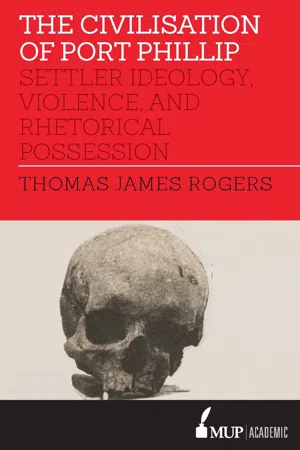
eBook - ePub
The Civilisation of Port Phillip
Settler ideology, violence, and rhetorical possession
- English
- ePUB (mobile friendly)
- Available on iOS & Android
eBook - ePub
The Civilisation of Port Phillip
Settler ideology, violence, and rhetorical possession
About this book
Trusted by 375,005 students
Access to over 1.5 million titles for a fair monthly price.
Study more efficiently using our study tools.
Information
CHAPTER 1
Huts, or the British idea of civilisation
An enduring image of Melbourne’s founding is that of John Batman being rowed up the Yarra, and the declaration found in his journal: ‘this will be the place for a Village’.1 It has become more common recently to quote the journal entry in full: ‘… this will be the place for a Village—The Natives on shore’.2 It is a disjointed and fragmented passage, as would be expected of a journal written on board ship or while exploring strange country.3 The inclusion of the last line of the entry has the effect of suddenly populating the scene with Aboriginal people, who in many narratives are more or less invisible. Batman’s boat is no longer plying the empty waters of a beautiful but forsaken land—it is entering a land that is already known and inhabited.
Let us add one mark of punctuation to the journal entry: ‘This will be the place for a Village—The Natives’ on shore’. With the hypothetical addition of an apostrophe, the lonely boat on the Yarra is suddenly alongside a bustling village, replete with curious locals staring at the strange men on the water. The story is no longer that Batman founded Melbourne, but that he found it. Now, tampering with the punctuation of a sacred primary document is an activity in which no self-respecting historian would engage—and one I suggest only as an illustrative exercise. In adding an apostrophe, I am not suggesting that this is how the entry should be read, nor am I suggesting that Batman’s boat rowed into a village. The apostrophe is intended as an illustration that brings the Aboriginal people of the area back into the picture, even if only by degrees. The apostrophe serves to point out that settlers did find ‘villages’, as some Britons called them, in the Port Phillip District. ‘Native huts’, as they were usually called, were mentioned by a wide array of settlers and explorers, a fact that this invented apostrophe brings to the fore.
The physical reactions of the explorers and settlers to the huts can be summarised in three ways: huts were variously observed, used, or destroyed. The Britons’ intellectual responses, however, tended towards a consideration of the nature of Aboriginal societies, and how these people could be placed in an Enlightenment worldview. Each European observer saw Aboriginal huts in a different light, depending on his role in the landscape as explorer, squatter, protector, or visitor. The prevailing attitudes of European men—as all the authors of the following sources were—influenced the observations they made about the permanent and semi-permanent dwellings of Aboriginal people. In addition, the differing class, religious, and cultural backgrounds of these observers played their part in shaping their response to Aboriginal huts. The idea of civilisation that these observers brought with them to Australia illustrates the role the settlers gave themselves in the landscape. Observations of Indigenous societies that drew on the stadial, or four-stage, idea of civilisation illustrate some of the strongest Australian settler myths.
The nineteenth-century British had a material understanding of civilisations; that is, when they ranked the world’s civilisations, the British looked for material evidence. The huts of Aboriginal people offered settlers a useful material focal point for a discussion of the idea of civilisation. British remarks about the huts can therefore be used to uncover settler mythologies, those matter-of-fact statements that both obscure and propagate ideology. This chapter will provide a brief overview of the idea of civilisation, then examine the observations it produced in the minds of the British when it arrived on the coasts of southern Australia. As we will see, Aboriginal housing has not attracted a vast scholarship in historical studies. Where it has been studied, there have been three main frameworks: in terms of stadial progress, in an archaeological manner not concerned with the period of contact, or most recently in the strategic terms of a British settler invasion.4 Drawing on these frameworks where necessary, this chapter will examine the first encounters settlers had with Aboriginal huts, then consider the differing reactions these huts provoked in settlers. The presence of huts elicited observations that allow historians to comprehend how settlers in the District understood possession and their role in it.
The settler idea of civilisation
The division between civilised and uncivilised peoples has been an object of earnest study since the Enlightenment, although thinkers in that period drew on traditions stretching back to ancient Greece and the Near East.5 Gilgamesh, the eponymous hero of the Babylonian Epic, had to civilise the wild, hairy Enkidu, who came from the forest and was more beast than man.6 The stories of the Bible drew on imagery from Near Eastern texts such as the Epic, and encapsulate what was to become the definitive conquest of the West—the triumph of the sedentary pastoralists over nomads.7 The thinkers of the Enlightenment changed the conception of civilised and savage societies by assuming that these stages were the schema followed by all human societies.
During the early modern period and the Enlightenment, Western European philosophers developed theories about human societies in what they termed a ‘state of nature’. The state of nature still fired the imaginations of the settlers and explorers of the Port Phillip District as they believed that their own societies had advanced out of that same state.8 In the seventeenth century, English political philosopher Thomas Hobbes had laid the groundwork for this thinking with his famous dictum that life in the state of nature was ‘solitary, poor, nasty, brutish, and short’.9 He imagined that Native Americans lived in a state of nature, which he understood to be a state of ‘war of every man against every man’.10 Such was ‘the natural condition of mankind’.11 Such societies as England had progressed out of that state. The idea of advancement was summed up by another English philosopher, John Locke. He followed Hobbes’ work with another famous maxim: ‘in the beginning all the World was America’.12 To modern eyes, Locke’s phrase seems somewhat cryptic; he meant that the peoples of the Americas that Europeans were meeting at this time were living in a state of nature, as the Europeans once had. The American societies were therefore ‘behind’ those of the Europeans in time and development.
Other European thinkers rejected Hobbes’ pessimistic view of the state of nature. For them, the state of nature was inhabited by the ‘noble savage’, a concept associated with the eighteenth-century French philosopher Jean-Jacques Rousseau.13 By the time the British came to Port Phillip, this figure had faded somewhat in their imaginations. As will be seen in the last section of this chapter, many settlers saw little of worth in Aboriginal societies. Explorers and sojourners, however, were more likely to espouse the positive aspects of a society in what they imagined was the state of nature. The concepts of the noble savage, the state of nature, and the four-stage theory of civilisation were reactions to the new societies Europeans encountered from the 1400s onward, but they were also bound up with the objectives of colonisers to control native peoples. The settlement of Port Phillip occurred before the so-called scientific racism of the later nineteenth century began in earnest.14 The foundations for such racism, however, were there: the stadial ideal of civilisations, for example, put the British Empire at the top of human societies and Australian Aboriginal people at the bottom.
The materialist conception of history that culminated in the four-stage theory was a joint Scottish and French Enlightenment phenomenon.15 Adam Smith, the Scottish Enlightenment philosopher, summed up the process: ‘There are four distinct stages which mankind pass thro:—1st, the Age of Hunters; 2dly, the Age of Shepherds; 3dly, the Age of Agriculture; and 4thly, the Age of Commerce’.16 The French philosopher Jacques Turgot, a contemporary of Smith, proposed that each advance in economic stage caused an improvement in a society’s moral and political life, and an improvement in the reasoning skills of that society’s members.17 Coupled with the belief that to observe contemporary Americans, Africans, and Australians was ‘to behold, as in a mirror, the features of our own progenitors’, these were powerful ideas indeed.18 As Patrick Wolfe describes the thinking: ‘pastoralists were not merely superior to nomads; they were so because they had once been nomads but were so no longer’.19 British settlers brought not only the notion that Aboriginal Australians were living in...
Table of contents
- Cover
- Title
- Copyright
- Dedication
- Contents
- Acknowledgements
- Introduction
- 1 Huts, or the British idea of civilisation
- 2 The prevention of conflict
- 3 Convicts, and the mythologies of free settlers
- 4 The search for Gellibrand and Hesse
- 5 Captain Foster Fyans
- 6 Free settler ideologies
- Conclusion
- Bibliography
- Index
Frequently asked questions
Yes, you can cancel anytime from the Subscription tab in your account settings on the Perlego website. Your subscription will stay active until the end of your current billing period. Learn how to cancel your subscription
No, books cannot be downloaded as external files, such as PDFs, for use outside of Perlego. However, you can download books within the Perlego app for offline reading on mobile or tablet. Learn how to download books offline
Perlego offers two plans: Essential and Complete
- Essential is ideal for learners and professionals who enjoy exploring a wide range of subjects. Access the Essential Library with 800,000+ trusted titles and best-sellers across business, personal growth, and the humanities. Includes unlimited reading time and Standard Read Aloud voice.
- Complete: Perfect for advanced learners and researchers needing full, unrestricted access. Unlock 1.5M+ books across hundreds of subjects, including academic and specialized titles. The Complete Plan also includes advanced features like Premium Read Aloud and Research Assistant.
We are an online textbook subscription service, where you can get access to an entire online library for less than the price of a single book per month. With over 1.5 million books across 990+ topics, we’ve got you covered! Learn about our mission
Look out for the read-aloud symbol on your next book to see if you can listen to it. The read-aloud tool reads text aloud for you, highlighting the text as it is being read. You can pause it, speed it up and slow it down. Learn more about Read Aloud
Yes! You can use the Perlego app on both iOS and Android devices to read anytime, anywhere — even offline. Perfect for commutes or when you’re on the go.
Please note we cannot support devices running on iOS 13 and Android 7 or earlier. Learn more about using the app
Please note we cannot support devices running on iOS 13 and Android 7 or earlier. Learn more about using the app
Yes, you can access The Civilisation of Port Phillip by Thomas James Rogers in PDF and/or ePUB format, as well as other popular books in History & Australian & Oceanian History. We have over 1.5 million books available in our catalogue for you to explore.