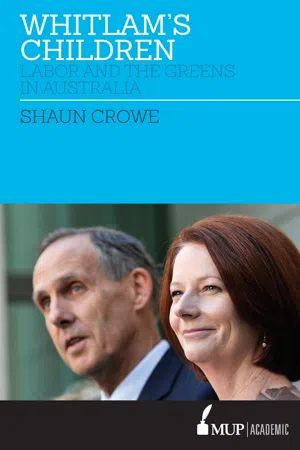
Over the past three decades, progressive politics in Australia has undergone a gradual but unmistakable transformation. Where the Australian Labor Party once enjoyed dominance over the political left it now shares space with the Greens; at times depending on minor-party support to form government, and even more often to pass contentious legislation. Based on over forty interviews with politicians and party figures, Whitlam's Children is the first study of this increasingly important relationship in Australian politics.Did previous attempts at cooperation, particularly minority government under Julia Gillard, deliver successful government, and how do each judge the experiment in hindsight? Why are certain policy areas, like refugee settlement and environmental policy, so stubborn and divisive? And will we ever see a more lasting coalition on the Australian left, to mirror the established arrangement on the Australian right? While revealing a variety of perspectives, even within parties, the research uncovers a productive, if often hostile relationship; united by a series of shared values, but divided by different approaches to politics, elections and parliament.Featuring a preface by Geoff Gallop
- English
- ePUB (mobile friendly)
- Available on iOS & Android
eBook - ePub
About this book
Trusted by 375,005 students
Access to over 1.5 million titles for a fair monthly price.
Study more efficiently using our study tools.
Information
CHAPTER 1
The Two-party System and its Discontents
If the 2010 hung parliament came as a shock, it was largely because, in the conventional wisdom, Australian politics was conducted within a stable, two-party system. Although one carried a slightly different name, a line of descent could be drawn from the parties competing for electoral support at the beginning of the twentieth century to the parties competing in the twenty-first.1 Other parties might exist, even exert influence, but only two possessed a credible prospect of claiming government. After the ‘fusion’ of liberal and conservative groups in 1909, scholars characterised this in different ways—as a clash between ‘Labor’ and ‘non-Labor’ groups, or between ‘parties of initiative’ and ‘parties of resistance’—but most implicitly accepted the bipartisan framework.2 Even arguments challenging two-party politics often accepted that, for most casual observers, it was the familiar Australian reality.3
But while this narrative emphasised Australia’s static tendencies, less influential accounts showed a greater interest in its more fluid elements. Without rejecting the concept outright, a second thread noted that Australian history was more fitful, less linear than the simple two-party image recognised. One of the earliest studies of local parties observed that, ‘although the Australian electorate has never been divided into the multiplicity of parties which is characteristic of republican France … it has seldom enjoyed a strictly two-party system’.4 A later history described it as ‘unstable’: ‘Governments change frequently enough … but the change of fortune has so often been accompanied by party disunity, by organisational chaos and the shifting of personal loyalties that it cannot be described as an allegiance between two broad alternatives.’5
In the first fifty years after fusion, this ‘chaos’ emerged periodically, with major parties fracturing and realigning, the system rarely surviving a major crisis without reorganisation.6 Labor, the constant presence in federal politics, itself split on three occasions, the same number of times the non-Labor grouping changed its name and identity.
While the bipartisan model survived these rifts, repurposing itself to fit new social demands, cracks in the two-party system became increasingly visible over the second fifty years of federal history. Mirroring international trends, support for the major parties fell steadily, as did consistent lifetime voting patterns.7 Although still dominating executive office, their position was less certain. By 2010, major parties won just 75 per cent of the national vote, down from 90 per cent in 1975.8 In this changing climate, small parties managed to squeeze their way through these growing cracks and into parliament. Some, like the Democrats, gained a durable position of influence in the Senate, only for their support to evaporate after controversial decisions.9 Others, such as One Nation, shot to prominence on a radical platform, then collapsed just as quickly—and then re-emerged more than a decade later.10 More recently, ‘micro parties’ gained federal representation, grouped around charismatic leaders, parliamentary defectors and ambitious independents. By 2010, the most popular of these minor parties was the Greens.
If nothing else, Australian political history is more interesting than is usually credited, littered with movements and moments complicating the two-party settlement. In some sense this is a history of the losers; those who either collapsed or were absorbed by major parties, those facing the enormous condescension of posterity. But although impermanent, each left an imprint on the party system, and each exposed the limits of bipartisan politics. Beginning with Federation and ending with Kevin Rudd’s election—from the nation’s first decade and its uncomfortable ‘three elevens’ to Labor’s run of schisms over conscription, the Depression and communism, to the staggered rise of Democrat and Greens politicians—this chapter examines the history of parties in Australia. With an emphasis on the political left, it focuses on moments of volatility in the system, when dominant formations splintered and formed anew. Some of these involved public Labor ‘splits’, others involved less obvious, more gradual shifts.
For Labor and the Greens, this history offers a number of lessons: that change can take many forms, following external shocks or gradual social change, originating inside or outside parliamentary parties, challenging or reinforcing the dominant economic clash; that Labor exhibited noticeable resistance to coalition politics at various significant moments; and that the nature of these splits affected Labor’s electoral performance, often disastrously, with hostility corresponding with long periods in opposition for the party. Each of these shaped Australian political history, and each is worth pondering.
Governing with ‘three elevens’ (1901–09)
Australia’s first federal decade of party politics was also in many ways its most volatile. As Alfred Deakin famously described it, this was the era of ‘three elevens’—Deakin’s Protectionist Party, George Reid’s Free Trade Party and the Labor Party—in which prime ministerial authority relied on fragile and shifting parliamentary coalitions.11 Parties granted leaders temporary confidence, only then to revoke it, often multiple times a term. Until the election of Andrew Fisher’s Labor government in 1910, at no ballot did a single party win a parliamentary majority. In these nine years—between Federation and the fusion of the two non-Labor parties—the Commonwealth held three elections, while parliament chose six separate governments.12
Amid this flux, questions of alliance and coalition were understandably central to Labor politics. Should it work with sympathetic parties, particularly the Protectionists, in order to implement parts of its platform? Alternatively, should it seek to govern alone, even if this meant directly confronting potential allies during elections? These were not easy questions, particularly as the line between colonial ‘labourism’ and ‘liberalism’ was fluid. While Protectionists opposed Labor’s ‘pledge’, many of its politicians, such as H.B. Higgins and Charles Kingston, supported an active and progressive federal government, one that ‘removed the kind of material insecurity and deprived living conditions that prevent individuals from realising their potential as active, engaged citizens’.13 Alliances could potentially achieve Labor objectives, although perhaps at the expense of the party’s own electoral growth.
For much of the first decade, Labor’s answer to this dilemma was, as state representative George Black put it, ‘support in return for concessions’.14 This suited its inaugural leader, Chris Watson, who by temperament and experience gravitated towards negotiation, and who also enjoyed a close relationship with Alfred Deakin.15 After the nation’s first election in 1901, Labor MPs backed Edmund Barton’s Protectionist government, assuring it confidence, and also voting for its major legislative achievements. The political system was still in an embryonic state, with party lines appearing ‘confused and uncertain’ even to MPs, yet the first parliament established key national institutions, as well as the foundations of ‘White Australia’—a policy strongly supported by Labor at the time.16 Although mostly concerned with procedural matters, the experience did imply that Labor could forward its agenda without itself being in government.
While Barton managed to last a full three-year term, the Commonwealth’s second parliament was extremely turbulent, perhaps the least stable in Australian history. In three years, the country was led by three prime ministers; one from the Protectionists, one from Labor and one from the Free Traders. The first, Alfred Deakin, lasted less than six months. After Labor sought to amend, and then eventually voted against, the new Protectionist leader’s industrial relations legislation, Deakin resigned as prime minister. In the ensuing parliamentary vacuum, Deakin gave Labor its first opportunity with a second model: governing itself, with the support of Protectionist MPs. This made Watson Australia’s first Labor prime minister, and the first leader of a national labour government anywhere in the world. The Sydney Morning Herald spoke for much conservative opinion when it lamented that ‘the Federal Ministry is made up almost entirely of untried politicians, the representatives of a class, and tied hand and foot to a caucus vote’.
With unprecedented formal influence, but without a parliamentary majority, Labor was still in a precarious position, and it knew it. As prime minister, Watson presented a cautious program, ‘less about Labor’s priorities as set out in the fighting platform, than an appeal to many of the Protectionists to keep them and the Free Traders from combining against the ministry’.17 Even with these modest goals, minority government was no easier for Watson than it had been for Deakin. Many within Labor resisted the sacrifices demanded by coalition politics, an opposition mirrored by much of the Protectionist Party. Deakin’s MPs were already split over whether to support Watson or Reid, with its more conservative representatives sharing the Free Trade contempt for Labor’s agenda. Contemplating this parliamentary minefield, Watson approached Deakin about creating a formal gov...
Table of contents
- Cover
- Title
- Copyright
- Contents
- Foreword by Geoff Gallop
- Acknowledgements
- Introduction
- 1 The Two-party System and its Discontents
- 2 Two Leftist Traditions: What divides Labor and the Greens?
- 3 The View from the Top: Why Labor or the Greens?
- 4 Beautifully Ugly? Labor, the Greens and minority government
- 5 The Diabolical Problem
- 6 Refugee Politics
- 7 Taxing Mining
- 8 A ‘Red-Green’ Coalition?
- Conclusion: ‘Certainly, the impotent are pure’
- References
- Index
Frequently asked questions
Yes, you can cancel anytime from the Subscription tab in your account settings on the Perlego website. Your subscription will stay active until the end of your current billing period. Learn how to cancel your subscription
No, books cannot be downloaded as external files, such as PDFs, for use outside of Perlego. However, you can download books within the Perlego app for offline reading on mobile or tablet. Learn how to download books offline
Perlego offers two plans: Essential and Complete
- Essential is ideal for learners and professionals who enjoy exploring a wide range of subjects. Access the Essential Library with 800,000+ trusted titles and best-sellers across business, personal growth, and the humanities. Includes unlimited reading time and Standard Read Aloud voice.
- Complete: Perfect for advanced learners and researchers needing full, unrestricted access. Unlock 1.5M+ books across hundreds of subjects, including academic and specialized titles. The Complete Plan also includes advanced features like Premium Read Aloud and Research Assistant.
We are an online textbook subscription service, where you can get access to an entire online library for less than the price of a single book per month. With over 1.5 million books across 990+ topics, we’ve got you covered! Learn about our mission
Look out for the read-aloud symbol on your next book to see if you can listen to it. The read-aloud tool reads text aloud for you, highlighting the text as it is being read. You can pause it, speed it up and slow it down. Learn more about Read Aloud
Yes! You can use the Perlego app on both iOS and Android devices to read anytime, anywhere — even offline. Perfect for commutes or when you’re on the go.
Please note we cannot support devices running on iOS 13 and Android 7 or earlier. Learn more about using the app
Please note we cannot support devices running on iOS 13 and Android 7 or earlier. Learn more about using the app
Yes, you can access Whitlam's Children by Shaun Crowe in PDF and/or ePUB format, as well as other popular books in History & Australian & Oceanian History. We have over 1.5 million books available in our catalogue for you to explore.