![]()
PART I
TEN MILLION PRIVATE ROOMS
![]()
I Survey and Sketch Plans
TOWARDS the end of the eighteenth century, Englishmen began building houses on the east coast of this warm land of curious life and unknown vastness. They had selected, more by luck than exploration, the banks of a magnificent harbour, a place which posterity generally recognized as one of the best city sites in the world.
It was about four centuries after the great community hall of the mediaeval manor house began to break into a collection of private rooms, and one and a half centuries before each collection of private rooms began to melt back into a single living space. It was two centuries after Queen Elizabeth had proclaimed the principle of a private house for every family. It was midway in history between Inigo Jones and Le Corbusier.
These Englishmen, marines and convicts, and their few women, had left the England of the Adam brothers; of tall, pastel-tinted rooms, gilded ornament and gleaming silverware; of Wedgwood and the water-closet — a state where domestic building for the privileged had reached physical and artistic maturity. Many of them, not having been privileged, knew nothing of these things. But all of them had the acquired English taste for privacy, and it was this taste which remained a prime motive through the subsequent generations of home-building.
Each family asked, when the day’s work wat done, for isolation from the next family. Each member asked for the possibility of privacy from the remainder of the family. The nation was built on the principle that for every family there should be a separate house and for every person there should be a separate room.
The pattern of this culture, through the years and across the great distances, was fairly consistent. Each town was in essence a great sea of small houses around a commercial and industrial island. Each house was a group of compartments of varying size, each compartment serving a slightly different purpose. People cooked in one, ate in another, sat reading in another, tucked their children to bed in another, slept in another. There came a time when they performed the principal movements of the preparation for the day — shave, tooth-clean, toilet, shower and dress — in four different cubicles. They liked to have separate compartments for eating breakfast and dinner, and if possible a third for lunch. They liked one room for sitting by themselves and one for sitting with visitors.
In a land of rolling plains and wide blue skies, a race of cheerful agoraphobes grew up in little weather-sealed boxes. By the middle of the twentieth century, with the population just over eight million, Australia had nearly two million private houses with an average of five rooms each — more rooms than people. And of every ten people, five lived in a capital city, one other lived in a city of more than 12,500 inhabitants, and another lived in a big town; only about three lived in a non-urban area. Living in an urban area almost invariably meant living in a suburban area. In 1947 (census year) 93.5 per cent of Sydney’s 1,484,434 inhabitants lived outside the municipality of Sydney, and 92 per cent of Melbourne’s 1,226,923 lived outside the city in the vast ring of suburbs.
The suburb was the major element of Australian society. Factory, shop, office, theatre and restaurant were not radically different the world over. The interior of an Australian house could be given any atmosphere; it might be no different from the interior of an apartment in Rome or a flat in Regent’s Park, London. But in the suburb was experienced that essentially Australian part of town life which lay between work and home.
The Australian suburb was a wide winding avenue of heavy oaks lined by tall fences and impenetrable hedges, a glimpse of high gables or plaster parapets through a curtain of leaves, a monumental gateway, a sweep of gravel drive, bay windows, lawns, flowering shrubs. Or it may have been a gully between two broken ranges of red walls and roofs, a straight street one chain in width, with narrow grass strips dividing sidewalks from the roadway, cropped trees and telegraph poles set in line in the grass, low continuous fences made of fifty-feet sections of pickets or bricks or woven wire, squares of lawn with beds of annuals and low shrubs and a sprinkling of decorative trees, high grey paling fences slicing up the gardens and the red façades, porches, bricks, cream weatherboards, curtained windows. Or it may have been a treeless traffic way with the fences divided into much smaller sections, continuous rows of buildings on each hand pressing greedily forward over the garden, the brown brick faces only a few feet behind the fences, like a football crowd craning to watch the defeat of the Australian domestic idea.
The suburb was a street in the cold dawn full of grey figures converging on a yellow cement railway station from which they would vanish to factory bench and serving counter. Or it was a car rolling with a long, luxurious bounce out of a driveway and on to the short road to town. Or it was a group waiting on a corner, newspapers dispensed by an honesty box, neat tailoring, leather cases, lunch-bags, and magazines to be read in the tram which would weave them through miles of similar streets into the fabric of the town.
The suburb was children playing cricket against a lamppost in a hot, narrow street or in an asphalt schoolyard or on steel equipment in a tan playground or in a broad park with secret stretches of shrubbery and with yabbies in the lake. It was women carrying bulging baskets in a busy, chatty street of small shops. It was a baby and toys in a wooden pen on the front lawn; a bored horse in a slow baker’s cart; dogs strutting the grass strip in an important procession. It was the slap of tennis rackets after Saturday lunch; a muddy foot-bail match on the municipal ground watched by a thin ring of friends; the squeals from a crowded swimming pool; a brief fist fight bursting through the doors of a packed bar. It was the purr of lawn-mowers; the car being washed in the street with a hose threaded through the fence; neighbours discussing the merits of their favourite manures while applying them to their front flower beds; a short burst of glassy laughter from the house where they entertained on Sunday mornings. It was the old tourer filled with two families of burnt backs and sand returning from the beach; or the new sedan with an elderly couple returning from a country spin.
The suburb was the bare neon tubes of the milk-bar; orange sodas in the interval between two features at the cinema; twisted streamers in the Oddfellows’ Hall; the silent line of cars outside one lighted house in a darkened street,
It was “Sunday Sport Not Allowed”, “Keep Off the Grass”, “Dogs Found Will Be Destroyed”, “Commit No Nuisance” and countless other kindred elements of a half-world between city and country in which most Australians lived.
Every time young Arthur Phillip saw his aunts in Bath he must have been conscious of the spectacular and unusual new buildings which had appeared since his last visit. His life in England before leaving to found Australia coincided with the great social period of Bath, and the great architectural works there by the elder and the younger John Wood. The Circus was built by the latter in 1764 and Royal Crescent in 1769. In London, at the time Phillip left with the First Fleet (1787), there were already some twenty residential squares — though the peak of square-building was not reached till half a century later.
An important principle behind all this building was the sharing of outdoor living-space, the provision of one sizeable mutually-owned parle in place of a number of small private garden plots connected with the houses. Externally the houses had no individuality. They lined the ring road around square or circus in an unbroken row — straight or curved —in a single architectural conception. Each tenant held a key to the gate of the central garden. Inside each house the English demand for privacy was granted. Externally, civic architectural unity was achieved.
Yet in the limitless new land, Governor Arthur Phillip apparently did not see the desirability of directing his embryonic city on any such cooperative principle. In a subsequently famous despatch to Lord Sydney he proposed that “the land will be granted with a clause that will ever prevent more than one house being built on the allotment, which will be 60-feet in front and 150-feet in depth”. As it happened, this (as also his other planning suggestions for Sydney) was ignored. The lots grew cramped and the streets haphazard; Sydney’s plan was out of hand in a few years, never to recover. But Phillip’s proposal was prophetic. The 60-ft. by 150-ft. lot, often contracted by ten feet in width and varied a few feet one way or the other in depth, was to become the norm in subdivisions in the twentieth century. By then the population was spread fifteen people to the acre over square miles of suburban development. And all that remained of co-operative planning, of civic unity, was the narrow grass “nature strip” running between the footpath and the road. The London square was replaced by the ribbon, the unified row of houses by architectural anarchy.
Soon after the first men landed, they were making bricks and stripping the forest, knocking together barracks for the military, a good brick house for the Governor, a rougher one of hewn stone for the Lieutenant-Governor, and primitive little huts for the rest. For one generation there was extreme inequality of comfort. The few privileged people tried hard to transfer some of the elegance of England to their clearings in the bush, importing many thousands of pounds worth of joinery and furniture for one wide, cool house. A much greater number lived in ramshackle single- or double-roomed huts. The windows were unglazed, with sawn hardwood shutters. The floor was mud and the furniture roughly improvised. Hundreds of convicts lived in cramped community huts. Later, when more women arrived, floors went in, chintz covered the windows and wooden stretchers, and the plain deal tables were scrubbed white. Such was the beginning of Australian suburban living.
To these early settlers, torn from the side of the world where trees were accountable and lost their leaves in winter, doubtless there seemed to be but one Australian tree — the tough gum. Others later counted over seven hundred varieties of eucalypt. In housing, the situation was the contrary. In the twentieth century there appeared to be at least seven hundred varieties of small houses, but a brief investigation of each variety indicated that there were in fact no more than four or five types, within each of which were superficial variations like the individual contortions of a tree’s branches.
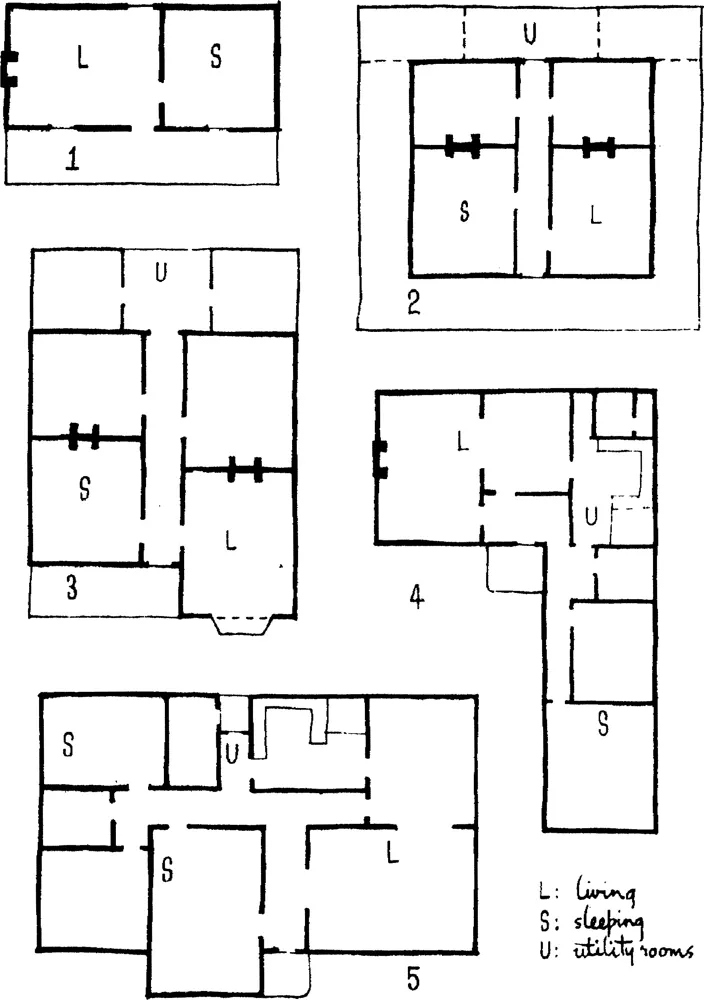
The principal types were:
(1) The Primitive Cottage. This consisted of only two rooms. One was slightly longer than the other, so that a central front door gave directly into it. This was the living-room. The other, entered by an internal door, was the bedroom. One small window to each room was placed at even distance on either side of the door. A fire-place and chimney stood at the far end of the living-room; the side walls were blind. In South Australia, New South Wales and northern Victoria, the cottage was provided with a verandah under a lower-pitched roof across the front. In Western Australia and northern Queensland, the verandah ran round the house. In the far south it was sometimes omitted. This plan was frequently extended, either at the time of building or later, by two rooms under a lower-pitched skillion at the back, matching the front verandah in a balanced profile. One of the additional rooms formed the kitchen, the other the children’s bedroom.
(2) The Bungalow. Based on the English cottage plan of the eighteenth century, this had a central passage with two or three rooms on each side. Australia discarded England’s upper floor, spread the house on the ground and added a verandah on every side. This plan survived in country districts for a full century from 1840. With its high crowned roof and drooping verandah it became as familiar and typically country Australian as a midday dinner of roast mutton and steamed pudding.
(3) The Asymmettical Front. This was the Victorian era’s contribution to the bungalow plan. One front room, usually the left-hand one facing the street, was thrust forward in line with the front verandah and the main roof was broken to extend over this projection. The verandah was omitted from the sides. The front verandah was thus reduced to little more than a porch. It was too small and too public to be used as living-space. Its one remaining function was to shelter the front door, Yet this convention of a verandah was to last at least until the 1920’s. Then the shelter was further reduced and became merely a porch in front of the door. Roth the verandah, and later the porch, having the lightest of functional anchors, gave themselves freely to stylism. They were the major features of façades, setting the stylistic note, as fire-place surrounds invariably set the notes for interiors. In the Victorian era, the verandah appeared again at the back, changed in character; it was glazed and partitioned into a central vestibule, with maid’s room and kitchen on either side. This plan persisted in the suburbs of the southern capitals for a full century from 1850, subject to numerous stylistic variations, From World War I onward it began to supplant the bungalow plan in the country, and even in the far north.
(4) The L-shape. An inverted L-shaped plan, with a bungalow unit forming a fat bottom stroke and a thin servants’ and service wing running off to the rear, was popular in the 1880’s. But the plan which became familiarly known and beloved in the 1930’s and 1940’s as the L-shape displayed the angle of its wings to the street. The living-room, dining-room or dining-alcove, and the kitchen and laundry formed the bottom stroke. Bedrooms and bathroom, linked by a glazed passage, projected in a long wing to the front. The entrance door nestled in the internal corner and was covered by a small hood, in the design of which individuality was encouraged. This plan was the popular reply to the open planning technique of twentieth-century architects. It was normally associated with corner-windows and, somewhere, a row of vertical posts supporting the eaves. A variation was known as the T-shape. Here the bedroom wing was taken back a little, with the result that the laundry and other rear appointments were in turn pushed backwards, past the rear of the main block.
(5) The Triple-front. Unless sliced in half to fit the mean allotments of some industrial housing developments, all the above types were known as “double-fronted”, for the reason that two rooms faced the street. A variation adopted by moderately successful men with wider building lots was known as the “triple-front”. This was contrived by turning the six-roomed bungalow plan until its longer side faced the street, forcing an entry between two of the rooms and blocking the unused section of the internal passage with cupboards or a bathroom.
An infinite number of minor compartmental v...