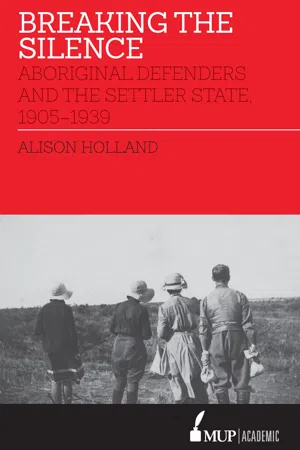
Breaking the Silence recovers the conflicted politics of Aboriginal affairs in the first decades of the twentieth century.From 1905, when the report of the controversial Roth Royal Commission in Western Australia was made known to the public, to the eve of World War II, the condition, status and treatment of Aboriginal Australians were leading social questions that generated much discontent and underscored the awakening of a national conscience. Styled the 'new public', defenders lobbied governments to develop policies to ensure viable Aboriginal futures.In charting aspects of this politics, Alison Holland uncovers the defenders' programs for reform and the responses of governments to them. She shows how the consternation of the defenders was disproportionate to political will. Governments didn't listen or hear. They viewed the issues and solutions in different ways. Where defenders saw a humanitarian crisis, governments identified a colour problem in White Australia and developed policies to eradicate it. Breaking the Silence shows that there was no 'great Australian silence' on this question in the first half of the twentieth century. While the history books may have been silent, the politics on the ground, in the press, the auditorium, parliament, university, church and mission were anything but. Holland asks why this was so. What form did this politics take, what was at stake and what were the outcomes? In answering these questions the book provides important historical context for the consternation and debates still being had in the Australian polity over Aboriginal affairs.
eBook - ePub
Breaking the Silence
Aboriginal Defenders and the Settler State, 1905–1939
- English
- ePUB (mobile friendly)
- Available on iOS & Android
eBook - ePub
About this book
Trusted by 375,005 students
Access to over 1.5 million titles for a fair monthly price.
Study more efficiently using our study tools.
Information
Subtopic
Australian & Oceanian HistoryIndex
HistoryCHAPTER 1
Remembering: Dispossession, Past Wrongs and Ancestral Beginnings
The Aborigines have not been given a dog’s chance. In the pages of Australian history their treatment will be found written in blood.1
… the murmurings of the people are today gaining strength and there has been open public confession of our past sins. Professor Wood Jones and other high authorities and Press correspondents have revealed the truth.2
In the first forty years of the twentieth century Aboriginal people’s dispossession, resistance and adaptation across the course of the nineteenth century were not reflected in its written history. If discussion of the Aborigines, including clashes with British settlers, had featured in historical works throughout the nineteenth century, in the first decades of the new century they were gradually erased from the official historical record.3 Australia was understood as the abode of white settlers, despite the fact that the total full-descent Aboriginal population was estimated to be around 41,500 in 1901.4 Twenty years later the estimate was closer to 60,000.5 The first published work to have, as its central purpose, a history of the administrative treatment of the Aborigines was published in 1941.6 While not an apology, it painted the past treatment of Aborigines in as positive light as possible. It argued that, while flawed and ignorant, past treatment was well-meaning.
This is quite remarkable because, at the same time, the daily recitation of Aboriginal dispossession and cruel treatment in the past was critical to mobilisation on their behalf. These themes were the underlying refrain of the first half of the twentieth century, drivers of an emergent national conscience. Indeed, a perusal of the regional and city daily newspapers shows how discussion around Aborigines and their status in the nation was prefaced by an appreciation of historic wrongs. This had very little to do with what various defenders had read in the texts of the nineteenth century, although there was an appreciation that Aboriginal bloodshed was integral to the Australian story. As one commentator noted, ‘the dispersals of early days are told by each succeeding generation’.7 While this suggests the oral transmission of memory, the immediate context of settler awareness related to either personal experience, scholarly interest or contemporary cases of abuse, injustice and ill-treatment that were ‘fresh in the memory’.8
Indeed, the new century was born as the convulsive impacts of the Roth Royal Commission reverberated across Australia and in London. This was a major government inquiry in Western Australia, following allegations of abuse and ill-treatment in the north-west of the state. Commissioner Roth, chief protector in Queensland, was appointed in 1904 to inquire into and report on the administration of the Aborigines Department and the condition of ‘the natives’.9 This was the result of years of agitation and consternation, as allegations of the enslavement of Aboriginal people in the north-west met with government non-interference, extreme parsimoniousness, cover up and what some commentators referred to as a conspiracy of silence in the region.10 As Chris Owen has shown, it was only in the context of political volatility in the west, including changes in government leadership, anti-slavery agitation abroad and the inclusion of Western Australia as part of the Commonwealth in 1901 that the long needed and requested royal commission could eventuate.11
Roth’s report cast a picture of a completely unregulated frontier where police, backed by local magistrates, as well as station managers and stockmen, had unchecked power over Aboriginal lives. Even where laws were in place to regulate the treatment and employment of Aboriginal workers, they were rarely adhered to and entire Aboriginal communities were held hostage in a violent, exploitative and masculine frontier: from the near enslavement of Aboriginal workers as young as ten; to the Aboriginal women who were cast as the unwilling witnesses to their husbands’ alleged cattle killing, and at the centre of a prostitution ring involving stockmen, trackers and escorting police; to the alleged cattle-killers who did not understand their sentences but pleaded guilty ‘at the muzzle of a rifle’; to the children who were brought in to give evidence or charged with cattle killing; to the old and feeble Aboriginal man who collapsed and died at the end of a long journey to the court; to the widespread use of chains—mostly neck but also wrist and ankle—Roth uncovered a ‘most brutal and outrageous condition of affairs’.12
When his report was released to the public in 1905 it generated intense discussion and angst in the public domain. While it raised concern about many aspects of policy, particularly in relation to employment, the worst features of the administration related to the treatment of prisoners brought in on charges of cattle stealing. Their arrest, transportation, trial and imprisonment disclosed an ‘inhuman and cruel state of affairs’, ‘a disgrace to humanity and civilization’.13 Included were cruel methods of arrest and transportation, harsh treatments and punishments in transit and in prison, abuse of women and children, and a corrupt but lucrative system of ‘blood money’ for police officers for arresting as many as possible and transporting them, in chains, over long distances.14 Such conditions, Roth maintained, could no longer be ‘hidden or tolerated’.15
Four years into the new century the consternation that this inquiry and subsequent report generated demonstrated a new kind of political engagement, what Lefroy, himself a Western Australian, described as a new civic consciousness around the ‘Aboriginal question’.16 The birth of the new nation coincided with the realisation of a brutal truth: settler and government treatment of Aboriginal people had been disgraceful, inhumane and unchristian. News of the inquiry reverberated and left its mark for several years to come, much like the Bringing Them Home Report did at the close of the century.17 It was as though national unity leant a new kind of legitimacy to a concern that had reached worrying levels by the end of the nineteenth century. The minority who had risked all to speak out about abuses then were now joined by many others, whom Lefroy defined as the ‘secret friends of the aborigines’.18
It also appeared to provide a platform for the admission of past sins and a renewed determination to monitor government policies and target the administration for a just, permanent and humanitarian settlement of the native question.19 The following excerpt from a local newspaper captures the mood:
The Government is in possession of all the facts. The question now is, what are they going to do? … The public will not be satisfied with any dilly-dallying over this subject. What they demand of the Government is prompt action. The Government has now a golden opportunity of giving some evidence of its capacity. Will they seize it or allow themselves to be controlled by particular heads of departments? … Let us … prove by our future policy and administration that we regard the natives of this country as human beings who are entitled to sympathy and consideration at our hands.20
This echoed Roth’s plea that Aboriginal people ‘must be allowed the wherewithal to live’.21 While some Western Australian politicians saw Federation as the means of loosening their grip on Aboriginal affairs, others increasingly demanded that the Commonwealth step in.
Memory and History
The heat over what was happening in the west and the contem-poraneousness of the ill-treatment meant that the history of Aboriginal–settler relations was less pertinent at the time. One paper reflected on its own vindication. Readers of the Sun and Sunday Times had been privy to many ‘exposures’ of the ‘dastardly deeds of the salacious whites who have brutally enslaved the blacks’ in these papers, which had been condemned by the ‘groper aristocracy of the state’.22 Now that such doings had reached London, according to the Sunday Times, the ‘groper aristocracy’ had nowhere to hide. More interested in rejoicing in the ‘unveiled truth’, the editor of the Sunday Times used the opportunity to hit back at the ‘Nor’-West Legrees’. He lauded the ‘fearless and manly independence’ of Roth, who had been ‘sent out with a whitewash brush, and lo! has come back with it dipped in tar’.23
Once the heat went out of the Roth controversy, the murmur of discontent, never far from the surface, revived around 1911 when the federal government assumed administrative control of the Northern Territory. This represented a fresh opportunity to press for a national solution. Increasingly the wrongs of the past were emphasised. This was not just about slave-like work practices and conditions or even brutal treatment of the Western Australian kind, although mem...
Table of contents
- Cover
- Title
- Copyright
- Dedication
- Contents
- Acknowledgements
- Author’s Notes
- Abbreviations
- Prologue
- Introduction
- Chapter 1 Remembering: Dispossession, Past Wrongs and Ancestral Beginnings
- Chapter 2 The Weight of Responsibility: Repaying a Debt and Saving a Race
- Chapter 3 A Plea for the Remnant: Promoting an Aboriginal Future
- Chapter 4 The Sex Question: The Lot of Aboriginal Women
- Chapter 5 Civilising the Frontier: Demanding Women Protectors
- Chapter 6 Compelling Evidence: The Rights of Aboriginal Wives
- Chapter 7 No Good Purpose: Containment and Consignment
- Kancubina: A Vignette
- Chapter 8 Under the Black Flag: Claiming Freedom, Justice and Representation
- Conclusion
- Bibliography
- Index
Frequently asked questions
Yes, you can cancel anytime from the Subscription tab in your account settings on the Perlego website. Your subscription will stay active until the end of your current billing period. Learn how to cancel your subscription
No, books cannot be downloaded as external files, such as PDFs, for use outside of Perlego. However, you can download books within the Perlego app for offline reading on mobile or tablet. Learn how to download books offline
Perlego offers two plans: Essential and Complete
- Essential is ideal for learners and professionals who enjoy exploring a wide range of subjects. Access the Essential Library with 800,000+ trusted titles and best-sellers across business, personal growth, and the humanities. Includes unlimited reading time and Standard Read Aloud voice.
- Complete: Perfect for advanced learners and researchers needing full, unrestricted access. Unlock 1.5M+ books across hundreds of subjects, including academic and specialized titles. The Complete Plan also includes advanced features like Premium Read Aloud and Research Assistant.
We are an online textbook subscription service, where you can get access to an entire online library for less than the price of a single book per month. With over 1.5 million books across 990+ topics, we’ve got you covered! Learn about our mission
Look out for the read-aloud symbol on your next book to see if you can listen to it. The read-aloud tool reads text aloud for you, highlighting the text as it is being read. You can pause it, speed it up and slow it down. Learn more about Read Aloud
Yes! You can use the Perlego app on both iOS and Android devices to read anytime, anywhere — even offline. Perfect for commutes or when you’re on the go.
Please note we cannot support devices running on iOS 13 and Android 7 or earlier. Learn more about using the app
Please note we cannot support devices running on iOS 13 and Android 7 or earlier. Learn more about using the app
Yes, you can access Breaking the Silence by Alison Holland in PDF and/or ePUB format, as well as other popular books in History & Australian & Oceanian History. We have over 1.5 million books available in our catalogue for you to explore.