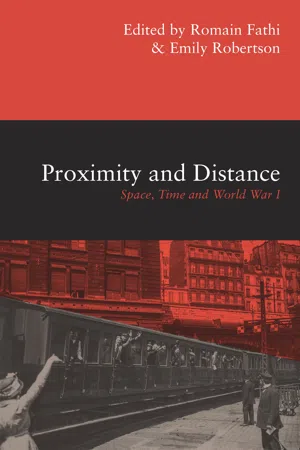
The global magnitude of World War I has meant that proximity and distance were highly influential in the ways the conflict was conducted, and how it was experienced at tactical, political and emotional levels. This book explores how participants and observers in World War I negotiated the temporal and spatial challenges of the conflict. International in scope, it investigates how technology, mass media, elite diplomacy and imperial networks interacted in conjunction with proximity and distance. The authors canvass a range of approaches to the conflict, from cultural history to social, political and military history. Proximity and distance were contingencies that participants had to continually adapt to. This book documents the ways in which these adaptations were approached.
- English
- ePUB (mobile friendly)
- Available on iOS & Android
eBook - ePub
About this book
Trusted by 375,005 students
Access to over 1.5 million titles for a fair monthly price.
Study more efficiently using our study tools.
Information
Subtopic
World HistoryIndex
HistoryChapter 1
World War I and the Space–Time–War Nexus
Romain Fathi and Emily Robertson
Stating that World War I is both distant and near to us may be seen as both an oxymoron and a truism. The centenary of the conflict was a reminder of the temporal distance that exists between us and the people who fought in that war. In that sense, World War I can be seen as a distant sequence of events that propelled the world into the tumultuous and unprecedentedly violent twentieth century. Yet we are constantly reminded of the presence of World War I in the twenty-first century through its global, state and local legacies.1 In this way, World War I remains proximate, very much an immediate and daily presence in the lives of many. In northern France and Belgium, people still live in a landscape shaped by the war, with some areas completely closed to the public owing to the presence of explosive devices, which continue to kill, and other areas so polluted that they cannot be returned to cultivation.2 For inhabitants of these regions, and others around the globe, the war is long gone but its traces remain present in everyday experiences. The apparent dichotomy between this past event and its immediate physical presence is a powerful reminder of the scale and intensity of the first truly global conflict.
This example also demonstrates that the relationship between proximity and distance is geographical as much as temporal. When we approach the conflict as one that transcended borders, cultures, and the boundaries of nationalism and empire in order to encompass the globe, proximity and distance appear as central themes. In terms of geography and time, the war demonstrated that the world consisted of ‘new kinds of stretchable, shrinkable spaces’, in which empires and nations could be demolished and others raised up in the space of a few years.3 The war altered how those who were taking part in it experienced time and space within physical, cultural and strategic dimensions. An understanding was gradually emerging that the battlefront was not the sole space in which wars were waged. The porosity between war zones and domestic zones became apparent as economic and political considerations at home affected the logistics of providing materiel and men to the front. Yet, while the distance between the battlefront and the home front shrank, cultural and political distances emerged between formerly friendly nations. New alliances and expedient military decisions reshaped distances and proximities, abolishing some while creating others.
The astonishing rate of geopolitical change that occurred during World War I draws attention to the psychological nature of geography itself. As political geographers Ronald Abler, John S Adams and Peter Gould have argued, ‘the spaces in which people live are much more psychological than absolute’: thus the lines drawn on a map do not solely determine what constitutes a nation; it is also a shared imaginative venture.4 This is equally the case with how a nation approaches war; psychological engagement with conflict, either to support or to oppose it, can carve out a new conception of the nation as surely as the cartographer’s pen.
Considering the ways in which organisations and individuals alike dealt with the shifts in time and space restores their agency and deepens our understanding of World War I. By reassessing how distances and proximities framed the everyday lives of millions both during and after the conflict, this book draws attention to the importance of considering the war through a space–time–war nexus. Geography and time interacted in the unique arena afforded by a world in which technology, mass media, elite diplomacy and imperial networks allowed people to psychologically span great geographical distances in order to participate in a global war. Time was narrowed through ‘technological innovation in transport and communication’. Railways, the telegraph and the telephone, aeroplanes, and artillery contributed to a war of increased speed and increased lethality.5
Alongside proximity, this book also examines how distance remained an obstacle for belligerents, despite technological innovations. Donald Mackinnon, the Australian Director-General for Recruiting, for example, was convinced that recruiting numbers had fallen to dangerously low levels partly because Australians at home had no comprehension of the devastation taking place overseas. Thus, despite Australia’s efforts to close the gap with numerous propaganda campaigns (discussed by Nathan Wise in chapter 5), distance from the violence of the battlefront had become, in Mackinnon’s view, an insurmountable psychological barrier to recruiting in the final months of the war.6 The capacity of imperial loyalty to close distances had weakened as psychological distance from the battlefront and war weariness took hold. It is such intricacies and networks between distance and proximity (in both their spatial and their temporal dimensions), and the ways in which individuals and organisations alike engaged with the war in relation to these parameters, that are the subject of this book.
Within the vast alteration of global power generated by World War I, individuals and governments sought to influence the war. They also sought to understand the war. They sought to understand how physical proximity in a tactical sense was shaped by the attritional warfare brought about by more efficient artillery; they sought to understand the geostrategic gains and losses that occurred at a rapid pace throughout the conflict; and, finally, they sought to understand how to grieve the death of a loved one, and how to bring his body home over a vast distance. Proximity and distance were contingencies that individuals, armies and nations had to constantly adapt to. For instance, being 10 kilometres away from the front did not mean that family and friends in Italy or Serbia could communicate more easily with soldiers than Canadians or New Zealanders could with their own men. If Italian or Serbian relatives were in occupied regions and their soldiers were fighting on the ‘free’ side, it would take far more energy, means and time to communicate with them than it would for relatives of very distant nations whose line of communication with the front was not interrupted by a no-man’s-land. In that sense, the idea that being physically ‘closer’ to the soldiers facilitated communication or support is fraught, as physical nearness, per se, sometimes meant little. What mattered was how historical actors negotiated these spatial and temporal factors. As this book explores, much energy was expended on increasing or decreasing distance and proximity, giving these variables an unprecedented elasticity and relevance.
World War I was not the first war to be experienced in this way. For those on the home front in Great Britain, the conflict’s mediated nature made it similar to the Napoleonic Wars. World War I, Mary Favret has argued, was not unique; it was a continuation of the mediated warfare that had developed in the early nineteenth century. Reportage from the distant battlefront to the home front during the Napoleonic Wars gave the long conflict a moral urgency and purpose. Despite the development of the nexus between home front and battlefront in the Napoleonic period, World War I’s position as a pivot in history and its role as a marker of the beginning of the brutal twentieth century, has endowed it with the reputation of having been a unique war. Historian John Horne has written that European people, during World War I, ‘were acutely aware that they were living through a moment of epochal change’; the war ‘shook time itself’.7 This book, however, approaches the Great War not as a rupture in time but as part of a trajectory of the modernisation of war that took place against a backdrop of technological, social and geopolitical change. Thus, while World War I was experienced as a ‘last war, a war on behalf of the world’, the idea that the war was one for ‘humanity’ and civilisation was not new. As Favret has argued, European people had experienced conflict within a similar moral framework since the revolutionary wars in the late eighteenth century.8 The Napoleonic Wars, a continuation of these revolutionary wars, set the foundations for the wars that followed. By considering World War I through a space–time–war nexus it is clear that the conflict, though unprecedented in its cost in terms of human life, was part of a continuation of developments in war—not a unique event. It sits between the Napoleonic Wars and recent contemporary wars as a conflict in which technology interacted with ideology and mass communication to close the distance between combatants and non-combatants.9
Favret’s book was groundbreaking in its conceptualisation of modern war and ‘wartime’ through the lenses of distance and time. Wartime, she contended, is the imaginative engagement by non-combatants with the war through the medium of image and text. For this volume, we asked the contributing authors to expand on Favret’s work in their own consideration of how temporal and geographical distance shaped various aspects of the conflict. In addition, we have further developed Favret’s conception of modern war and distance by examining how proximity also played a crucial role in the lived experience of World War I. While the Great War was very much a ‘mediated’ war, distilled and communicated through mass media and personal correspondence, proximity was the inevitable antonymic companion of distance throughout the war. Emotional proximity, the ability to be ‘touched and moved by the unaccountable violence of war’, was vital to mobilising support for the conflict.10 Belligerents sought to achieve both emotional and ideological proximity as they reached across geographical distances to bind diasporas and different nations to their cause.
Over the past fifteen years, scholars have been grappling with ideas of imperial and global connections, and the inherent temporal and spatial elements of such links, in their work on World War I. Indeed, the ‘imperial turn’ and the influence of postcolonial theory in historical studies have created a shift in First World War studies towards examining the primacy of empires in that conflict and the role of imperial networks in connecting the coloniser and the colonised to the conflict. The ‘imperial turn’, Antoinette Burton has written, ‘provoked … not a turn toward empire so much as a critical return to the connections between metropole and colony, race and nations’, connections that ‘imperial apologists’ had ‘long appreciated’.11 Santanu Das, for instance, has, through a cultural lens, examined the linkages between Great Britain and India during World War I.12 Robert Gerwarth and Erez Manela’s edited volume Empires at War: 1911–1923 moved away from the Eurocentric focus of Western World War I historiography and expanded the temporal and spatial focus of the conflict. As they argue, ‘the paroxysm of 1914–1918 … was the epicentre of a cycle of armed imperial conflict’ that commenced in 1911, when Italian forces attacked Ottoman-controlled territories in North Africa and, of course, with the outbreak of the Balkan Wars in 1912. They contend that the ‘massive waves of violence triggered by imperial collapse’ continued until 1923.13 The recent series The Cambridge History of the First World War also examines the role of imperialism—and the relative strength and weaknesses of empires—in the conflict. As John Horne and Jay Winter have observed, ‘The huge advantage the Allied Powers had from the outset of the war … arose from the stock of capital, human and material, which they had accumulated in imperial expansion throughout the nineteenth and early twentieth centuries’.14 Thus, there has been an increasing engagement with the notions of ‘proximity’ and ‘distance’, in their temporal, geographical and political dimensions, through this imperial turn in First World War studies. This engagement, however, was a consequence of the imperial themes explored within this field of scholarship, not a purposefully dedicated research into the question of proximity and distance in particular.
These concepts have begun to be considered by First World War scholars. Keith Jeffery used the lenses of proximity and distance in his nuanced examination of the way two nations under British imperial control—New Zealand and Ireland—commemorated the Great War in the interwar period. His work on the inter-imperial connections between these countries compared how the geographically ‘distant’ yet politically ‘proximate’ experience of New Zealand differed from that of the complex political relationship that Ireland (and Ulster in particular) experienced during this period.15 More recently, Mariano Siskind drew on Favret’s work in his examination of how the war was a spectacle of ‘war at a distance in Latin America’.16 Finally, Louis Halewood, Adam Luptak and Hanna Smyth have explored the part that time has played, across a variety of topics—from medical care during the conflict, to the role that the passing of time has had on memory—and examined how ‘temporality’ interacted ‘with the formulation and implementation of strategy’.17
This edited volume contributes to this developing area of scholarship in First World War studies by combining proximity and distance with both space and temporality. It suggests that these concepts have a heuristic dimension that enables a deeper comprehension of aspects of World War I such as combat, diaspora, correspondence, the home front and memory. The reflections on proximity and distance, in their spatiality and temporality, in the following chapters highlight their impact on selected topics and case studies and invite us to think anew about the conflict. Such reflections allow for new ways of understanding and investigating the challenges faced by belligerents during World War I.
Tactical and Strategic Challenges
The chapters in this volume are organised thematically, in four sections. The first section ranges from the close tactical challenges that arose on the Western Front, as a result of technological advances in weaponry, to the broad strategic and diplomatic issues the Germans faced in their alliance with the Ottoman Empire and how this played out in the Middle Eastern theatre of the war. In chapter 2, Jean-Philippe Miller-Tremblay examines physical distance and proximity on the battlefield in the British and French armies. In the later part of the nineteenth century, developments in machine guns and artillery increased the lethality of offensive weaponry. Thus, the use of close-order formation for combat was ultimately rendered obsolete by the density of the mur de feu (wall of fire). Amassing soldiers thus became hazardous, but physical proximity on the battlefield had been at the...
Table of contents
- Cover
- Title Page
- Copyright Page
- Foreword
- Contents
- Chapter 1: World War I and the Space–Time–War Nexus
- Part I: Tactical and Strategic Challenges
- Part II: Bridging the Divide: Propaganda and Persuasion
- Part III: Bringing The Diaspora Together
- Part IV: Time, Memory And Understanding
- Select Bibliography
- Contributors
- Index
Frequently asked questions
Yes, you can cancel anytime from the Subscription tab in your account settings on the Perlego website. Your subscription will stay active until the end of your current billing period. Learn how to cancel your subscription
No, books cannot be downloaded as external files, such as PDFs, for use outside of Perlego. However, you can download books within the Perlego app for offline reading on mobile or tablet. Learn how to download books offline
Perlego offers two plans: Essential and Complete
- Essential is ideal for learners and professionals who enjoy exploring a wide range of subjects. Access the Essential Library with 800,000+ trusted titles and best-sellers across business, personal growth, and the humanities. Includes unlimited reading time and Standard Read Aloud voice.
- Complete: Perfect for advanced learners and researchers needing full, unrestricted access. Unlock 1.5M+ books across hundreds of subjects, including academic and specialized titles. The Complete Plan also includes advanced features like Premium Read Aloud and Research Assistant.
We are an online textbook subscription service, where you can get access to an entire online library for less than the price of a single book per month. With over 1.5 million books across 990+ topics, we’ve got you covered! Learn about our mission
Look out for the read-aloud symbol on your next book to see if you can listen to it. The read-aloud tool reads text aloud for you, highlighting the text as it is being read. You can pause it, speed it up and slow it down. Learn more about Read Aloud
Yes! You can use the Perlego app on both iOS and Android devices to read anytime, anywhere — even offline. Perfect for commutes or when you’re on the go.
Please note we cannot support devices running on iOS 13 and Android 7 or earlier. Learn more about using the app
Please note we cannot support devices running on iOS 13 and Android 7 or earlier. Learn more about using the app
Yes, you can access Proximity and Distance by Romain Fathi, Emily Robertson in PDF and/or ePUB format, as well as other popular books in History & World History. We have over 1.5 million books available in our catalogue for you to explore.