- 133 pages
- English
- PDF
- Available on iOS & Android
eBook - PDF
Electronic Art
About this book
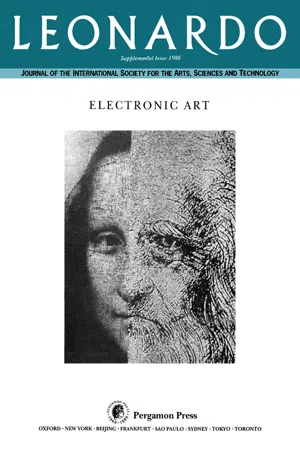
Computers are more and more becoming creative tools in music as well as in the visual arts and design. In the last few years, it has become clear that digital technology provides a platform for multimedia productions as well as a medium for new art forms. Computer Music and Computer Graphics & Animation have their own international forums. The need was felt, however, to bring together the diverse disciplines within art and technology in one international event - the First International Symposium on Electronic Art (FISEA). The Symposium attracted considerable interest and hundreds of papers and proposals were submitted, of which a selection were accepted. This book, also published as a supplement to the journal Leonardo, publishes 20 of these selected papers under the editorship of Wim van der Plas, Ton Hokken and Johan den Biggelaar. This richly illustrated issue on Electronic Art reflects the enormous international interest which FISEA generated and will further stimulate interest in applications of new technology in music, visual arts and design.
Information
Subtopic
Art GeneralTable of contents
- Front Cover
- Electronic Art
- Copyright Page
- Table of Contents
- EDITORIAL
- Chapter 1. Perceptual Correspondences of Abstract Animation and Synthetic Sound
- Chapter 2. Art and Education in the Telematic Culture
- Chapter 3. The Electronic Bauhaus: Gestalt Technologies and the Electronic Challenge to Visual Art
- Chapter 4. Logic and Time-Based Art Practice
- Chapter 5. Computational Art
- Chapter 6. Establishing a Tonic Space with Digital Color
- Chapter 7. The Creation Station: An Approach to a Multimedia Workstation
- Chapter 8. Computer Music Languages . . .and the Real World
- Chapter 9. Computer Graphics and Animationas Agents of Personal Evolution in the Arts
- Chapter 10. Storing Art Images in Intelligent Computers
- Chapter 11. The Making of a Film with Synthetic Actors
- Chapter 12. Towards a Universal and Intelligent MIDI-Based Stage System: A Composer/Performer's Testimony
- Chapter 13. Geometric Image Modelling of the Musical Object
- Chapter 14. The Computer: Liberator or Jailerof the Creative Spirit
- Chapter 15. The Aesthetics of Exhibition:A Discussion of Recent American Computer Art Shows
- Chapter 16. The Staging of Leonardo's Last Supper: A Computer-Based Exploration of Its Perspective
- Chapter 17. State-of-the-Art Art
- Chapter 18. A New Language for Artistic Expression: The Electronic Arts Landscape
- Chapter 19. Some Issues in the Development of Computer Art as a Mathematical Art Form
- Chapter 20. Orphics: Computer Graphics and the Shaping of Time with Color
- ABSTRACTS
Trusted by 375,005 students
Access to over 1.5 million titles for a fair monthly price.
Study more efficiently using our study tools.
Frequently asked questions
Yes, you can cancel anytime from the Subscription tab in your account settings on the Perlego website. Your subscription will stay active until the end of your current billing period. Learn how to cancel your subscription
No, books cannot be downloaded as external files, such as PDFs, for use outside of Perlego. However, you can download books within the Perlego app for offline reading on mobile or tablet. Learn how to download books offline
Perlego offers two plans: Essential and Complete
- Essential is ideal for learners and professionals who enjoy exploring a wide range of subjects. Access the Essential Library with 800,000+ trusted titles and best-sellers across business, personal growth, and the humanities. Includes unlimited reading time and Standard Read Aloud voice.
- Complete: Perfect for advanced learners and researchers needing full, unrestricted access. Unlock 1.5M+ books across hundreds of subjects, including academic and specialized titles. The Complete Plan also includes advanced features like Premium Read Aloud and Research Assistant.
We are an online textbook subscription service, where you can get access to an entire online library for less than the price of a single book per month. With over 1.5 million books across 990+ topics, we’ve got you covered! Learn about our mission
Look out for the read-aloud symbol on your next book to see if you can listen to it. The read-aloud tool reads text aloud for you, highlighting the text as it is being read. You can pause it, speed it up and slow it down. Learn more about Read Aloud
Yes! You can use the Perlego app on both iOS and Android devices to read anytime, anywhere — even offline. Perfect for commutes or when you’re on the go.
Please note we cannot support devices running on iOS 13 and Android 7 or earlier. Learn more about using the app
Please note we cannot support devices running on iOS 13 and Android 7 or earlier. Learn more about using the app
Yes, you can access Electronic Art by Roger F. Malina,W. Van der Plas,T. Hokken,J. den Biggelaar in PDF and/or ePUB format, as well as other popular books in Media & Performing Arts & Art General. We have over 1.5 million books available in our catalogue for you to explore.