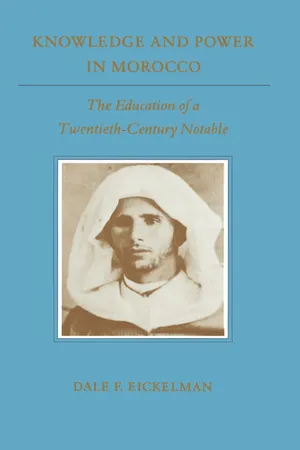
This intensive social biography of a rural Moroccan judge discusses Islamic education, the concept of knowledge it embodies, and its communication from the early years of colonial rule in twentieth-century Morocco to the present. The work sensitively combines the outlooks and perceptions of the author and those of the shrewd and reflective `Abd ar-Rahman, supplementing our knowledge of resurgent militant Islamic movements by describing other popularly supported Islamic attitudes toward the contemporary world.
eBook - ePub
Knowledge and Power in Morocco
The Education of a Twentieth-Century Notable
- English
- ePUB (mobile friendly)
- Available on iOS & Android
eBook - ePub
About this book
Information
Publisher
Princeton University PressYear
2020Print ISBN
9780691025551
9780691094151
eBook ISBN
9780691221861
INDEX
With the exception of ‘ulama’ (men of learning), all Arabic terms are listed in their singular form only, with plurals formed by the addition of s.
Aafīf, Mohamed, 54n, 82n, 96n, 124n
‘Abd al-Ḥāfizẓ, Sultan Mūlāy (r. 1908–1912), 4, 120n
adab (literature and poetry): among men of learning, 123–24; in mosque university education, 97, 100–102. See also Arabic; ‘ulamā’, rhetorical style of
W/s (notaries), 9, 22, 83–84, 100, 106; in Bzu region, 49–50, 107–108; writing style of, 26–27
administration, colonial, 6–8, 25, 140n; in Bzu region, 49–50, 140–48; in rural areas, 137–38; after 1940, 139–48
Americans, 1940s perceptions of, 141, 146
‘āmm (common), see khāṣṣ/‘āmm
Arabic: in Berber regions, 54, 60, 68; classical and colloquial, 63–64, 93, 97, 101–104; in court, 22. See also ‘ulamā’, rhetorical style of
‘Arafa, Mūlāy Muhammad bin (“puppet” sultan, 1953–1955), 151, 152, 154
Aron, Raymond, 173–74
authority, see sulṭa
Berber Decree (1930), 102–103, 135–36
Berbers, 15, 16, 35, 46–47, 60, 73, 109; tashalḥīt (Berber language), 35, 60. See also Arabic, in Berber regions; Bzu, description of; ṭalibs, rural-urban differences
Berque, Jacques, 9–10, 14, 52, 56, 92, 114n
bid’a (innovation): in shrā‘, 116–18; in sulṭa, 132–33
Binsa‘īd, Saīd, 7
biography, social, defined, 14–16. See also tarjama
Bloch, Maurice, 94
Bourdieu, Pierre, 5, 64–65
Brown, Kenneth, 135
Bu ‘Ayyāshī, Aḥmad ibn ‘Abd as-Salam al-, 157n
Bū Na‘mānī, Ḥasan al- (poet), 113, 128; career, 110n; poem for ‘Abd ar-Raḥmān, 110; visits to Bzu, 122–24, 149
Bzīwī, Mūlāy Ḥasan al- (nationalist notary), 150
Bzu, 16, 72, 113; description of, 37–41; droughts and epidemics in, 70, 144–46; notables in, 111–30, 149–50; in Second World War, 144–46
Cénival, Pierre de, 90
“Christian” (nasrani), in popular speech, 110...
Table of contents
- Cover Page
- Title Page
- Copyright Page
- Dedication
- Contents
- List of Illustrations, Tables, and Maps
- Foreword by Clifford Geertz
- Preface
- Introduction
- One. Biography as a Social Document
- Two. Beginnings
- Three. The Education of a Qadi: The Quranic Presence
- Four. The Yusufiya: A Profile of Higher Islamic Learning
- Five. The World of the Educated Rural Notable
- Six. Politics and Religion: From Protectorate to Independence
- Seven. The Great Transformation?
- Glossary
- Bibliography
- Index
Trusted by 375,005 students
Access to over 1.5 million titles for a fair monthly price.
Study more efficiently using our study tools.
Frequently asked questions
Yes, you can cancel anytime from the Subscription tab in your account settings on the Perlego website. Your subscription will stay active until the end of your current billing period. Learn how to cancel your subscription
No, books cannot be downloaded as external files, such as PDFs, for use outside of Perlego. However, you can download books within the Perlego app for offline reading on mobile or tablet. Learn how to download books offline
Perlego offers two plans: Essential and Complete
- Essential is ideal for learners and professionals who enjoy exploring a wide range of subjects. Access the Essential Library with 800,000+ trusted titles and best-sellers across business, personal growth, and the humanities. Includes unlimited reading time and Standard Read Aloud voice.
- Complete: Perfect for advanced learners and researchers needing full, unrestricted access. Unlock 1.5M+ books across hundreds of subjects, including academic and specialized titles. The Complete Plan also includes advanced features like Premium Read Aloud and Research Assistant.
We are an online textbook subscription service, where you can get access to an entire online library for less than the price of a single book per month. With over 1.5 million books across 990+ topics, we’ve got you covered! Learn about our mission
Look out for the read-aloud symbol on your next book to see if you can listen to it. The read-aloud tool reads text aloud for you, highlighting the text as it is being read. You can pause it, speed it up and slow it down. Learn more about Read Aloud
Yes! You can use the Perlego app on both iOS and Android devices to read anytime, anywhere — even offline. Perfect for commutes or when you’re on the go.
Please note we cannot support devices running on iOS 13 and Android 7 or earlier. Learn more about using the app
Please note we cannot support devices running on iOS 13 and Android 7 or earlier. Learn more about using the app
Yes, you can access Knowledge and Power in Morocco by Dale F. Eickelman in PDF and/or ePUB format, as well as other popular books in History & Middle Eastern History. We have over 1.5 million books available in our catalogue for you to explore.