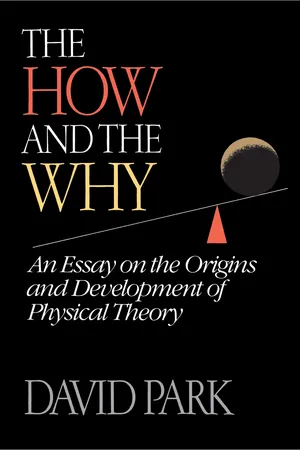
The description for this book, The How and the Why, will be forthcoming.
eBook - PDF
The How and the Why
About this book
Information
Publisher
Princeton University PressYear
2020Print ISBN
9780691025087
9780691084923
eBook ISBN
9780691221670
i
4
CHAPTER
I
Cy
\
a
/
a
h
,
a,
\
a
s'
The
ufhole
area
is
C
2
Hove
turn
triangles
CL
y
CL
e
cjfiole
area
is
CL
Z
-*-
b
z
FIGURE
1.2.
Simple
constructive
proof
of
the
Pythagorean
theorem.
proof
exhibited.
The
theorem
was
known
in
China
at
about
the
time
of
Pythagoras,
and
a
proof
resembling
the
one
given
here
appears
in
the
Chinese
classic
Chou
Pei
Suan
Ching
(The
Arithmetical
Classic
of
the
Gnomon
and
the
Circular
Paths
of
Heaven;
see
Needham
1954,
vol.
3,
p.
22).
Like
the
Babylonians,
the
Chinese
did
not
ordinarily
pay
much
atten-
tion
to
proof,
and
neither
developed
a
body
of
mathematics
in
the
system-
atic
way,
setting
down
definitions
and
axioms
and
requiring
that
one
proof
stand
on
the
shoulders
of
another.
It
seems
that
interest
in
the
process
of
proof,
in
logic
as
in
mathematics,
began
in
the
Greek
world
and
for
a
long
time
flourished
nowhere
else.
The
Pythagorean
relation
is
not
restricted
to
integers,
of
course.
Con-
Table of contents
- Cover Page
- Half-title Page
- Title Page
- Copyright Page
- Dedication Page
- Contents
- List of Illustrations
- List of Tables
- Acknowledgments
- Note on References
- Introduction
- Chapter 1: What Is the World?
- Chapter 2: How Is It Built?
- Chapter 3: How Should We Think About It?
- Chapter 4: The Sky Is a Machine
- Chapter 5: The Christian Cosmos
- Chapter 6: What Are These Things I See?
- Chapter 7: The Wider Shores of Knowledge
- Chapter 8: Illumination
- Chapter 9: The Spheres Are Broken
- Chapter 10: Influences
- Chapter 11: They Move According to Number
- Chapter 12: Time, Space, and Form
- Chapter 13: A World of Bronze and Marble
- Chapter 14: Two Theories of Relativity
- Chapter 15: Very Small and Far Away
- Chapter 16: Does It Make Sense?
- Chapter 17: Moving Down the Scale
- Chapter 18: And Now the Universe
- Chapter 19: Order and Law
- Note A: Hero's Principle
- Note B: Fermat's Principle
- Note C: Newton's Theorem
- Note D: Calculation of the Moon's Period
- Note E: The Law of Areas
- Note F: Elliptical Orbits
- Note G: Derivation of Young's Formula
- Note H: Of Time and the River
- Note I: The Mass of a Moving Object
- Note J: The Two-Slit Experiment in Quantum Mechanics
- Note K: Quantum Correlations That Suggest Action at a Distance
- Note L: The Troublesome Question of How Things Look
- Note M: Theory of the Expanding Universe
- Bibliography
- Index
Trusted by 375,005 students
Access to over 1.5 million titles for a fair monthly price.
Study more efficiently using our study tools.
Frequently asked questions
Yes, you can cancel anytime from the Subscription tab in your account settings on the Perlego website. Your subscription will stay active until the end of your current billing period. Learn how to cancel your subscription
No, books cannot be downloaded as external files, such as PDFs, for use outside of Perlego. However, you can download books within the Perlego app for offline reading on mobile or tablet. Learn how to download books offline
Perlego offers two plans: Essential and Complete
- Essential is ideal for learners and professionals who enjoy exploring a wide range of subjects. Access the Essential Library with 800,000+ trusted titles and best-sellers across business, personal growth, and the humanities. Includes unlimited reading time and Standard Read Aloud voice.
- Complete: Perfect for advanced learners and researchers needing full, unrestricted access. Unlock 1.5M+ books across hundreds of subjects, including academic and specialized titles. The Complete Plan also includes advanced features like Premium Read Aloud and Research Assistant.
We are an online textbook subscription service, where you can get access to an entire online library for less than the price of a single book per month. With over 1.5 million books across 990+ topics, we’ve got you covered! Learn about our mission
Look out for the read-aloud symbol on your next book to see if you can listen to it. The read-aloud tool reads text aloud for you, highlighting the text as it is being read. You can pause it, speed it up and slow it down. Learn more about Read Aloud
Yes! You can use the Perlego app on both iOS and Android devices to read anytime, anywhere — even offline. Perfect for commutes or when you’re on the go.
Please note we cannot support devices running on iOS 13 and Android 7 or earlier. Learn more about using the app
Please note we cannot support devices running on iOS 13 and Android 7 or earlier. Learn more about using the app
Yes, you can access The How and the Why by David Park in PDF and/or ePUB format, as well as other popular books in History & Science History. We have over 1.5 million books available in our catalogue for you to explore.