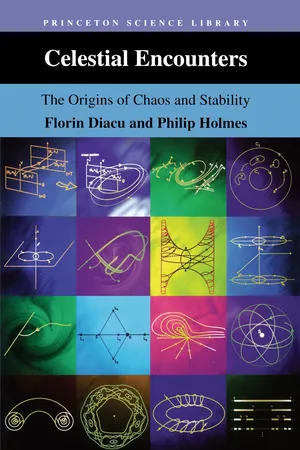
Celestial Encounters is for anyone who has ever wondered about the foundations of chaos. In 1888, the 34-year-old Henri Poincaré submitted a paper that was to change the course of science, but not before it underwent significant changes itself. "The Three-Body Problem and the Equations of Dynamics" won a prize sponsored by King Oscar II of Sweden and Norway and the journal Acta Mathematica, but after accepting the prize, Poincaré found a serious mistake in his work. While correcting it, he discovered the phenomenon of chaos.
Starting with the story of Poincaré's work, Florin Diacu and Philip Holmes trace the history of attempts to solve the problems of celestial mechanics first posed in Isaac Newton's Principia in 1686. In describing how mathematical rigor was brought to bear on one of our oldest fascinations--the motions of the heavens--they introduce the people whose ideas led to the flourishing field now called nonlinear dynamics.
In presenting the modern theory of dynamical systems, the models underlying much of modern science are described pictorially, using the geometrical language invented by Poincaré. More generally, the authors reflect on mathematical creativity and the roles that chance encounters, politics, and circumstance play in it.
eBook - ePub
Celestial Encounters
The Origins of Chaos and Stability
- English
- ePUB (mobile friendly)
- Available on iOS & Android
eBook - ePub
About this book
Trusted by 375,005 students
Access to over 1.5 million titles for a fair monthly price.
Study more efficiently using our study tools.
Information
Publisher
Princeton University PressYear
2020Print ISBN
9780691005454
9780691027432
eBook ISBN
9780691221830
____________ 1.
A Great Discovery—And a Mistake
It is probable that for half a century to come it will be the mine from which humbler investigators will excavate their materials.
—George Darwin, concerning Poincaré’s masterpiece, Les methodes nouvelles de la mécanique celeste
HENRI POINCARÉ pushed back his chair and stood up. He had to get out for a while. It was a beautiful spring afternoon: the sounds and smells drifting through his open study window made him restless and unaccountably optimistic. There was no other reason to feel encouraged, since his work seemed to be at a complete standstill. How could he believe what his calculations were telling him? Although each step of the argument followed logically from the previous one—after all, he had constructed them himself and checked them repeatedly—he could not grasp the whole. He had first tackled the problem ten years earlier and returned to it repeatedly, but a crucial insight was still missing. Until he found it, he would be unable to finish the final chapter of his book.
A break sometimes helps one overcome such obstacles. He would go for a walk. It would not matter where his steps took him. The important thing would be to free his mind and pay attention to the world around him. Paris at the end of the nineteenth century was a charming mixture of parks, history, cultural monuments, and romance, as it remains today. There would be plenty to see and think about as he walked. After an hour or two he could return to his desk, refreshed.
Although he possessed unusual gifts, Poincaré had for many years appeared to live like any other Parisian bourgeois. His acquaintances and colleagues saw him as a respected professor and member of the community, a loving husband, and an attentive father. Only within himself, when not consumed by research, was he aware of how difficult it was to divide his time among teaching, administrative duties, and his family.
A WALK IN PARIS
Jules Henri Poincaré was born on April 29, 1854, in Nancy, where his father was a respected physician. Nancy is the former residence of the dukes of Lorraine and the present government seat of the Meurthe-et-Moselle region. It lies in northeastern France on the Meurthe River and the Marne-Rhine Canal, 175 miles east of Paris. Both of Henri’s parents were born in Lorraine, and the Poincaré family had lived in that area for some time. Jean Joseph Poincaré, an ancestor, was conseiller au bailliage (a judicial officer) in Neufchâteau, where he died in 1750. One of his sons, Joseph Gaspard Poincaré, taught mathematics at the Collège de Bourmont, nearby.
This distant mathematical connection did not prepare the family for Poincaré’s arrival. He was a precocious child who rapidly surpassed his schoolmates in all subjects. The Franco-Prussian War interrupted his education, but during the occupation, from 1870 to 1873, he quickly became fluent in German without formal lessons. His fascination with mathematics began when he was fifteen. Once he had become absorbed in a problem, noise and activity in the room could not divert him.
In 1873 Poincaré graduated at the top of his class and entered the prestigious Éole Polytechnique in Paris, where he was able to follow the mathematics lectures without needing to take notes. His original concentration was mining and geophysics; in fact, he was admitted to the École National Supérieure des Mines in 1876, but he soon abandoned engineering and began doctoral studies in mathematics at the University of Paris in 1878, obtaining his Ph.D. in the amazingly short space of a single year. His thesis, “The Integration of Partial Differential Equations with Multiple Independent Variables,” addressed a difficult technical question. It was to be followed by a flood of papers and books, which would define whole new areas of mathematics and change the course of others. It is amusing to note that he scored zero in the drawing examination for entry to the École Polytechnique and a special exception was necessary to admit him. The man who was to reintroduce a geometrical approach to dynamics was practically unable to draw a coherent picture.
It was the spring of 1897 when we joined Poincaré struggling with his problem. Approaching his mid-forties, a professor at the University of Paris and a member of the Academy of Sciences, he was already famous and respected in the intellectual world. He had published over three hundred scientific papers, books, and articles in physics and philosophy as well as mathematics. One of the last scientific “universalists,” he was able to grasp and contribute fundamental ideas in several different fields. His influence in mathematics and science was enormous.

Plate 1.1. Henri Poincaré. (Courtesy of Mittag Leffler Institute)
Poincaré was enjoying his walk. He tried to completely empty his mind of mathematics. His steps had taken him toward the Seine. As the Eiffel Tower came into view, he remembered its inauguration at the Paris Exposition of 1889. That year had been as important in his career as it was in Gustave Eiffel’s, for it was then that Poincaré had won the prize established by King Oscar II of Sweden and Norway for the work that is the subject of this chapter: his paper on the dynamics of the three-body problem.
For the exposition, Eiffel had built the tallest structure in the world. After more than a century, it has become a symbol for Paris throughout the world. Parisians did not like it at first, and many still dislike it today. This unearthly creature appears to dominate so much that is of more intimate beauty and architectural value. A tourist visiting the capital often goes first to the Eiffel Tower. L’Île de la Cité with the Notre Dame cathedral, the Champs Élysées guarded by the Arc de Triomphe and the Concorde square, the Opéra, the Tuileries Garden and the Louvre Museum, Montmartre and the Latin quarter: all are overshadowed by the great tower. It stands in its effrontery, straddling the crowds on its four huge legs.
Eiffel’s vision and daring were admirable, but Poincaré could not admit approval of the tower. Too well established and respected as a mathematician, as a professor, and as a citizen, he would not take the risk of espousing a controversial view and perhaps appearing ridiculous in the eyes of his fellow countrymen. For a mathematician, there is little danger of this within his own profession. No matter how surprising the final result, as long as one shows that each statement follows logical reasoning and computation, one seldom runs the risk of being considered ludicrous. In the fine arts, architecture, or literature, where judgment is subjective and uncontrollable criteria are important, a swing of the public mood can destroy a career. Often it is just a question of luck. Sometimes it is a matter of seizing—or mistaking—the social and historical moment. Such unfortunate events rarely occur in mathematics, although timing, accidents, and the public mood do exert a more subtle influence.
Poincaré was one of very few among his peers who knew and could follow almost every achievement in mathematics up to their time. The explosion of research and information has made this impossible today: mathematicians, like their fellow scientists, are each confined in limited worlds, largely ignorant of progress and issues outside. Today, at the major quadrennial meeting, the International Congress of Mathematicians, participants cannot always understand even the titles of papers outside their specialties.
As he walked, Poincaré found himself recalling earlier thinkers and the tricks that fate had played on them. Gauss, the most famous mathematician in the first half of the nineteenth century, refrained from publishing his discovery of non-Euclidean geometry for fear of the “screams” of his contemporaries. Gauss knew that they would fail to understand his abandonment of Euclid’s “common sense” axioms. Some years later, Janos Bolyai, a young Transylvanian officer whose father had also worked on the problem, developed similar ideas and did publish them. Bolyai even wrote to Gauss on the subject. In his reply, the German mathematician revealed his earlier thoughts. Yet today it is Gauss who is much more widely cited. Ironically, there is little recognition of Bolyai’s work, which became known only several decades after his death. Other instances occurred to Poincaré: Galois, who died at the age of twenty-one in a duel, left behind a short paper, to be appreciated by the French Academy only half a century later. Today, Galois theory is a mathematical field in itself.
As he strolled home through the streets of Paris, Poincaré’s thoughts returned to his own problem. Was he being too conservative in his approach to it? No, he must proceed in a logical way. His mind drifted back to the scene around him. Just as it seemed that he had achieved nothing with his walk, revelation came like a flash of light. Now he understood. He was given a sudden, graphic hint of the consequences of his finding, eight years earlier, that certain motions of the restricted three-body problem are unstable. His reasoning and computations had been entirely correct. It was their implications that he had not been able to accept. He now saw that the problem, which he wanted to present in the book that would summarize half his research career, did indeed exhibit unexpected and strange behavior. He had no name for it and dared not pursue it further for the moment, but he had glimpsed a new land. Although it appeared incredible to his clear and straightforward beliefs, he would have to come to terms with it.
We shall spend the rest of this chapter describing the background to this startling insight. This will require a trip through several areas of mathematics and science, for one hundred years later we have found more than a mere name for the bizarre behavior that Poincaré glimpsed that day in Paris. It has become a new way of thinking. We call it chaos.
NEWTON’S INSIGHT
What happened in Poincaré’s mind at that moment? To appreciate it, we must go back more than two centuries, to the midsummer of 1687, when Sir Isaac Newton published his masterpiece, Philosophiae Naturalis Prinicipia Mathematica (The Mathematical Principles of Natural Philosophy). The main goal of this long trip back in time is to trace a crucial notion in the development of mathematics and physics: that of a differential equation. The rudiments of differential equations were already known at the end of the sixteenth century to the Scottish mathematician John Napier, the inventor of logarithms. (The name derives from “na pier” [no peer], meaning a free man.) But it was Newton who raised differential equations to their present central position in science. He showed not only how to express problems in physics using them, but also developed the basic mathematical tools needed for their solution.
The style of the Principia is difficult. The ideas Newton proposed are hard to understand if one has no prior feeling for them. Newton even claimed that he wrote the book in this manner with a purpose: “to avoid being baited by little smatterers in mathematics.” His major physical contribution is the idea of connecting gravitation with the dynamical behavior of the solar system: its evolution in time. Prior to Newton’s work, it was widely believed that gravitation acted only on bodies close to the earth’s surface. By proposing that its force extends throughout the universe, Newton realized that the moon’s motion, the tidal effects, and the precession of equinoxes could all be explained by gravitation. The conclusions drawn in his book brought Newton an immediate scientific reputation.
Although the Principia’s impact in physics was to be enormous, the longer-term consequences, which make the work celebrated even three centuries after its first publication, lie in its mathematical contributions. The heart of this is the differential and integral calculus, topics which form the course taken by many of today’s university freshmen (a course loathed by some), and on which practically all modern science and engineering are founded. It is, however, hard to see in Principia a resemblance to a modern calculus textbook. Newton’s notation appears old-fashioned to a modern reader. His geometric language is hard for contemporary scientists to follow. The conventional formalism is closer to that proposed by Gottfried Wilhelm von Leibniz, who is considered the co-creator of calculus (and with whom Newton had bitter disputes about scientific priority). Ironically, the new approach to differential equations due to Poincaré, which we shall describe below, is in some ways closer in spirit to Newton’s, for it is geometrical in nature. Many mathematicians “think in pictures,” even t...
Table of contents
- Cover
- Title Page
- Copyright Page
- Dedication
- Contents
- Preface and Acknowledgments
- A Note to the Reader
- 1. A Great Discovery—And a Mistake
- 2. Symbolic Dynamics
- 3. Collisions and Other Singularities
- 4. Stability
- 5. KAM Theory
- Notes
- Bibliography
- Index
Frequently asked questions
Yes, you can cancel anytime from the Subscription tab in your account settings on the Perlego website. Your subscription will stay active until the end of your current billing period. Learn how to cancel your subscription
No, books cannot be downloaded as external files, such as PDFs, for use outside of Perlego. However, you can download books within the Perlego app for offline reading on mobile or tablet. Learn how to download books offline
Perlego offers two plans: Essential and Complete
- Essential is ideal for learners and professionals who enjoy exploring a wide range of subjects. Access the Essential Library with 800,000+ trusted titles and best-sellers across business, personal growth, and the humanities. Includes unlimited reading time and Standard Read Aloud voice.
- Complete: Perfect for advanced learners and researchers needing full, unrestricted access. Unlock 1.5M+ books across hundreds of subjects, including academic and specialized titles. The Complete Plan also includes advanced features like Premium Read Aloud and Research Assistant.
We are an online textbook subscription service, where you can get access to an entire online library for less than the price of a single book per month. With over 1.5 million books across 990+ topics, we’ve got you covered! Learn about our mission
Look out for the read-aloud symbol on your next book to see if you can listen to it. The read-aloud tool reads text aloud for you, highlighting the text as it is being read. You can pause it, speed it up and slow it down. Learn more about Read Aloud
Yes! You can use the Perlego app on both iOS and Android devices to read anytime, anywhere — even offline. Perfect for commutes or when you’re on the go.
Please note we cannot support devices running on iOS 13 and Android 7 or earlier. Learn more about using the app
Please note we cannot support devices running on iOS 13 and Android 7 or earlier. Learn more about using the app
Yes, you can access Celestial Encounters by Florin Diacu,Philip J. Holmes,Philip Holmes in PDF and/or ePUB format, as well as other popular books in Mathematics & Applied Mathematics. We have over 1.5 million books available in our catalogue for you to explore.