eBook - PDF
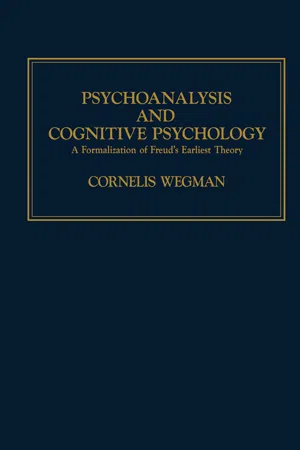
Psychoanalysis and Cognitive Psychology
A Formalization of Freud's Earliest Theory
- 317 pages
- English
- PDF
- Available on iOS & Android
eBook - PDF
About this book
Psychoanalysis and Cognitive Psychology: A Formalization of Freud's Earliest Theory is an attempt to translate psychoanalytic theory into a computer model—a model psychoanalysts will accept as accurately mirroring Freud's theory, while at the same time satisfying the demands made upon any formal model within contemporary psychology. Given the vast extent and the continued development of psychoanalytic theory, the present study focuses on Freud's earliest theory. In a sense, this limitation is a natural one. Anyone really wishing to come to grips with psychoanalytic theory will listen to Freud's advice and follow the path he himself took. In his earliest theory, the theory of abreaction, Freud lays the foundation for all of his later work. Here, for the first time, we encounter concepts—psychical conflict, repression, unconscious ideas, the principle of constancy—which have proved decisive for the development of psychoanalytic theory. Moreover, this was the period during which Freud himself was obsessed by the idea of representing his theory in a single, coherent model, much as in natural science. The present monograph may be regarded as a belated effort to realize the ideal that Freud had in mind in his Project for a Scientific Psychology: a psychology in which psychical processes are represented in such a manner that they become ""perspicuous and free from contradiction"".
Information
Table of contents
- Front Cover
- Psychoanalysis and Cognitive Psychology: A Formalization of Freud's Earliest Theory
- Copyright Page
- Table of Contents
- Dedication
- Preface
- Chapter 1. Introduction
- Chapter 2. The Theory of Abreaction: A Brief Overview
- Chapter 3. Ideas: The Problem of Cognitive Representation
- Chapter 4. Affect in the Theory of Abreaction
- Chapter 5. Information-Processing Systems and the Relationship between Psychology and Physiology
- Chapter 6. Fitting Affect into the Model
- Chapter 7. Working-Over
- Chapter 8. Memory
- Chapter 9· Symptom Formation
- Chapter 10. Epilogue
- Bibliography
- Author Index
- Subject Index
Trusted by 375,005 students
Access to over 1.5 million titles for a fair monthly price.
Study more efficiently using our study tools.
Frequently asked questions
Yes, you can cancel anytime from the Subscription tab in your account settings on the Perlego website. Your subscription will stay active until the end of your current billing period. Learn how to cancel your subscription
No, books cannot be downloaded as external files, such as PDFs, for use outside of Perlego. However, you can download books within the Perlego app for offline reading on mobile or tablet. Learn how to download books offline
Perlego offers two plans: Essential and Complete
- Essential is ideal for learners and professionals who enjoy exploring a wide range of subjects. Access the Essential Library with 800,000+ trusted titles and best-sellers across business, personal growth, and the humanities. Includes unlimited reading time and Standard Read Aloud voice.
- Complete: Perfect for advanced learners and researchers needing full, unrestricted access. Unlock 1.5M+ books across hundreds of subjects, including academic and specialized titles. The Complete Plan also includes advanced features like Premium Read Aloud and Research Assistant.
We are an online textbook subscription service, where you can get access to an entire online library for less than the price of a single book per month. With over 1.5 million books across 990+ topics, we’ve got you covered! Learn about our mission
Look out for the read-aloud symbol on your next book to see if you can listen to it. The read-aloud tool reads text aloud for you, highlighting the text as it is being read. You can pause it, speed it up and slow it down. Learn more about Read Aloud
Yes! You can use the Perlego app on both iOS and Android devices to read anytime, anywhere — even offline. Perfect for commutes or when you’re on the go.
Please note we cannot support devices running on iOS 13 and Android 7 or earlier. Learn more about using the app
Please note we cannot support devices running on iOS 13 and Android 7 or earlier. Learn more about using the app
Yes, you can access Psychoanalysis and Cognitive Psychology by Cornelis Wegman in PDF and/or ePUB format, as well as other popular books in Psychology & History & Theory in Psychology. We have over 1.5 million books available in our catalogue for you to explore.