- 272 pages
- English
- ePUB (mobile friendly)
- Available on iOS & Android
eBook - ePub
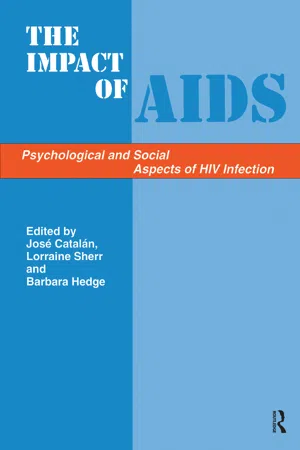
Impacts of Aids:Psych&Soc Aspe
About this book
First Published in 1997. From the start of the HIV epidemic, the psychological and social aspects of the AIDS infection have been recognized. This volume contains a selection of key contributions to the discussion on the psychological and social implications of such infection.
Trusted by 375,005 students
Access to over 1.5 million titles for a fair monthly price.
Study more efficiently using our study tools.
Information
Subtopic
Health Care Delivery1
Condom Use in Heterosexual Sex: A Review of Research, 1985-1994.
INTRODUCTION
The condom has been and will remain the major technology to limit sexual transmission of HIV in the foreseeable future, and thus issues related to its acceptance and use are a priority. Since the isolation of HIV, the establishment of its primary modes of transmission, and the development of HIV/AIDS prevention programs, hundreds of studies have been undertaken on the male condom. These include cross-sectional KABP (knowledge, attitudes, behaviour and practices) studies of condom and/or other HIV prevention strategies, condom interventions and evaluations, and recently, ethnographic studies that document the social, cultural and interpersonal contexts of safer sex and condom use. This paper surveys articles published in biomedical and social science journals from 1985 to early 1994.1 In reviewing this literature, we examine critically the research assumptions and construction of categories used, and draw attention to inconsistencies in findings and inferences.
Factors associated with the use of condoms do not apply universally across cultures or populations. A variety of issues influence acceptability, frequency and consistency of use among the study populations defined as ‘at risk’, although the conceptualisation and operational definitions of risk and the definition of the populations are themselves often problematic. Reasons for non-use of condoms by heterosexual youths, for example, are different from those of homosexual/bisexual adult men. Similarly, reasons for non-use across cultural and national boundaries (for instance, between Americans and Zaireans) are marked, although there is some interesting concordance too. Variations in sexual situations and contexts have a strong influence over condom use. Here, we largely limit our discussion to the male condom, heterosexual sex, and industrialised countries, although for comparative purposes we allude to other condom research. The studies on which we base this review reflect research predominantly conducted in the United States and Europe. There is far less published which addresses issues of HIV prevention in developing countries; this bias is not surprising given the concentration of researchers in the United States and the relatively early response by funding agencies to support research and behavioural interventions.2 The papers which we describe below, their subject matter, methodological approaches, conceptual frameworks and research questions suggest that they are reasonably typical of the literature, although some of the work being conducted within the humanities (e.g. in anthropology and cultural studies) has a very different focus (e.g. Clatts & Mutchler, 1989; Bolton & Singer, 1992; Herdt & Lindenbaum, 1992).
POPULATION SELECTION
For research purposes, studies on condom use for AIDS prevention have defined target populations in line with epidemiological classifications of ‘at risk’ populations (Murray & Payne, 1989). These are not coincident with the target populations for contraceptive condom use, with the exception of young people, and there has been little reflection back on that earlier literature in terms of its possible lessons for HIV prevention. Although the selection of research populations of condom studies largely reflects the current burden of infection, the volume of research is not proportionate: within the US, for example, while men who have sex with men, commercial sex workers and recreational injecting drug users are disproportionately affected by the disease, ‘heterosexuals’ and ‘youth’ are the most common target populations for research, accounting for around half of all published studies. Blacks, Hispanics and other ethnic minorities have been the subject of relatively little research (around 10% of all studies) despite their disproportionate share of infection (Lesnick & Pace, 1990: 173).
Recruitment procedures vary considerably among the studies. Research conducted with ‘at risk’ populations often draws participants from groups that have been labelled and stigmatised, e.g. as prostitutes, homosexuals, alcoholics, or drug users (or ‘abusers’), who are usually recruited in urban areas where the behaviour by which they are identified is presumed prevalent. Hence drug users tend to be recruited through clinics or street locations (e.g. Watters et al., 1990), adolescents/youth through schools (Mathews et al., 1990) or probation or remand homes (Wilson et al., 1990), and commercial sex workers from ‘red light districts’ and similar geographic concentrations. The identification of locales and the recruitment of participants is frequently undertaken through relevant social networks such as community service agencies (health/medical clinics), social organisations, local media, and so on (Valdiserri et al., 1989; Fullilove et al., 1990) and volunteers are consequently individuals who have self-identified with the population group or its defining characteristics. By maintaining this focus, the literature tends to represent these groups as homogenous. The contradictions in research findings suggests that this is a fallacy, and that there are as many differences – across class, race, ethnicity, gender, age, and sexual orientation, for example – as there are commonalities.
Population selection, appropriateness of the research tool, and the context of data collection limit and at times bias findings. Many of the study populations have been recruited through opportunistic or convenience sampling, limiting generalisability. For example, a KABP study among Black and Hispanic students in the Bronx was conducted because of lack of information of perceptions and risk factors of transmission of this population, which has a high prevalence of HIV. The study population, however, was entirely opportunistic: students attending English language classes in one college, the majority with ‘limited’ proficiency in English, completed a self-administered questionnaire as a compulsory classroom assignment (Lesnick & Pace, 1990). Other examples of limitations on population selection (and method) might include the work of de Graaf et al. (1992), who recruited clients of prostitutes through newspapers and used ‘snowballing’ to recruit prostitutes direct from workplaces and through intermediaries and referrals – here the problem is not in terms of population recruitment per se, but in terms of its limitations when the research aim was to generate quantifiable data. Contrast this, for example, with the study of Fox et al. (1993), designed to test the effectiveness of an intervention (through discussion groups and the distribution of condoms) among commercial sex workers, where the use of opportunistic sampling was clearly appropriate.
Sample size in the studies surveyed varied enormously. It includes as few as two (where the notion of ‘sample’ is not appropriate) (Kane, 1990) to over 8000 (e.g. Campbell & Baldwin, 1991; Catania, Coates, Stall et al., 1992). While sample size is not entirely predictive of method, generally studies with smaller samples used qualitative methods whilst larger studies used cross-sectional surveys with a simple, standardised instrument. Although generalizability and representativeness is a problem even with some of the very large studies, the low number of respondents in some of the ‘qualitative’ studies is a particular concern, since these are rarely based in ethnography and ‘qualitative’ often simply means the use of an open-ended semi-structured interview rather than a structured one, with few other differences in study methods or design.3 Abramson’s comments on the quality of sex research have some resonance here, at least in terms of methodological rigour (Abramson, 1990, 1992), although one might also question the gate-keeping functions of journal reviewers who allow such work to press.
As anticipated above with reference to the employment of epidemiologic categories, population definition tends to be problematic. Many studies fail to define it adequately, and variation within the literature makes comparison and the cumulative goals of research difficult (see also de Zalduondo, 1991: 228). Prior criticism of population definition and inclusion has focused on prostitution (de Zalduondo, 1991), and in this area most caution has been exercised to differentiate between commercial sex workers and others who trade sex, since these factors may influence condom use. Two papers illustrate this point: one from The Netherlands distinguishes brothel, window, street, home and escort prostitution and then searches for difference in condom use among women working in each of these industry sectors (de Graaf et al., 1992); the other, describing female sex workers in Zaire, distinguishes between home-based, hotel-based and street-based prostitution and defines women as ‘prostitutes’ on the basis of self-reports of multiple sexual partners in exchange for money or goods (Nzila et al., 1991). Other papers from both the social and medical sciences emphasise the heterogeneity of this population due to social class, geographic location and site of prostitution, frequency of partners, price of transaction, the permanent, transitory or opportunistic nature of commercial sex, and women’s full-time, part-time or casual commitment to commercial sex work (e.g. Cortes et al., 1989; d’Costa et al., 1985; Kreiss et al., 1986; Lyttleton, 1994; Schoepf, 1992; Simonsen et al., 1990). This has not broken the general distinction between ‘prostitutes’ and ‘wives’, however, as if there were no overlap (although see Carovano, 1991; Osmond et al., 1993).4
The use of other categories to define ‘target populations’ and ‘risk groups’ presents similar problems. This is particularly pertinent to the classification of sexuality (homosexual, heterosexual, bisexual) where distinctions between self-identity, community membership and affiliation, and sexual practice may be quite different (e.g. Dowsett et al., 1992; Kippax et al., 1994).5 Shifts in operational definitions occur also in the quantification of multiple partnering, assumed to be high risk for infection with HIV insofar as the greater the number of partners, the greater the possibility that one partner will be infected and the virus transmitted. Whilst Uitenbroek and McQueen (1992:588) concede that ‘there is no generally agreed definition for level of sexual activity’, they somewhat conservatively define a ‘multi-partner’ respondent as anyone who reported that they or their partner had had another partner in the past year, or who had had more than three partners in the past five years.6 Yet we might expect major differences in background, personality and personal attributes, as well as risk of infection, between those at the narrow end of this scale and those who have had 100 or more partners in ...
Table of contents
- Cover
- Half Title
- Title Page
- Copyright Page
- Table of Contents
- Preface
- About the Editors
- Notes on Contributors
- Prevention
- Drugs
- Gender Issues
- Care and Treatment
- Index
Frequently asked questions
Yes, you can cancel anytime from the Subscription tab in your account settings on the Perlego website. Your subscription will stay active until the end of your current billing period. Learn how to cancel your subscription
No, books cannot be downloaded as external files, such as PDFs, for use outside of Perlego. However, you can download books within the Perlego app for offline reading on mobile or tablet. Learn how to download books offline
Perlego offers two plans: Essential and Complete
- Essential is ideal for learners and professionals who enjoy exploring a wide range of subjects. Access the Essential Library with 800,000+ trusted titles and best-sellers across business, personal growth, and the humanities. Includes unlimited reading time and Standard Read Aloud voice.
- Complete: Perfect for advanced learners and researchers needing full, unrestricted access. Unlock 1.5M+ books across hundreds of subjects, including academic and specialized titles. The Complete Plan also includes advanced features like Premium Read Aloud and Research Assistant.
We are an online textbook subscription service, where you can get access to an entire online library for less than the price of a single book per month. With over 1.5 million books across 990+ topics, we’ve got you covered! Learn about our mission
Look out for the read-aloud symbol on your next book to see if you can listen to it. The read-aloud tool reads text aloud for you, highlighting the text as it is being read. You can pause it, speed it up and slow it down. Learn more about Read Aloud
Yes! You can use the Perlego app on both iOS and Android devices to read anytime, anywhere — even offline. Perfect for commutes or when you’re on the go.
Please note we cannot support devices running on iOS 13 and Android 7 or earlier. Learn more about using the app
Please note we cannot support devices running on iOS 13 and Android 7 or earlier. Learn more about using the app
Yes, you can access Impacts of Aids:Psych&Soc Aspe by Catalan, Jose Catalan,Barbara Hedge,Lorraine Sherr in PDF and/or ePUB format. We have over 1.5 million books available in our catalogue for you to explore.