eBook - ePub
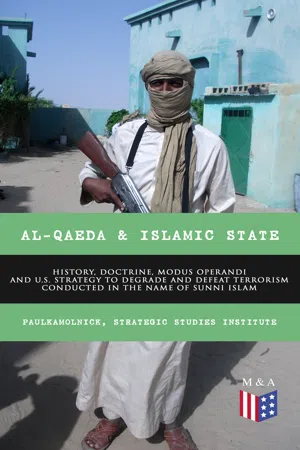
Al-Qaeda & Islamic State: History, Doctrine, Modus Operandi and U.S. Strategy to Degrade and Defeat Terrorism Conducted in the Name of Sunni Islam
Terror Warfare
- 354 pages
- English
- ePUB (mobile friendly)
- Available on iOS & Android
eBook - ePub
Al-Qaeda & Islamic State: History, Doctrine, Modus Operandi and U.S. Strategy to Degrade and Defeat Terrorism Conducted in the Name of Sunni Islam
Terror Warfare
About this book
Dr. Kamolnick's book is a meticulously documented investigation and comparison of the al-Qaeda and the Islamic State across three key strategically relevant dimensions: essential doctrine, beliefs, and worldview; strategic concept, including terrorist modus operandi; and in the final chapter, specific implications, and recommendations for current U.S. Government policy and strategy.
Contents:
Belief-System, Creed, Worldview, Doctrine
The Al-Qaeda Organization
Sunni Islamic Orthodoxy
Sunni-Salafism/"Fundamentalism"
The Muwahhidun/Wahhabism/Salafi-Wahhabism
Muslim Brotherhood-Salafi-Wahhabi
The "Base of the Jihad"; Al-Qaeda
From Qa'idat Al-Jihad to Bin Ladenism
From Bin Ladenism Back to Qa'idat Al-Jihad
Post-Arab Spring Qa'idat Al-Jihad
"What is Qa'idat Al-Jihad?" In a Nutshell:
Fazul Abdullah and Adam Gadahn
III. Islamic State Organization
"Zarqawism" vs. AQO: Abu Musab
Al-Zarqawi's Worldview and Doctrine: 1989-June 7, 2006
From Non-Religious Violent Street Tough to Ultra-Sectarian Salafi-Wahhabi Jihadist Prison
Tough: 1980-1999
Al-Zarqawi's Private Jihasist Armies of the Levant: 1999-2004
The History, Doctrines, and Worldview of Abu Bakr Al-Baghdadi's "Caliphate":
From ISI to the Caliphate: Brief Organizational History
Self-Proclaimed Emir Al-Muminin Abu Bakr Al-Hussaini Al-Qurayshi Al-Baghdadi:
The Caliphate Now!
The "Final Solution" to the "Shia Problem"
Terrorist Modus Operandi
Terrorist Quadrangle Analysis
The Al-Qaeda Organization
The "Classical" Base First Bin Ladenist
Lone Mujahid"
"Far Enemy" Strategy
Islamic State
Conclusions, Implications, and Recommendations for U.S. Government
Key Findings
Belief-Systems, Worldviews, Doctrines, Creeds
Strategies and Terrorist Modus Operandi
Implications for U.S. Government
Policy and Strategies
Implications for Existing USG Policy and Strategy to Permanently Defeat AQ and its Affiliates
Implications for Existing USG Policy and Strategy to Permanently Defeat the IS
Trusted by 375,005 students
Access to over 1.5 million titles for a fair monthly price.
Study more efficiently using our study tools.
Information
CHAPTER 1
BELIEF-SYSTEM, CREED, WORLDVIEW, DOCTRINE
Table of Contents
I. INTRODUCTION
Table of Contents
The concept “doctrine” as used throughout refers to a more or less presumed “worldview” or “ideology” rooted in a set of core beliefs about how the world works, and in particular, about a presumed reality that describes the factual state of Islam and Muslims in the present socio-political, socio-cultural world. Doctrine is rooted in belief-systems: it is about what is true or false, real or unreal. Belief-systems are about statements of fact; and for their adherents, about what they take to be the definite factual reality of the world as it is. Belief-systems are not knowingly rooted in the will or intention to deceive others; they are Truth, and a Truth to be known and shared. Beliefs are not therefore deceptive, manipulative, or intentionally distorted propaganda — a form of communication, which will be discussed in Chapter 2. One can refer to an adherent as a believer, ideologue, or doctrinaire, but not a deceiver, or not an intentional deceiver at least.
The term “doctrine” is similar but distinct from the term “creed” (aqida) in that doctrine extends beyond orthodox beliefs that cannot be denied if one is to maintain one’s status as an orthodox adherent of a particular faith. They include religious faith but extend beyond to beliefs about past and current history as it pertains to the origins, development, rise and fall, and the current status of Sunni Muslims in the present world. In other words, it also involves certain fundamental beliefs about the how, why, and “what for” of politics, culture, power, and violence that encompass and extend beyond the articles of creedal faith that makes one an “orthodox Sunni Muslim,” a term that seems to encompass both worldview or weltanschauung — literally “world picture” — captures these elements in a simple phrase and will be used interchangeably with belief-system in this course of exposition.
II. THE AL-QAEDA ORGANIZATION (TANZIM QA’IDAT AL-JIHAD)
Table of Contents
SUNNI ISLAMIC ORTHODOXY
Table of Contents
AQO’s worldview or doctrine has been consistently propounded over the course of nearly 30 years and is contained in a number of publicly available sources. Relative to the ISO, it has been subject to extensive scholarly analysis, and a more or less rough consensus has been reached regarding its essential premise. Though simplified, the following is an accurate depiction. First, a Perfect and Final faith was revealed by the seal of the prophet, Prophet Muhammad. Second, the one and almighty sovereign, Allah (God), blessed this singular faith to conquer the Earth and eventually to establish Allah’s rule, manifest especially in the maintaining of essential legal requirements and punishments contained in Allah’s Divine word, the Quran and other sources and principles deemed essential to a proper legal judgment; for example, the Traditions of the Prophet (ahadith), consensus of the learned scholars and jurisprudents (ijma), and use of analogical reasoning to infer to new cases from past judgments (qiyas). Third, Allah’s rule on Earth as manifest in conquered lands ruled by an imperial Muslim religio-political sovereign, the Caliph, represented the singular triumph and exclusive example of Allah’s word, law, and sovereignty. That Islam is the perfected final faith — revealed through the perfected final prophet and his immediate companions and successors; blessed by the singular sovereign Allah to conquer and rule; and to be manifest in an earthly Caliphal imperium charged with upholding and further spreading the worship of Allah — is an essential starting point for discerning the AQO worldview. Contained here is an inarguable premise within Sunni orthodoxy that Allah is the one and only God, and that Muhammad is his final messenger.
SUNNI SALAFISM/“FUNDAMENTALISM”
Table of Contents
A “Salafist” sub-set of Sunnism is also key, however. Salafism as a genus — despite its varieties — is manifest in the belief that Islam reached its noblest and purest expression in Prophet Muhammad’s own exemplary conduct (Sunnah), and those of his closest companions and the first three generations of his successors known collectively as al-salaf al-salih (the pious ancestors).3 Salafists seek to emulate these truest and most faithful exemplars of the Prophet’s Message, and believe that genuine Islam — Prophet Muhammad’s Islam — requires that one adhere as faithfully as possible to what is known of their sayings and doings, without amendment. To introduce innovation (bida) to what is believed to be the Prophet’s own exemplary path (Sunnah), or “the prophetic methodology” (manhaj), is to insinuate an imperfect present into the perfected past.
3. For a comprehensive recent analysis, see Roel Meijer, ed., Global Salafism: Islam’s New Religious Movement, New York: Columbia University Press, 2009.
THE MUWAHHIDUN/WAHHABISM/SALAFI-WAHHABISM
Table of Contents
The reformist Muwahhidun (Oneness of Allah) or “Wahhabi” movement established by the neo-Hanbali Najd Shaykh Muhammad ibn Abd al-Wahhab (d. 1792) and his faithful adherents and proponents furnish an essential re-statement of the orthodox Sunni fundamentals in their most rigorous form.4 These consist in the following. Chief among al-Wahhab’s contributions was his reconceptualization of the manner in which “faith” or Iman — what it actually means to believe — is to be proven as fact. This also applies to its opposite — Kufr(unbelief/infidelity), and whether takfir (apostasy, heresy) is declared against persons accused of such. Al-Wahhab declared that genuine faith is not merely a matter of an internal belief — belief of the heart or the mind — of those twin creedal essentials comprising the Shahadaor first pillar of Islam — Allah is One, and Muhammad is his final messenger. Private confessions of faith are necessary, but insufficient. Faith must also and especially be manifest publicly through active worship of Allah in public utterance, as well as deeds that openly signify the operationalization of the principle of Allah’s Oneness (tawhid) in one’s life activities. Other pillars of Islam — the obligatory five prayers (salat), obligatory giving of alms (zakat), obligatory fasting on Ramadan (sawm), and the obligatory pilgrimage (Hajj) — are essential dimensions of faith in action and as action.
Failure to actively and correctly worship Allah may indicate ignorance, error, moral weakness, or coercion, and an active program of education, instruction, and moral rectification may be required. This is the function of preachers and learned scholars (ulema), and the Call to Tawhid (da’wa). However, to voluntarily and intentionally deny in one’s mind, heart, tongue, or hand these practical manifestations of faith; to willfully and knowingly deny the worship of Allah through these visible signs of submission and surrender, is to be guilty of infidelity (Kufr). It is to deny Allah what is owed to Allah. It is to be guilty of disloyalty, infidelity (Kufr). For al-Wahhab, the rigorous enforcement of all practical dimensions of worship, including but extending far beyond an internal conviction of belief, is therefore essential to proving one’s faith in Islam. The question of what exactly constitutes idolatry (shirk), distinctions between greater and lesser shirk, and the lawful and prudent means for combating shirk, are core theological questions at the heart of the present schism between AQO and ISO.
At the core of al-Wahhab’s preaching and program for reforming Islam is the essential master concept that Judaism, and later Islam, bequeaths to the world: the concept of God’s/Allah’s Oneness (tawhid). Tawhid, according to al-Wahhab, following Shaykh ul Islam Ibn Taymiyyah’s (d. 1328) original coinage, comprises three integral dimensions: Allah’s Oneness as Sovereign Creator, Sustainer, Provider (Tawhid al-Ruboobiyyah); Allah’s Oneness as Sovereign Lord worthy of exclusive worship (Tawhid al-Uloohiyyah); and Allah’s Oneness as His Unique Names (Tawheed al-Asma’ was-Sifaat).5 The implications al-Wahhab derived from this re-statement of Sunni orthodoxy was profound, highly controversial, profoundly unsettling, and even revolutionary for his present milieu. The opposite of tawhid, and the greatest of sins in Islam which even Allah does not forgive, is the sin of worshipping/associating other deities with Allah (shirk). The absolute uncompromising monotheism represented by al-Wahhab’s Muwahiddun reformist movement demands monolatry. It is unsparing in its denunciation and disavowal of, and obligation to, uproot shirk.
Theologically armed with a re-conceptualized notion of Iman as faith, as actualized in essential worshipful acts and rituals; and Tawhid actualized in beliefs and actions displaying loyalty to the Singular Absolute Sovereign that is Allah as Creator, Lord, and Unique and Ineffable Names; al-Wahhab and his Muwahiddun movement proceeded to purge the Saudi landmass and its immediate environs. Sharing a divine kinship with Islam, we find the “People of the Book/Covenant/Divine Scripture” (Ahl al-Khitab). Jews, Christians, and often Zoroastrians, though deemed guilty of adulterating original scripture were — owing to their adherence to worshiping a singular Deity — granted the right to retain ancestral faiths and practices, though not in Prophet Muhammad’s ancestral homeland. Though subject to submission and humiliation displays, and liabilities to their further expansion and preservation, these groups could maintain their worship in their status as dhimmis required to pay a “protection” or head tax, the jizya.
Toleration, even if intolerant, was not to be extended any further, however. For the Muwahhidun followers of al-Wahhab, the true eternal, abiding threat to Allah’s Sovereignty does not come from the original infidels (original Kufr) — obvious enemies from without and against whom jihad, both defensive if necessary and offensive if legal and prudent, be waged.6 True, targets outside the faith included sorcerers, magicians, and others claiming intercessory powers that the Muwahhidun claimed were the exclusive prerogative of Allah. However, within the faith, the Muwahhidun waged war against Sufi mysticism and its doctrines and practices granting mystics and holy men intercessory powers. And, also against the Shia — those partisans of the Prophet’s son-in-law Ali, the fourth Caliph — who based in unique theological conceptions endowing and privileging the Prophet’s family with divinely-sanctioned spiritual powers, engaged in reverential treatment and worship of saints, shrines, and tombs, and attributed divine qualities and powers to an infallible Imamate.
For the followers of al-Wahhab — the Muwahhidun — the genuine, abiding, and eternally greatest threat is this internal enemy — this nearest enemy. At best, it is the one who claims Islam, but who is either a pretender (the hypocrite), or an innovator (bida) (the heretic). At worst, it is a Muslim apostate (murtadd) who willfully, with complete knowledge, publicly disavows essential tenets of tawhid as conceptualized by al-Wahhab and, if unrepentant, is guilty of Islam’s greatest sin: apostasy (ridda). The narrowness of the Muwahhidun bridge to salvation — rooted in its unique conceptions of iman/Kufr, Sunnah/bida, tawhid/shirk— narrows the distance between salvation and sin, salvation and heresy, and salvation and apostasy.
It is not just in Islam that the true enemy of genuine faith arises from within. It is the unique nature of orthodoxy (literally, “correct belief”) that gives rise to the fact that it is what is closest, not furthest and most obviously distant, from one’s essential core tenets that genuinely threatens one’s foundations. One only has to recall the very origins of the concept of the satanic in the Gospel of Matthew’s denunciation of the Jewish Pharisees,7 or the rise of the Reformation and its inauguration of bloody centuries of intra-Christian warfare, to understand an essential sociological law explaining the intensity of conflict: i.e., that a feared and dreaded treason within mobilizes far greater enmity, and policing, than the expected and prepared for enemy without; again, the smaller the differences that divide, the greater the perceived injury those smaller differences make.8
This depiction of Sunni theological orthodoxy, Sunni conservative Salafism, and Muhammad al-Wahhab’s Muwahiddun movement provides the essential theological background required for understanding precisely how the AQO and ISO dip from the same well — Sunni, SalafiMuwahhidun/Wahhabi — but with varying foci, in quite different doses, and with quite different additives that led to novel synthetic organisms.9 It marks an essential point of departure required to understand their last shared common ancestor before their marked divergence as species, and eventually with additional mutation, as contemporary terrorist entities claiming to represent the worldwide Sunni (Ahl-us Sunnah). Our first task is to describe the terrorist species Tanzim Qa’idat al-Jihad (AQO). To do so, we will trace a brief history that begins with Abdullah Azzam and ends with the codification of Osama bin Laden’s mature “Far Enemy” doctrine.
4. For its classic statement, see Sheikh-ul-Islam Muhammad bin Abdul Wahhab, The Book of Monotheism (Kitab at-Tauhid), transl. by Compilation a...
Table of contents
- Al-Qaeda & Islamic State: History, Doctrine, Modus Operandi and U.S. Strategy to Degrade and Defeat Terrorism Conducted in the Name of Sunni Islam
- Table of Contents
- Foreword
- About the Author
- Summary
- Prologue
- 1. Belief-System, Creed, Worldview, Doctrine
- 2. Terrorist Modus Operandi
- 3. Conclusions, Implications, and Recommendations for U.S. Government Policy and Strategy
Frequently asked questions
Yes, you can cancel anytime from the Subscription tab in your account settings on the Perlego website. Your subscription will stay active until the end of your current billing period. Learn how to cancel your subscription
No, books cannot be downloaded as external files, such as PDFs, for use outside of Perlego. However, you can download books within the Perlego app for offline reading on mobile or tablet. Learn how to download books offline
Perlego offers two plans: Essential and Complete
- Essential is ideal for learners and professionals who enjoy exploring a wide range of subjects. Access the Essential Library with 800,000+ trusted titles and best-sellers across business, personal growth, and the humanities. Includes unlimited reading time and Standard Read Aloud voice.
- Complete: Perfect for advanced learners and researchers needing full, unrestricted access. Unlock 1.5M+ books across hundreds of subjects, including academic and specialized titles. The Complete Plan also includes advanced features like Premium Read Aloud and Research Assistant.
We are an online textbook subscription service, where you can get access to an entire online library for less than the price of a single book per month. With over 1.5 million books across 990+ topics, we’ve got you covered! Learn about our mission
Look out for the read-aloud symbol on your next book to see if you can listen to it. The read-aloud tool reads text aloud for you, highlighting the text as it is being read. You can pause it, speed it up and slow it down. Learn more about Read Aloud
Yes! You can use the Perlego app on both iOS and Android devices to read anytime, anywhere — even offline. Perfect for commutes or when you’re on the go.
Please note we cannot support devices running on iOS 13 and Android 7 or earlier. Learn more about using the app
Please note we cannot support devices running on iOS 13 and Android 7 or earlier. Learn more about using the app
Yes, you can access Al-Qaeda & Islamic State: History, Doctrine, Modus Operandi and U.S. Strategy to Degrade and Defeat Terrorism Conducted in the Name of Sunni Islam by Paul Kamolnick,Strategic Studies Institute in PDF and/or ePUB format, as well as other popular books in Politics & International Relations & Military & Maritime History. We have over 1.5 million books available in our catalogue for you to explore.